Description
Key Technical Specifications
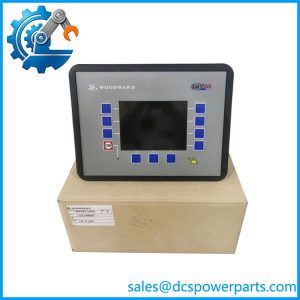
The Woodward MRN3-11D is a mains decoupling protection relay. Its ordering code identifies the MRN3-1 protection version, 100 V nominal measuring input, and flush-mount housing configuration.
| Parameter | Specification |
|---|---|
| Manufacturer | Woodward / SEG Electronics GmbH |
| Model | MRN3-11D |
| Product Series | MRN3 HighTECH Line |
| Product Type | Mains Decoupling Protection Relay |
| Protection Version | MRN3-1 |
| Main Protection Functions | Overvoltage, undervoltage, overfrequency, underfrequency, vector surge |
| Nominal Measuring Voltage | 100 VAC |
| Nominal Frequency | 40–70 Hz |
| Phase Configuration | Three-phase voltage monitoring |
| Voltage Connection | Star or delta, configurable |
| Vector Surge Detection | Supported |
| Frequency Protection | Three independently adjustable frequency elements |
| Voltage Protection | Two-stage overvoltage and undervoltage supervision |
| Output Relays | 5 total: 2 trip relays and 3 alarm/self-supervision relays |
| Fault Recording | Up to 8 fault occurrences with timestamps |
| Parameter Sets | 2 |
| Communication | RS485; protocol option depends on ordering configuration |
| Mounting | Flush mounting |
| Housing Width | 12 TE |
| Voltage Circuit Consumption | Less than 1 VA |
| Minimum Operating Time | 40 ms |
| Dropout Time | 60 ms |
The exact auxiliary supply voltage and communication protocol should be checked against the unit nameplate and ordering documentation. Do not assume the RS485 Modbus option is included in every -11D configuration.
Product Introduction
Woodward -11D Mains Decoupling Protection Relay
The Woodward -11D is a multifunctional grid-protection relay designed to monitor electrical networks operating in parallel with generators. It combines voltage supervision, frequency protection, and vector surge detection to identify abnormal grid conditions and initiate protective disconnection.
Its -1 configuration provides vector surge protection, an important function when synchronous generators operate in parallel with a utility network. The 100 V measuring-input configuration and flush-mount housing make it suitable for designated generator switchgear and power distribution panels.
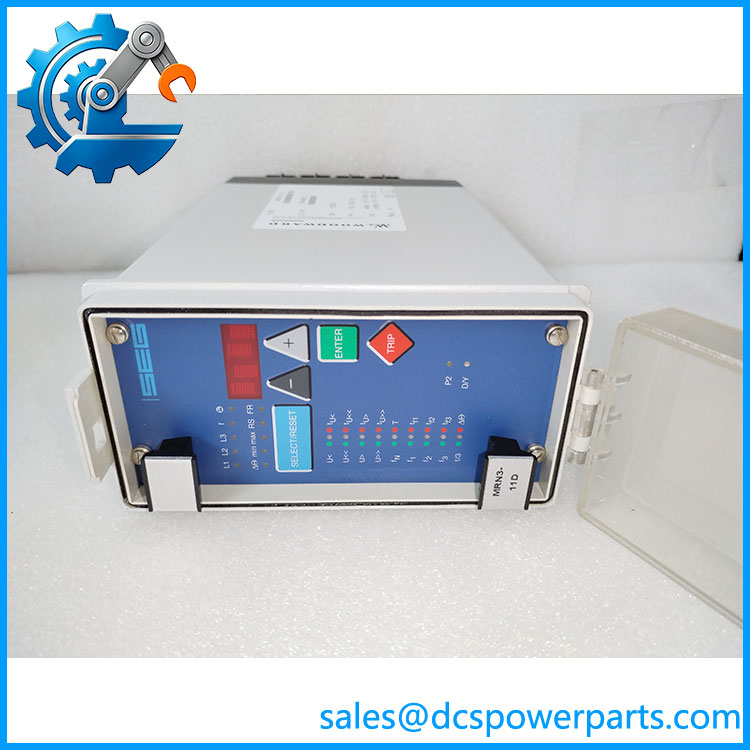
MRN3-11D
Application Scenarios & Field Pitfalls
Engineering Pain Point
A generator operating in parallel with the utility grid experiences a sudden grid disturbance. Voltage remains temporarily within an acceptable range, but the phase relationship between generator voltage and utility voltage changes sharply. If the protection system fails to detect this condition, the generator may remain connected during an unsafe operating state.
The Woodward -11D addresses this problem through voltage, frequency, and vector surge supervision. Its protection functions are particularly relevant to synchronous generator installations where rapid mains-failure detection is required.
Typical Applications
- Power Generation: Grid decoupling protection for synchronous generators operating in parallel with utility networks.
- Industrial Manufacturing: Protection of captive power plants against abnormal grid voltage and frequency conditions.
- Cogeneration Facilities: Generator disconnection during utility disturbances to protect generating equipment.
- Renewable Energy Plants: Electrical protection for generator installations connected to distribution networks, subject to applicable grid-code requirements.
Technical Pitfalls to Avoid
1. Confusing -1 with -2
This distinction matters.
- -1 provides vector surge supervision.
- -2 provides frequency gradient (df/dt) supervision.
The belongs to MRN3-1 configuration. Do not substituteMRN3-2 simply because the rated voltage and housing appear identical.
The two versions address different grid-disturbance detection requirements.
2. Incorrect Voltage Transformer Configuration
The uses a 100 V nominal measuring input.
Check the voltage transformer secondary rating, transformer ratio, and star/delta connection configuration before commissioning.
An incorrect transformer ratio can cause inaccurate voltage readings and incorrect protection thresholds. Verify actual phase measurements against the switchgear metering instruments.
3. Incorrect Vector Surge Settings
Vector surge protection is particularly important for synchronous generators operating in parallel with utility networks.
Incorrect phase-angle thresholds or measurement logic can result in unnecessary trips or delayed detection of grid disturbances.
The manual provides configurable vector surge logic, including 1-of-3 and 3-of-3 measurement arrangements. Select the appropriate configuration according to the generator protection study and applicable utility requirements.
4. Neglecting Self-Supervision and Relay Testing
The includes internal self-supervision and fault recording.
Connect the self-supervision output to the central alarm system. During maintenance, test the output relay assignments, voltage thresholds, frequency settings, and operating times.
A healthy display does not prove that the complete protection trip circuit works.
Field recommendation: Before repla an , export or manually record both parameter sets, transformer ratios, frequency settings, trip delays, and output relay assignments. Preserve the original protection coordination settings unless an approved engineering review requires changes.
Related Products
The following SEG/Woodward protection relays provide relevant alternatives and complementary functions within generator and mains protection systems.
| Model | Product Description | Compatibility and Application Differences |
|---|---|---|
| -12D | , 230 V flush-mount relay | Higher nominal measuring-voltage configuration. Suitable for installations designed around 230 V voltage-transformer inputs. |
| -14D | , 400 V flush-mount relay | 400 V measuring-input version for compatible electrical installations. |
| -21D | -2, 100 V flush-mount relay | Provides frequency-gradient df/dt protection instef vector surge protection. |
| -22D | -2, 230 V flush-mount relay | Combines 230 V measuring input with frequency-gradient protection. |
| -24D | -2, 400 V flush-mount relay | Higher-voltage measuring configuration for df/dt-based grid protection. |
| MRU3-1 | Overvoltage and undervoltage protection relay | Dedicated voltage protection for applications that do not require the complete multifunctional protection arrangement. |
| MRU3-2 | Voltage protection relay with symmetrical component evaluation | Provides additional voltage supervision functions for generator protection applications. |
| MRF3 | Multifunctional frequency protection relay | Provides overfrequency, underfrequency, and frequency-gradient supervision. |
| MRG2 | Generator mains monitoring and vector surge relay | Dedicated generator mains monitoring and phase-angle disturbance detection. |
Important: These models are functional alternatives, not automatically interchangeable replacements. Rated voltage, protection logic, housing, auxiliary supply, and terminal assignments must all be checked before substitution.
Procurement and Replacement Checklist
Before purchasing Ward , verify:
- Completeel: .
- Protection ver: with vector surge supervision.
- Measuring voltage: 100 V nominal.
- Mounting: Flush-mount, 12 TE housing.
- Auxiliary supply: Confirm from the nameplate.
- Communication: Confirm RS485 protocol and whether Modbus is required.
- Protection settings: Check voltage, frequency, vector surge thresholds, and trip delays.
- Output contacts: Verify trip and alarm relay assignments.
- Condition: Confirm new surplus or previously operated status.
- Testing: Request functional test results and relay calibration records.
Final engineering noThe is a power-system protection relay, not a conventional PLC controller. Its replacement must preserve the generator protection philosophy and grid-disconnection logic. A matching part number is the starting point; secondary injection testing and trip-circuit verification are essential before returning the installation to service.