Description
Product Overview
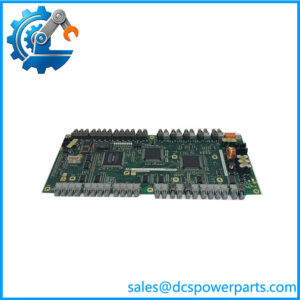
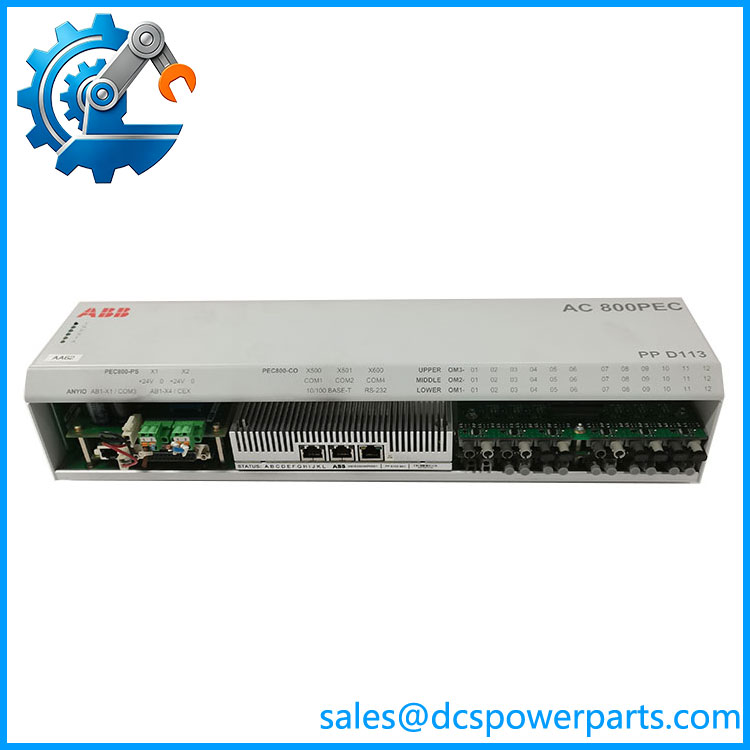
PP D113B 3BHE023784R1023 arrives in the trade as three codes stacked on one line, and each of them does a different job. PP D113B is the type designation — the name the platform actually uses, and the one that appears in ABB’s own technical literature. 3BHE023784R1023 is the article number: a 3BHE-block base identifying the product within ABB’s power-electronics control range, plus an R release field that pins it to one specific version of that base. B01-10-150000 is neither of those things — it carries no 3B prefix, so it is not an ABB article number, and its most probable reading is that the leading B belongs to the type designation itself (making the type PP D113B, as ABB’s exciter specifications write it) while 01-10-150000 is a factory assembly or drawing reference. Reading the string is therefore less about decoding a code than about not mis-splitting one: the character after D113 is part of the product’s name, not the start of the next token.
What the thing actually is, is a controller. AC 800PEC is ABB’s high-performance control platform for power electronics, built around a fast processor combined with an FPGA so that loops and switching events can be handled at speeds a conventional PLC cannot reach. One unit of that platform is designated PP D113 — and the clearest proof comes from ABB’s own published work rather than from a reseller’s page. In a SmartMill white paper describing a hardware-in-the-loop test of a model-predictive controller for grinding mills, the NMPC controller runs on one AC 800PEC unit (PP D539) while the dynamic model of the mill itself runs in real time on another (PP D113). A unit that can execute a full dynamic process model in real time is not an I/O card; it is a computing engine in a power-electronics enclosure.
The application side is documented just as concretely, from the other direction. A United States federal procurement specification for excitation equipment at a hydroelectric dam lists, as its first line item, two ABB exciter units described as “PEC800 Modbus TCP, 30M, 10k FPGA, Typ. PP D113B”, with part numbers in the 3BHE0237… range. That is a buyer stating in a public solicitation exactly what it expects to receive: the PEC800 controller variant, with Modbus TCP communication and a 10k FPGA, under the type designation PP D113B. It is a configuration statement for that variant rather than a datasheet for every release — but it fixes the product’s class, its communication option and its FPGA scale, which is more than any listing achieves.
The release field is where the money is lost. The same base article number 3BHE023784 circulates with at least two releases — R1023, the number in this order, and R2030, which a reseller lists under the identical PP D113 type designation. Different releases of the same base are different article numbers, not interchangeable stock, and a cabinet fitted with one will not necessarily accept the other. That is the same discipline the 3BHE024415R0101 gate-driver board demands at the other end of the drive: base plus R field is the identity, and the base alone is only a family name.
The descriptions attached to it in the market are the usual mix. One reseller calls 3BHE023784R2030 an “advanced power supply module” for DCS systems — which is wrong twice: AC 800PEC is a controller platform, and the unit’s job is computation, not power conversion. Others attach the number to generic automation-module prose without any platform content at all. And the type designation itself is a search hazard: PP D113 collides with machine-readable text in unrelated documents — a passport-style line in an Irish housing application form contains the literal string — which is exactly why short alphanumeric designations need the article number beside them in any search, quotation marks or not.
So the defensible description is: an ABB AC 800PEC controller unit of the PP D113 family, delivered under a specific article number and release, carrying a 10k-class FPGA and Modbus TCP in the exciter configuration, and configured by an application plus FPGA image that belong to the plant rather than to the box. Its supply arrangement, dimensions, memory and thermal figures are not published, and no attempt should be made to fill those gaps from reseller prose.
Technical Specifications
| Parameter | Value |
|---|---|
| Type designation | PP D113B (PP in shorter form; the trailing B is part of the name) |
| Article number | 3BHE023784R1023 — base 3BHE023784 plus release field R1023 |
| Third code | B01-10-150000, not an ABB article number; most probable reading is a factory assembly or drawing reference, with the leading B belonging to the type designation |
| Manufacturer | ABB (Switzerland–Sweden) |
| Platform | AC 800PEC / PEC800 power-electronic controller |
| Product type | Controller unit — processor plus FPGA, not a power supply and not a passive I/O board |
| Processing architecture | Fast CPU combined with an FPGA; large enough to execute a dynamic process model in real time in ABB’s own hardware-in-the-loop demonstration |
| FPGA scale (exciter configuration) | 10k class, per a public federal procurement specification naming |
| Communication (exciter configuration) | Modbus TCP; the same specification also lists a 30M figure without expanding it |
| Release field | R1023; the same base also circulates as R2030, which is a different article number |
| Supply and dimensions | Not published in accessible sources |
| Environment | Governed by the platform’s own installation rules; not published per article number |
| Published documentation | ABB technical literature establishes the platform and the type’s use; no article-number-level datasheet located |
| Lifecycle status | No end-of-life notice located; supply is dismantled and surplus stock |
3BHE023784R1023 PP D113 B01-10-150000
Key Features and Advantages
Three codes, three functions: type designation for identity, article number for procurement, release field for compatibility. Keeping them separate is what stops a purchase from being placed against a family name.
A real product name, not a reseller’s label: appears in ABB’s own white paper and in a public procurement specification, which is a standard of evidence that no listing for this family reaches.
FPGA-backed control: the platform pairs a fast processor with an FPGA so that switching-level and fast-loop work happens in hardware rather than in scan cycles. That is why the same unit can run a controller in one application and a real-time process model in another.
Demonstrated in hardware-in-the-loop: ABB’s SmartMill work runs the mill’s dynamic model on a while the controller runs on a PP D539 — a concrete, published example of what this class of unit does, and a legitimate way to explain the platform to an engineer who has never seen one.
Exciter-proven configuration: the dam procurement sets out PEC800 with Modbus TCP and a 10k FPGA under this type, which tells a buyer what the exciter variant of the family looks like before any quote is requested.
Release discipline: R1023 and R2030 are not the same stock. Recording the release beside the base number is the single most valuable habit in buying this family.
Honest limits: no memory, supply, dimension or environmental figure is published for this article number; the third code has no public footprint; and reseller descriptions of the unit as a power supply belong to a different product class entirely.
Applications
Generator excitation control: the documented exciter configuration puts at the centre of a static excitation system, where field current and voltage are regulated at switching speeds and the communication interface carries the unit’s data to the plant control layer.
Grinding mill and high-performance drive control: ABB’s own SmartMill work places AC 800PEC hardware in the control path of a mill drive, with model-predictive control running on the platform — a duty that requires deterministic, fast execution rather than sequential scanning.
Hardware-in-the-loop test benches: a second unit executing the process model in real time is the standard arrangement for validating control strategies before they touch a live mill, and is the documented example of that role.
Renewables and power-electronic conversion: the platform’s purpose is control of converters, and units of this class appear in wind, solar, static VAR and drive applications where the loop must run faster than a PLC’s cycle.
Retrofit and legacy support: existing cabinets keep AC 800PEC units in service long after the product generation has moved on, which makes release-accurate spares — not merely type-accurate ones — the practical requirement.
Where it does not fit: power supply duty, DCS I/O card duty, or any role described by channel counts and field terminals. Those descriptions are attached to this number by resellers who have not identified the platform.
Related Products
PP D539 — the sibling AC 800PEC unit that ran the NMPC controller in the same published hardware-in-the-loop test as ; a different type in the same platform, not a substitute. 3BHE023784R2030 — the same base article number at a different release, listed by resellers under the identical type designation; a different article number, not interchangeable stock. PC D231 B01 — the converter control PC listed alongside ABB exciter hardware in the same federal procurement, with an article number in the 3BHE0255… range; the same B01 suffix convention appears here. PP C9xx / UF C7xx / XV C7xx — the other type-designation families carried in the 3BHE block; the neighbours that make PP identifiable as one member of a wider board and controller range. 3BHE024415R0101 (GVC714A101) — the IGCT gate-driver board of the drive’s power stage; a different layer of the same converter, and equally release-sensitive. 3BHE019719R0101 — a further 3BHE article of the power-electronics control range, not a substitute for this controller. 5SHY3545L0014 — an IGCT semiconductor device, not a controller; it appears beside this number in listings for the same drive family, which is where the confusion between device and controller begins.
Installation and Maintenance
Before installation: confirm the release, not just the type. Record the article number in full — 3BHE023784R1023 — and check it against the cabinet’s record, because the same base exists at R2030 and the two are different stock. Confirm the type designation reads and that the application running in the cabinet expects this release’s FPGA image. Obtain the current project, the parameter set and the FPGA configuration before disturbing anything: on a platform where the same hardware can carry different firmware and perform different functions, the software is the asset and the unit is only its carrier. Handle the assembly at an ESD-protected bench, verify the cabinet’s supply rails and cooling before fitting, and photograph the installed unit and its connections.
Installation: fit the unit per the platform’s own mechanical and wiring rules, seat connectors fully, and restore the application and configuration from the site’s verified copy rather than assuming the replacement is pre-configured. Bring the unit up with the drive or exciter isolated, confirm communication with the control layer — Modbus TCP in the documented exciter configuration — and verify the FPGA-side functions before the power stage is enabled.
Maintenance: keep the FPGA image, the application and the parameter set archived together with the article number and release of every unit in the cabinet; this is what makes a spare usable rather than merely present. Treat cabinet airflow and heatsink condition as part of the controller’s service life, since a fast processor with an FPGA dissipates real heat, and log any unit swap with its release so that a future fault investigation has a starting point. Do not fit a different release on the assumption that it will work; on this family the release field is where incompatibilities hide.
Warranty and Quality
Every PP 3BHE023784R1023 unit is supplied as an ABB AC 800PEC controller of the PP family and is documented by type designation, full article number and release field, so that it can be matched against a cabinet record rather than against a description. Units are inspected for connector and terminal condition, PCB and assembly damage, rework evidence, corrosion, heatsink and thermal-path condition, and for label legibility including the article number and release marking; verification covers power-up presence and communication behaviour where a compatible cabinet is available. No memory size, supply range, dimension or environmental rating is asserted, because no article-number-level datasheet exists in accessible sources and the reseller descriptions for this family misidentify the product class. A 12-month repair, replacement or refund commitment applies. Technical support covers what this part actually requires: reading PP as the product’s real name with the trailing B inside it, keeping the R1023 release distinct from R2030 on the same base, treating B01-10-150000 as an assembly reference rather than an ABB article number, and recognising that on AC 800PEC the application and FPGA image — not the hardware — are what a swap actually has to preserve.
免费
今天 17:15