Description
Product Overview
500TRM02 1MRB150011R1 is the module in this family that carries no data of its own. It sits at the boundary where field wiring enters the rack: screw or spring terminations on one side, the backplane on the other, and the rack’s binary and analog input modules behind it. In a block whose members spell out their functions — 500CPU05 a processor, 500BIM01 binary input, 500AIM02 analog input, 500MBA01/500MBA02 a module bus adapter — TRM reads as terminal, the marshalling element that presents the plant’s wires to the electronics. It is the least interesting card in the cabinet and the one most often blamed for faults that originate twenty metres away at a junction box.
The order code has one practical fact worth more than the function description. 1MRB150011R1 and 1MRB150011R0001 are the same release written two ways — the market uses both, often for the same item, with R1 in one catalogue and R0001 in another. Nothing is lost in the shorter form and nothing is gained in the longer one; they are notations, not variants. This matters because it corrects a habit the family invites: with R0002, R0003, R1E, R0002Y and /M all appearing across these modules, it is tempting to read every difference as a different product. The useful rule is that the release field is a number with optional padding and optional letters, and R1 = R0001 is the worked example that proves it.
The family map has also filled in with this order. Across the 1MRB15 block the trade now documents, in ascending order: 150003 for 500MBA01 and 500MBA02, 150011 for 500TRM02, 150022 for 500AIM02, 150024 for 500BIM01 and 150081 for 500CPU05. Two things follow. First, the block is a factory-planned module series that increments with gaps rather than a continuous list, so a missing number means an unlisted module rather than a missing product. Second, the two-digit suffix on each name is a variant index per function — 500BIM01, 500BIO01, 500AIM02, 500TRM02, 500MBA01 and 500MBA02 are pairs and singles within their own function, which is why TRM02 should be read as the second terminal variant rather than as a model number with a serial tail.
One more structural detail arrived with the analog module. 500AIM02 is listed as 1MRB150022R0002Y together with 1HDF930412X010 — an 1HDF code used as a second-layer identifier inside this very family. That retroactively explains the oddity of 500CPU03, which circulates with 1HDF700003R5122 and no 1MRB code at all: 1HDF was never foreign to these racks, it is the other half of a two-code structure, and the processor’s missing 1MRB half is an information gap rather than evidence of a different product line.
The market’s descriptions for this module are a study in acronym-driven invention. Two unrelated catalogues expand TRM as Transformer — one calling it a “transformer monitoring relay”, the other a “transformer module” that it immediately hedges as “or terminal/input-output board” in the same sentence. That both sellers reached for the same wrong expansion suggests a shared upstream template rather than independent error, and the hedge inside the second page is the confession: the writer knew the word did not fit. A third describes it as a coupler module with “signal translation” and channel isolation, which is a generic guess dressed as a specification. Against this, the naming convention has four witnesses in its favour — the family’s own other members — and no credible counter-argument.
What the module certainly is, physically, is a rack element with field terminations and a backplane interface. What it is not, on any reading, is a device with firmware to load or parameters to configure: its correctness is a matter of pinout, terminal style and variant, not of software. That makes it the easiest module in the block to hold as a spare and the easiest to fit wrongly, because nothing in the rack will complain about a terminal unit that is wired to the wrong field-side convention until a loop check fails.
Technical Specifications
| Parameter | Value |
|---|---|
| Module designation | 500TRM02 |
| Order code | 1MRB150011R1, equivalently 1MRB150011R0001 — same release, two notations |
| Family | 500xxx rack modules, 1MRB15xxxx block |
| Block position | 150011, between the bus module at 150003 and the input modules at 150022 / 150024 |
| Function category | Terminal / marshalling module — field wiring interface to the rack |
| Variant index | 02, second terminal variant of the function code |
| Manufacturer | ABB, Sweden |
| Platform compatibility as stated | Procontrol P13 / P14, per listing compatibility fields |
| Mounting | Rack plug-in module with field-side terminations; slot per the rack’s layout |
| Terminal style, pinout, voltage rating | Not published in accessible sources |
| Firmware / configuration | None of its own; correctness is wiring and variant, not software |
| Published documentation | None located at module level |
| Lifecycle status | No end-of-life notice located; supply is dismantled and surplus stock |
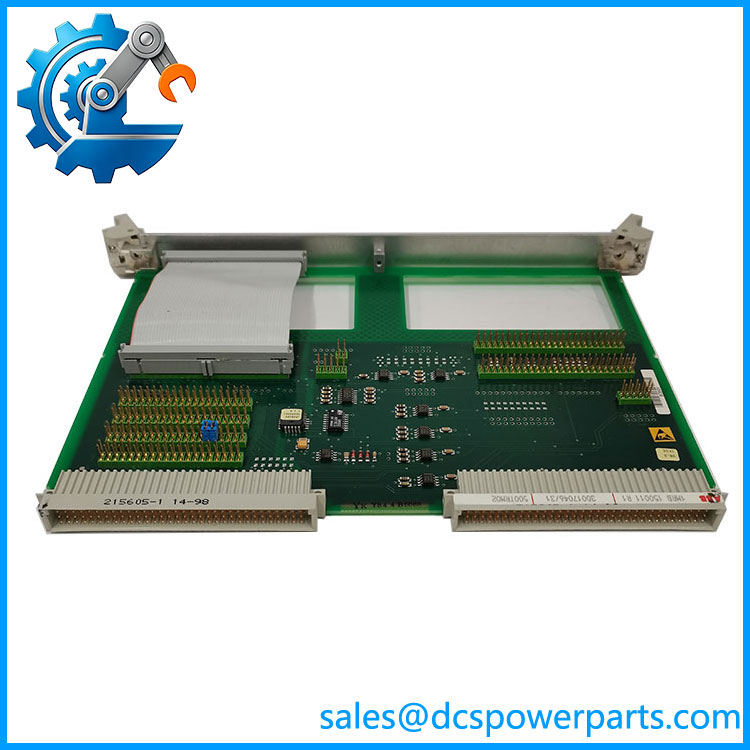
500TRM02 1MRB150011R1
Key Features and Advantages
One release, two notations: R1 and R0001 are the same thing. Buyers who treat the padded and unpadded forms as different parts create phantom variants out of a formatting habit — and this module is the clearest case in the family.
A naming convention with four witnesses: CPU, BIM, AIM and MBA all spell out their functions in this block, so TRM reading as terminal is a family-consistent conclusion rather than a guess — and it outranks the two catalogues that expanded it as transformer, one of which contradicts itself in the same sentence.
A variant index, not a serial: 500TRM02 is the second terminal variant of its function, exactly as 500MBA01/500MBA02 are two variants of the bus module and 500BIM01/500BIO01 are two of the input family. Buying by name means buying a variant, and the variant is what must match the cabinet.
A family map that now closes: 150003, 150011, 150022, 150024, 150081 place seven known modules of one series in order, which lets an engineer identify an undocumented rack from its card names alone.
The 1HDF question resolved by adjacency: 500AIM02 carries an 1MRB code and 1HDF930412X010, so 1HDF is a second-layer identifier within this family — which is why 500CPU03 appearing with an 1HDF code and no 1MRB partner is incomplete data, not a different platform.
No firmware, therefore no software risk: a spare terminal module does not need an application or a parameter set, and its failure modes are mechanical and electrical — terminal torque, oxidation, pinout — which are checkable before installation rather than after commissioning.
Applications
Field wiring marshalling in power-plant racks: the module is where instrument and actuator cables land, so every loop in the cabinet passes through it — which makes it the natural place to look when a group of channels misbehaves together.
Loop checking and commissioning: because the terminal element defines the physical point where a signal enters the system, loop continuity and polarity tests are performed across it, and a documented pinout saves hours per cabinet during a retrofit.
Cabinet rewiring and I/O reallocation: where a plant adds instruments to an existing rack, the terminal module is what gets rewired; having the correct variant on hand is what allows the work to be done without disturbing neighbouring loops.
Retrofit of legacy station control: terminal modules survive longer than processors, and the practical risk is fitting a variant whose field-side convention differs from the cabinet’s — a mismatch that shows up as a failed loop check rather than as an obvious fault.
Spares holding for a fence-line cabinet: the module is cheap relative to downtime and is the single most frequently disturbed card during maintenance, so one verified variant held against the cabinet’s record is a reasonable inventory decision.
Where it does not fit: transformer monitoring relay duty, transformer module duty, REB500 busbar protection duty, or a “coupler module” with channel isolation and communication speed. None of those descriptions survives the family’s naming convention, and one of the sellers that used the transformer expansion hedged it away in the same sentence.
Related Products
500BIM01 (1MRB150024R0002) — binary input module of the same block; the electronics the terminal unit feeds on the digital side. 500AIM02 (1MRB150022R0002Y, 1HDF930412X010) — analog input module of the same block; the terminal unit’s analog counterpart, and the module that shows 1HDF codes acting as second-layer identifiers in this family. 500BIO01 (1MRB…) — the other binary input variant of the same function family, paired with 500BIM01. 500CPU05 (1MRB150081R1E) — processor of the same block; the module whose release letter E shows the release field’s optional letters. 500CPU03 (1HDF700003R5122) — the processor that circulates with an 1HDF code only; its missing 1MRB half is a data gap, not a platform difference. 500MBA01 / 500MBA02 (1MRB150003R0002 / R0003) — the module bus adapters of the same block, coupling the rack’s bus and the earliest assignment in the series. 07KT98-H2 (GJR order code) — the older 07KT9x/GJR module pattern of the same power-plant control lineage, catalogued alongside these 500xxx parts. AC500 / AC500-eCo PM5xx modules — the product line this family is mis-sold as; 1SAP codes and DIN-rail format separate them decisively.
Installation and Maintenance
Before installation: confirm the code in both notations — 1MRB150011R1 and 1MRB150011R0001 are the same release, so a supplier quoting either is not offering a different part, but a supplier quoting R1E or R0002Y is. Then check the variant: 500TRM02 must match the cabinet’s terminal variant, and the field-side convention — terminal style, pinout, wire range — must be verified against the existing wiring schedule rather than assumed from the module’s appearance. Photograph the existing terminations, tag every wire before disturbing any of them, and confirm that the replacement presents the same pinout on both sides.
Installation: with the rack de-energised and the field circuits isolated, seat the module to full backplane engagement, then land the wires per the schedule with correct ferrules and torque. On a marshalling element, the installation is the wiring: a module fitted correctly and wired one position off will pass a power-up check and fail every loop through it. Verify continuity from the field side to the rack side before re-energising, and check that no wire has been landed on a spare terminal position that a neighbouring module expects.
Maintenance: inspect terminations for loosening, oxidation and damaged ferrules at planned outages, since these faults arrive as intermittent, channel-specific errors that are routinely blamed on the input modules behind the terminal unit. Keep the cabinet’s wiring schedule and terminal variant recorded alongside the module code, and store a spare 500TRM02 labelled with the release notation used in the plant’s own documents so that the next person does not mistake R1 for a different part from R0001.
Warranty and Quality
Every 500TRM02 1MRB150011R1 module is supplied as a terminal / marshalling module of ABB’s 500xxx rack family in the 1MRB15 block, documented by designation and full order code, with the release stated in both R1 and R0001 form so that it can be matched against a plant’s own notation. Units are inspected for terminal and backplane-interface condition, PCB and assembly damage, rework evidence, corrosion, label legibility and the presence of all termination hardware; verification covers power-up presence and continuity behaviour where a compatible rack is available. No terminal style, pinout, wire range or voltage rating is asserted, because none is published for this module, and the circulating descriptions that expand TRM as transformer — including the one that contradicts itself — are not adopted. The function is stated as a family-consistent reading: terminal, in a block where every other three-letter code spells out its function. A 12-month repair, replacement or refund commitment applies. Technical support covers what this part actually requires: treating R1 and R0001 as one release, distinguishing 500TRM02 from its sibling variants by the two-digit index, and confirming the field-side convention against the cabinet’s wiring schedule before a spare is dispatched.