Description
Product Overview
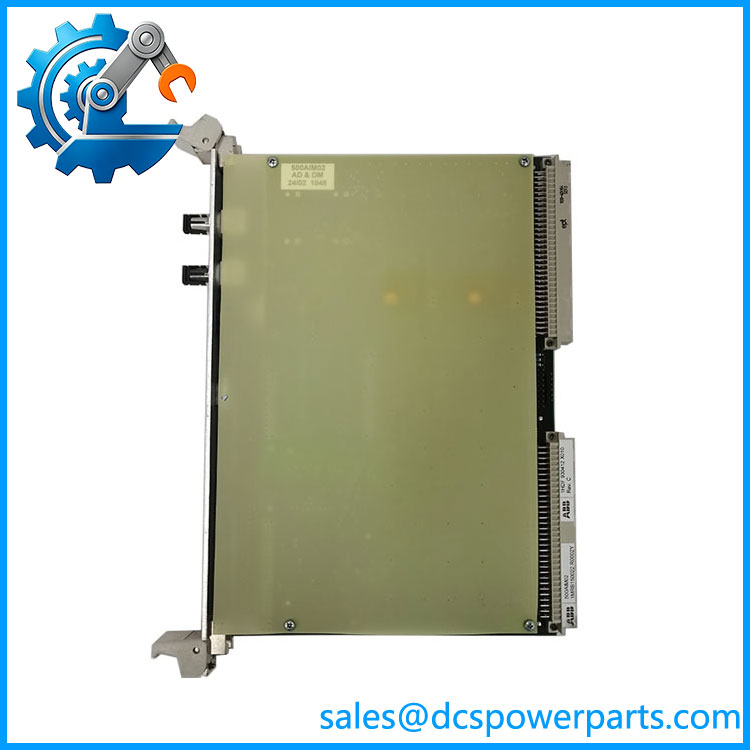
500AIM02 1MRB150022R001 is the one member of this family the market actually agrees about. Five catalogues independently call it an analog input module, and the letters say the same thing: AIM is the only three-letter code in the block that needs no argument, because analog input module is what the abbreviation spells. In a family where 500TRM02 gets expanded as transformer by two sellers and 500MBA02 as a medium-voltage relay by another, consensus on this module is worth noting — and it is earned, because an analog front end is the element whose function is visible in its own wiring: two terminals per channel, a range, and an engineering unit at the end of the conversion.
The block position supports it. 150022 sits between the terminal module at 150011 and the binary inputs at 150024, which is exactly where an analog acquisition card belongs in a rack built from a factory-planned series — after the marshalling element that lands the wires, before the digital inputs that share the same field-side discipline. So the family now reads as a complete, ordered set: 500MBA01/500MBA02 coupling the bus at 150003, 500TRM02 marshalling at 150011, 500AIM02 acquiring analog at 150022, 500BIM01 and 500BIO01 acquiring digital at 150024, and 500CPU05 processing at 150081. That ordering is the most reliable piece of knowledge obtainable about these racks, because it comes from the numbers rather than from anyone’s prose.
The release field is where this order diverges from its sibling, and the distinction is the practically useful part. R1, R0001 and R001 are one and the same release written with one, four or three digits — padding is notation, and the value is what counts. But R001 is release 1, while the market overwhelmingly lists this module as R0002 or R0002Y, which are release 2 with and without a trailing letter. That is not a formatting preference; it is a later hardware revision. So a buyer reading “500AIM02” across a dozen listings will almost always be quoted release 2, and this order asks for release 1 — a genuinely different stock item, in the same family where a padded and an unpadded spelling would have meant nothing at all. The test is simple and worth stating plainly: compare the release value, not the release typography.
The two-code structure is now fully visible on this module, and it resolves the family’s oddest member. 1MRB150022R001 is the ordering code. 1HDF930412X010 is a second code from a different block, which sellers correctly print split into three segments — 1HDF, 930412, X010 — and which the same block also uses in the form 1HDF700003R5122 on 500CPU03: the same 1HDF prefix, a six-digit middle, and a trailing field that is X010 here and R5122 there. That is an engineering or hardware-identification layer, not an alternative way of ordering the module. Its practical consequence for the family is that 500CPU03‘s apparent oddity is explained: that processor circulates with its 1HDF code only because its 1MRB half is missing from the listings, not because it belongs somewhere else.
One seller’s page demonstrates the family’s recurring error in its own syntax: it places this module “within the ABB Procontrol P13 and AC50…” — the sentence starts to name AC500 and stops. Elsewhere the same claim is completed, and this module becomes an “8-channel differential analog input module for the AC500 series”. No official source supports either the channel count or the differential arrangement, and the platform is contradicted by the block’s whole structure. What the analog front end does is not in doubt; how many channels it has, what ranges it accepts and how it converts them are all unpublished, and a spare should be bought against the cabinet’s slot and wiring rather than against a listing’s channel count.
There is also a claim about hot-swap that deserves to be labelled rather than repeated. One catalogue explains the 1HDF 930412 X010 code as an engineering reference tied to hardware mapping and firmware compatibility that permits hot-swapping in certain configurations. It is a plausible-sounding sentence with no documentary anchor, of the kind that gets pasted onto every module in a family until all of them are described identically. Whether 500AIM02 can be changed live depends on the rack and its configuration, and that answer lives in the plant’s own documentation — not in a reseller’s explanation of a code.
Technical Specifications
| Parameter | Value |
|---|---|
| Module designation | 500AIM02 |
| Order code | 1MRB150022R001 — block 1MRB150022, release R001 (release 1) |
| Second code | 1HDF930412X010 — 1HDF + 930412 + X010, an engineering/hardware identification layer |
| Release equivalence | R1 = R0001 = R001 (same value); R001 ≠ R0002 / R0002Y (different value) |
| Family | 500xxx rack modules, 1MRB15xxxx block |
| Block position | 150022, between the terminal module 150011 and the binary inputs 150024 |
| Function category | Analog input module — analog acquisition into the rack |
| Manufacturer | ABB, Sweden |
| Platform compatibility as stated | Procontrol P13, per listing compatibility fields |
| Channel count, input ranges, accuracy | Not published; the circulating “8-channel differential” figure is unsourced |
| Mounting | Rack plug-in module; slot per the rack’s layout |
| Configuration | Scaling and engineering units held in the rack’s configuration, not in the module |
| Published documentation | None located at module level |
| Lifecycle status | No end-of-life notice located; supply is dismantled and surplus stock |
500AIM02 1MRB150022R001
Key Features and Advantages
The one unambiguous member: AIM needs no decoding, and five independent catalogues agree — which makes this module the anchor that validates the family’s naming convention for the members whose codes are opaque.
A release rule that separates notation from revision: R1, R0001 and R001 are one release; and R0002 are two. Buyers who learn only the first half of that rule will treat a genuine hardware change as a formatting difference.
The two-code structure, finally legible: 1MRB orders the module, 1HDF identifies its engineering/hardware state, and the trailing fields differ between blocks — X010 here, R5122 on 500CPU03. One layer is for purchasing, the other for matching a build.
Family order that stands on numbers: 150003 → 150011 → 150022 → 150024 → 150081 maps coupling, marshalling, analog, digital and processing in ascending order, allowing an undocumented rack to be characterised from its card names.
A caution against the family’s most confident invention: the “8-channel differential” specification appears on no official document; the module’s real channel count, ranges and conversion behaviour need to be read from the cabinet’s wiring schedule before a spare is chosen.
No firmware to preserve: unlike the processor, the analog card carries no application to migrate — but its scaling and engineering units live in the rack’s configuration, so a replacement still has to be matched to the configuration, not merely to the socket.
Applications
Process measurement in power-plant racks: boiler, turbine and balance-of-plant cabinets pass pressure, flow, level and temperature signals through cards of this class, and the analog front end is where a plant’s engineering units first become numbers inside the control system.
Transmitter loops and temperature measurement: a four-wire or two-wire transmitter loop, a thermocouple through its transmitter, a level probe — the module’s job is to accept the loop’s electrical signal and hand a stable digital value to the processor, and its accuracy sets the floor on every control loop above it.
Channel expansion on legacy cabinets: where a plant adds measurements to an existing rack, an analog card is the usual addition, which makes a correct variant and release the difference between a working loop and a commissioning problem.
Loop calibration and comparison testing: because the conversion happens here, injected-signal tests and loop checks are performed against this card, and a documented configuration prevents a replacement from arriving with the wrong range.
Retrofit and obsolescence support: with factory supply gone, a verified release-accurate module is what keeps an instrument loop in service through another maintenance cycle.
Where it does not fit: AC500 series PLC duty, an “8-channel differential” specification, a controller module for “data exchange and communication”, or a touchpad, driver or load cell. Each of those descriptions has been attached to this number and none survives the code structure.
Related Products
500TRM02 (1MRB150011R1) — the terminal module immediately preceding this one in the block; the marshalling element whose field terminations feed the analog card. 500BIM01 (1MRB150024R0002) — binary input module of the same block; the digital counterpart sharing the same field-side discipline. 500BIO01 (1MRB…) — the other binary input variant of the same function family. 500CPU05 (1MRB150081R1E) — processor of the same block; the card that consumes what the analog module acquires, and the one carrying a letter suffix in its release field. 500CPU03 (1HDF700003R5122) — the processor listed with an 1HDF code only; this module’s dual-code listing shows why that is an information gap rather than a different platform. 1HDF930412X010 — this module’s engineering/hardware code; the second layer, printed split into three segments, not an alternative order code. 500MBA01 / 500MBA02 (1MRB150003R0002 / R0003) — the module bus adapters at the head of the same block. 07KT98-H2 (GJR order code) — the older 07KT9x/GJR pattern of the same power-plant control lineage, catalogued alongside these 500xxx parts.
Installation and Maintenance
Before installation: compare the release value, not its spelling. This order is 1MRB150022R001, release 1; the market mostly quotes release 2 as R0002 or R0002Y, and those are later hardware revisions rather than alternative notations. Confirm which release the cabinet’s record calls for before accepting a substitute. Then read the slot’s wiring schedule: channel count, range and termination convention all come from the drawing, never from a listing, and the second code 1HDF930412X010 should be recorded alongside the order code so that a future replacement can be matched on both layers.
Installation: with the rack de-energised and field loops isolated, seat the module to full backplane engagement and land terminations per the schedule with correct ferrules and torque. Verify loop supply and polarity at the field side before energising — an analog card presented with a reversed or unpowered loop reports a plausible but wrong value rather than a fault. After power-up, confirm the rack’s configuration expects this module’s range and scaling, and check each channel against a known signal before the loop is returned to the plant.
Maintenance: treat calibration drift and termination condition as the two failure modes worth scheduling. Inject a reference signal at planned outages and compare against the recorded value, inspect terminals for oxidation and loosened ferrules, and keep the rack’s scaling configuration archived with the module’s order code and engineering code. Store a spare 500AIM02 labelled with the release it carries, because release 1 and release 2 are different stock and the label is the only thing that will tell the next person.
Warranty and Quality
Every 500AIM02 1MRB150022R001 module is supplied as an analog input module of ABB’s 500xxx rack family in the 1MRB15 block, documented by designation, full order code, release value and the engineering code 1HDF930412X010, so that both layers can be checked against a cabinet record before dispatch. Units are inspected for terminal and backplane-interface condition, PCB and assembly damage, rework evidence, corrosion, label legibility and the legibility of the release field; verification covers power-up presence and channel behaviour with an injected reference signal where a compatible rack is available. No channel count, input range, resolution or accuracy figure is asserted: the circulating “8-channel differential” statement has no documentary source, and the platform attribution to AC500 contradicts the block’s structure. The function is stated as the family’s one settled reading — analog input, in a block where CPU, BIM, MBA and TRM each spell out their own. A 12-month repair, replacement or refund commitment applies. Technical support covers what this part actually requires: reading as release 1 rather than as a formatting variant of R0002, keeping the 1MRB ordering code distinct from the 1HDF engineering code, and confirming the slot’s channel and range expectations from the cabinet’s wiring schedule before a spare is sent.