Description
Product Overview
VOOB8-B 12004-106-04 VER 1.0.0 is the output board at the field end of its block, and its designation is one of the few in this family that can be read rather than merely memorised. The scheme is series mnemonic, channel count, variant letter: VOOB for the type, 8 for eight channels, -B for the variant. The sibling input board VIIB16-C 12011-105-00 follows exactly the same grammar with its own count and letter, and two boards agreeing on a naming rule is as close to a decode as this product line offers. The channel count 8 is also the one specification that both substantive accounts of this part agree on.
The block position adds what the designation cannot. Function code 106 sits at the far end of the 12004 sequence: VLE 12004-101-01 is the logic core, VPS 12004-102-01 its supply, I/OBUS2 12004-103-01 the bus interface, I/OBE2 12004-104-00 the extender, and VOOB8-B at 106 is where the bus finally reaches something that touches the plant. A card at the highest code with its own front termination is an I/O card, and everything about the board’s role follows from that position rather than from any description.
The descriptions themselves split cleanly in two, and the split is the article’s real subject. One seller calls it a ruggedised eight-channel digital output module with 2 A per channel switching, and files it under a railway signalling product name. Another calls it an analogue output module, with the platform given as the IOBUS2 power-station I/O rack serving gas and steam turbine DCS and SIS. Both agree on eight channels. Both disagree on whether those eight channels switch discrete loads or drive analogue values. And on closer inspection both carry provenance claims that do not survive a check: the railway product name in the first does not appear among Alstom’s published interlocking families, which are Smartlock 400 GP and Onvia Lock; the second seller is the same source that gave two entirely different boards the identical 258 × 225 × 40 mm outline and invented a SIL 3 rating without a certificate number. Neither account is clean enough to settle the question on its own.
So the question stays open, and it matters more than a naming preference. An eight-channel discrete output board drives solenoids, lamps, contactors, signal aspects and point machines — loads that either energise or do not. An eight-channel analogue output board drives valve positioners, I/P converters, variable-speed references and recorder inputs — loads that take a value and complain when the value is wrong. A plant that fits the wrong one does not get a degraded function; it gets no function, sometimes with a channel that looks alive on the front panel while the field device sits at a fixed position.
The trade’s remaining descriptions are noise. One files the card as a generic “control board”; another attaches it to the same template that files every Alstom part as a high-frequency power controller. And the designations themselves get mangled in circulation: one page writes it as VOB8-B, dropping one of the two O’s, which is exactly the kind of normalisation that makes an ERP search miss the item or, worse, match a different board.
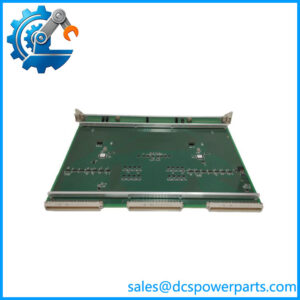
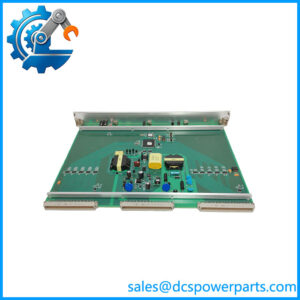
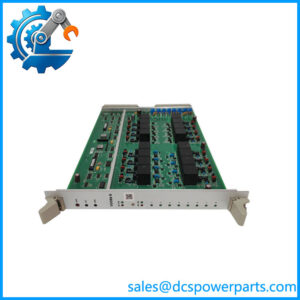
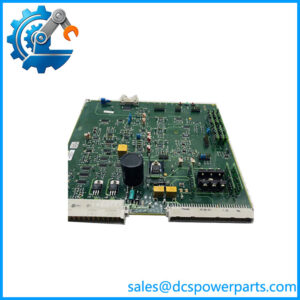
What a technician can rely on is the physical description: a plug-in card for the 12004 rack, backplane-powered, front-terminated into eight channel assignments, carrying a variant letter and a revision, cold-swapped. The rest is settled at the cabinet — by the front termination, by what the eight channels are wired to, and by the drawing that says which of the two signal types belongs in that slot.
Technical Specifications
| Parameter | Value |
|---|---|
| Model designation | VOOB8-B (also seen written VOB8-B, with one O dropped) |
| Order number | 12004-106-04 |
| Revision | VER 1.0.0, also written V1.0.0 and VER:V1.0.0 |
| Designation decode | Series mnemonic VOOB + channel count 8 + variant letter -B (inference, calibrated against VIIB16-C) |
| Manufacturer | Alstom (legacy control rack line; power automation transferred to GE, 2015) |
| Product type | Eight-channel output module, rack plug-in card |
| Position in block | Function code 106, the field end of the 12004 sequence |
| Signal type | Unresolved: discrete output with 2 A per channel claimed; analogue output also claimed; no primary document |
| Channel count | 8 — the one figure both substantive accounts agree on, and corroborated by the designation |
| Rack format | Plug-in card, card guides, captive screws, backplane connector |
| Power supply | From the rack backplane; no separate supply input on the board |
| Field interface | Front termination, eight channel assignments |
| Operating environment | Ventilated control cabinet, typically 0 to +55 °C; IP20 cabinet interior |
| Replacement method | Cold swap with rack de-energised |
| Published documentation | None — no Alstom or GE board-level datasheet, no channel-level parameter set |
| Lifecycle status | No OEM end-of-life notice located; supply is dismantled and refurbished stock |
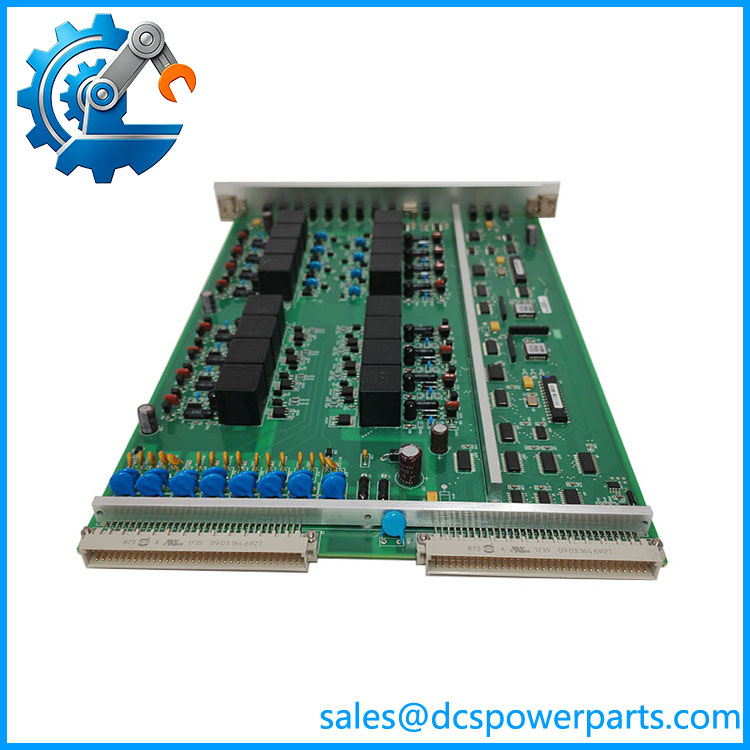
VOOB8-B 12004-106-04 VER 1.0.0
Key Features and Advantages
A designation with content: VOOB type, 8 channels, -B variant — all three readable, and calibrated against VIIB16-C on the same grammar. For a family where most numbers are opaque, being able to state the channel count from the label alone is a genuine procurement advantage.
Position that settles the role: at function code 106, behind the bus interface and the extender, this card is where the architecture meets the plant. That is why the board has a front termination at all, and why it cannot be confused with the core processor at 101.
Eight channels as a practical unit: one card per small cluster of final elements — a group of solenoids, a bank of positioners, a set of indication lamps — which keeps spares, terminations and fault isolation at a working granularity rather than a cabinet-wide one.
Variant letter discipline: -B is a variant of the VOOB8 type, not a synonym for it. The trailing letter is in active use across this family, and matching it is what prevents a card that fits, powers up and behaves plausibly while being the wrong variant for the slot.
A clear, checkable decision point: because the signal type is genuinely unresolved in the record, the board forces a verification step that pays for itself — read the drawing, look at the termination, identify the field device. That step is also what protects against the far more common error of buying on a listing’s prose.
Honest limits: the discrete-versus-analogue question is not settled here, the platform attribution splits between a power-station rack and a railway cabinet, and both substantive seller accounts carry provenance claims that do not hold up. Those gaps are stated rather than filled.
Applications
Discrete output duty, if that is what the slot takes: solenoid valve piloting, contactor and relay coil driving, indication and annunciation lamps, and — in a rail reading — signal aspects and point machine control, all of which are energise-or-not functions with per-channel switching current as the sizing figure.
Analogue output duty, if that is what the slot takes: valve and damper positioner commands through I/P converters, variable-speed drive references, and recorder or controller setpoints passed to equipment outside the rack, all of which are value-carrying functions where a wrong value is worse than no value.
Mixed-cabinet I/O expansion: in a cabinet built from the 12004 block, this card extends the field interface at the far end of the architecture, downstream of I/OBUS2 and I/OBE2, which is why it appears in the same bills as those boards.
Legacy plant spares: with no factory supply, a working eighth-channel output card is held deliberately, identified by designation, variant letter and revision rather than by a description of its function.
Cabinet reconstruction: reading the 12004 block as a sequence lets a maintenance team place this card correctly before opening anything — core, supply, bus, extender, field I/O — and that placement is what makes the front termination worth examining.
Where it does not fit: processor or interlocking core duty, multi-protocol conversion, mains-powered standalone operation, DIN-rail mounting, or any role without field terminals. Those descriptions are attached to neighbouring Alstom numbers in the market and belong to templates, not to this card.
Related Products
VIIB16-C 12011-105-00 — the 16-channel input sibling in the parallel 12011 block; the board that calibrates the designation grammar shared with this one. I/OBUS2 12004-103-01 — the bus interface board that feeds this card; its direct upstream partner in the block. I/OBE2 12004-104-00 — the bus extender paired with I/OBUS2, relevant wherever this card’s segment crosses a chassis boundary. VPS 12004-102-01 — the supply board of the same rack family; the source of the rails this output card runs on. VLE 12004-101-01 — the core processor at function code 101; the board whose logic ultimately commands these eight channels. SDK-C0167-1 12004-08-01 — another 12004-family board whose code falls outside the -10x- sequence, showing how uneven this numbering is in practice. CMP1838 TRVCO62345000 / CP00005202 — ALSPA-generation rack board from the same engineering culture; a three-layer designation rather than a block code.
Installation and Maintenance
Before installation: settle the signal type before ordering, not after. Read the cabinet drawing for the slot at function code 106, identify what the eight channels are wired to — pilot solenoids and lamps on one side, positioners and I/P converters on the other — and confirm which card the site actually carries. Then confirm the variant letter -B and the revision VER 1.0.0 against the cabinet record, because both are part of this card’s identity. Check the front termination and the backplane connector for bent pins, photograph the removed card with its wiring in place, and de-energise the rack: cold swap only.
Installation: seat the card to full backplane engagement and tighten the captive screws evenly, since a partially seated output card produces intermittent switching that reads as a field wiring fault. Transfer the front termination by designation rather than by position. Then prove every channel against a known load — a solenoid that visibly moves, a lamp that lights, a positioner that travels to its commanded value — rather than trusting the front-panel indication, which reports activity and not correctness. Confirm the common returns and, on an analogue reading, the screening and shield bonding before returning the loop to service.
Maintenance: output cards fail in ways that hide. A discrete channel can stick energised and hold a solenoid open; an analogue channel can drift and leave a valve at the wrong position while every status bit looks healthy. Check the field device and its wiring before pulling VOOB8-B 12004-106-04, inspect terminals for oxidation at planned outages, and keep the card in dissipative packaging labelled with designation, order number, variant letter and revision — a spare matched on channel count alone will eventually be the wrong variant or the wrong signal type. Do not re-seat working cards as routine practice; these connectors are no longer in production.
Warranty and Quality
Every VOOB8-B 12004-106-04 VER 1.0.0 card is supplied as an Alstom 12004-series eight-channel output module and is documented by designation, order number, variant letter and revision, so that it can be matched against a cabinet drawing and a slot rather than against a description. Units are inspected for backplane connector condition and pin integrity, front termination condition, card-edge and guide wear, captive screw function, PCB damage, rework evidence and corrosion, and for label legibility; verification covers power-up presence and channel indication in a compatible rack where one is available. No signal type, channel current, output range or isolation figure is asserted, because the two substantive published accounts for this number disagree on whether the channels are discrete or analogue and neither cites an Alstom document. A 12-month repair, replacement or refund commitment applies. Technical support covers what this part actually requires: reading VOOB8-B as type plus channel count plus variant, placing function code 106 at the field end of the 12004 block behind I/OBUS2 and I/OBE2, watching for the VOB8-B misspelling that circulates in listings, and settling the discrete-versus-analogue question at the front termination before a card is bought for the wrong kind of load.