Description
Product Overview
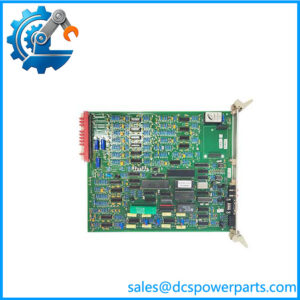
VPS 12004-102-03 V1.0.0 is the board every other board in the cabinet depends on, and the one whose part number is most often recorded wrongly. VPS is the voltage supply of the 12004 rack: function code 102, sitting immediately behind the logic core at 101 and ahead of the I/O bus at 103. That position is the architecture, not a coincidence — the core needs rails before it can run, the bus interface needs rails before it can drive a segment, and the I/O cards at 106 need rails before they can drive a field coil. Read as a sequence, the block describes a power tree: 102 generates and distributes, everything above 102 consumes.
The part that gets lost is the trailing field. This card is 12004-102-03, and the same function code exists as 12004-102-01 with a letter revision marking attached. Same function, same block, same rack, different variant. That is exactly the field in which a supply board’s electrical differences would normally be encoded — input range, output rating, rail configuration — and no published source states what -01 and -03 differ in. The safe engineering position is therefore the conservative one: they are not interchangeable, and a spare must match the trailing field as well as the function code.
The revision conventions make the trap worse, not better. The -01 variant carries a VER.C style marking, the -03 variant carries V1.0.0. One block, two revision languages, both live at the same time. So a cabinet does not have “a revision” — each board has its own, and the supply board’s convention depends on which variant it is. A maintenance record that reads “VPS 12004-102” without the trailing field and without the revision is not a procurement record; it is an invitation to fit the wrong card.
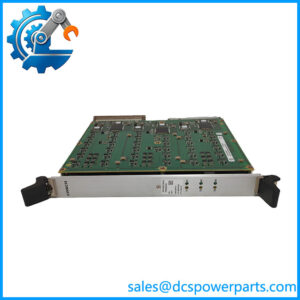
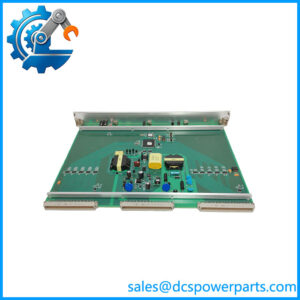
What this card does physically is the part that survives the market’s noise: it is a rack plug-in card, it has no field terminals of its own, and its output goes onto the backplane where the other cards draw it. That also defines its diagnostics. A supply card does not fail one channel; it fails a rail, and a failing rail presents as several cards behaving implausibly at once — the core reporting internal disagreement, the bus interface losing segments, I/O cards returning stuck states. That failure signature is the most useful thing a technician can know about VPS, because it inverts the usual instinct: when many boards misbehave simultaneously, the answer is usually underneath all of them, not inside one of them.
The trade’s listings for this number are contaminated in a way worth naming, because it is the clearest example in this family. At least one seller prints the VPS entry as three numbers glued together — the VPS designation, the block code, and two further strings. One of those strings, VP32702X, is not an Alstom rack code at all: it is a GE 6U VME Pentium M single board computer, documented in a vendor BSP as running at 1.8 or 1.4 GHz with up to 2 GB of DDR ECC memory, two SATA ports, CRT and flat-panel graphics, and extended-temperature options. That is a completely different product in a completely different form factor, and appearing beside a rack supply board is evidence of listing assembly rather than of a product family. The other string, V4561983-0100, is sold widely as a “16-input/16-output digital input module” — with the specifications changing from seller to seller, 0.5 A here and 1 A there, −20 °C here and −25 °C there, which is the signature of a template rather than a datasheet. Its V-plus-seven-digits form does resemble the material-code style used on Alstom power-conversion boards, so it may be a legitimate code for something; what it is not is a documented description of this supply card.
So the usable picture is narrow and solid: a backplane supply board at function code 102, third variant, numeric revision, no field terminals, feeding every other card in the rack. Its input source, output rails and current ratings are not published anywhere, and no amount of listing prose substitutes for measuring them at the cabinet.
Technical Specifications
| Parameter | Value |
|---|---|
| Model designation | VPS |
| Order number | 12004-102-03 |
| Revision | V1.0.0 |
| Manufacturer | Alstom (legacy control rack line; power automation transferred to GE, 2015) |
| Product type | Rack power supply board — backplane supply unit |
| Position in block | Function code 102, between the core at 101 and the I/O bus at 103 |
| Variant field | -03; the same function code exists as -01 with a VER.C marking; difference not published |
| Rack format | Plug-in card, card guides, captive screws, backplane connector |
| Power input | External feed into the rack through the supply position; input range not published |
| Power output | Backplane rails to all rack boards; rail voltages and current ratings not published |
| Field termination | None — no front-panel field wiring |
| Operating environment | Ventilated control cabinet, typically 0 to +55 °C; IP20 cabinet interior |
| Replacement method | Cold swap with rack de-energised; rails to be verified under load afterwards |
| Published documentation | None — no Alstom or GE board-level datasheet |
| Lifecycle status | No OEM end-of-life notice located; supply is dismantled and refurbished stock |
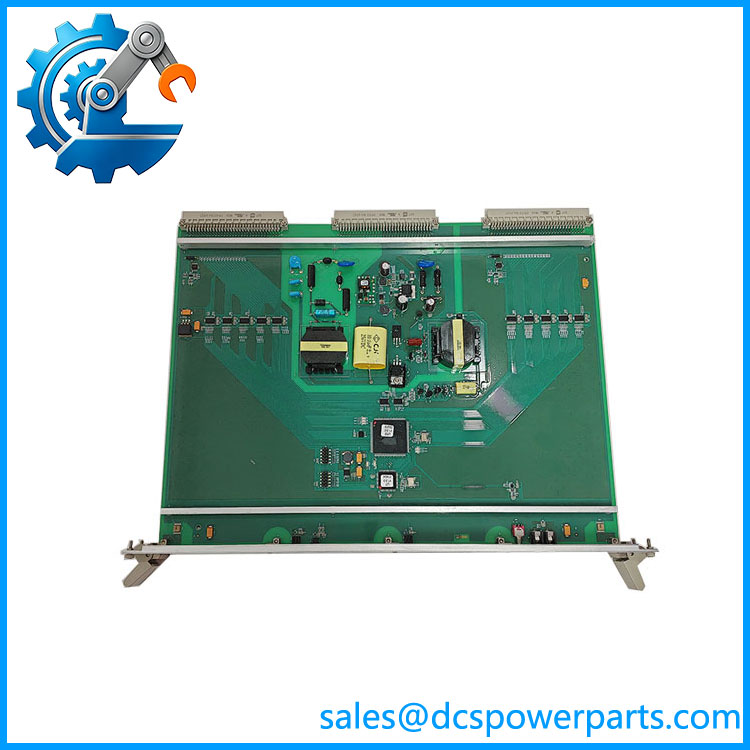
VPS 12004-102-03 V1.0.0
Key Features and Advantages
Power at the root of the tree: with VPS at function code 102, the whole block is readable as a power tree — supply, core, bus, extender, field I/O. That ordering is the reason a supply fault looks like a dozen unrelated faults, and knowing it shortens diagnosis more than any meter reading.
Variant discipline: -03 versus -01 is the field that decides whether a supply board is the right one, and it is the field most often dropped from maintenance records. Matching it, together with the revision, is the difference between a spare and a paperweight.
Two revision languages, one block: letter revisions on the -01 variant and V1.0.0 here mean that cabinet-level version records are meaningless for this card. Per-board revision recording is the only method that works.
No field terminals, rail-level diagnostics: the card has nothing to wire, so its health is read from the rails and from the behaviour of the boards they feed rather than from channel status. That makes it fast to test and slow to misattribute.
A single point whose loss stops everything: every other card in the rack depends on this board, which is precisely why it deserves a dedicated spare rather than being covered by the loose stock that accumulates around I/O cards.
Honest limits: no input range, output rail, current rating or efficiency figure is published for this board, the difference between the -01 and -03 variants is undocumented, and the codes bundled with it in listings belong to a GE VME single board computer and to a generic module template. Those gaps are stated, not filled.
Applications
Cabinet power integrity: the board is the entry point for the rack’s supply and the reference point for every rail measurement taken during commissioning or troubleshooting, which makes it the first card to verify when a cabinet is being returned to service after storage.
Multi-board fault triage: when several cards in the same rack misbehave at once — the core reporting disagreement, the bus dropping a segment, I/O returning implausible states — the common factor is upstream. VPS 12004-102-03 is that common factor, and checking it first is cheaper than swapping three cards.
Legacy rack life extension: with no factory supply and dismantled stock as the only channel, a verified supply board is the card that keeps an otherwise healthy cabinet alive. Losing it makes every other spare worthless.
Cabinet reconstruction from numbers: reading 101 through 106 as a sequence lets a team establish that the rack’s supply is the 102 card, what it feeds, and which variant the cabinet carries — before the first screw is touched.
Rail and power cabinets alike: because this family’s platform attribution is split between railway interlocking and power-station I/O racks, the supply card serves either reading, and the power-integrity work is identical in both.
Where it does not fit: 16-input/16-output I/O duty, single board computer duty, 6U VME slot duty, or any role with field terminals and channel counts. Those descriptions attach to codes that circulate beside this one, not to the supply board itself.
Related Products
VLE 12004-101-01 — the logic core immediately above this supply in the block; the board whose rails this card provides, and whose “internal disagreement” symptoms are usually a rail problem. I/OBUS2 12004-103-01 — the I/O bus interface fed by these rails; a segment loss on this board is frequently read as a bus fault. I/OBE2 12004-104-00 — the bus extender paired with I/OBUS2; equally dependent on the same supply. VOOB8-B 12004-106-04 — the eight-channel output board at the far end of the block; the card whose stuck outputs most often trace back here. VIIB16-C 12011-105-00 — 16-channel input module in the parallel 12011 block; a different block, not a substitute, with its own supply arrangement. SDK-C0167-1 12004-08-01 — another 12004-family board outside the -10x- sequence, showing how uneven this numbering is in practice. VP32702X — not a relative. That string is a GE 6U VME Pentium M single board computer, and its appearance beside this part number in listings is a bundle, not a family link.
Installation and Maintenance
Before installation: match both fields. Confirm the order number reads 12004-102-03 and not -01, and confirm the revision marking on the replacement against the cabinet record, since the two variants use different revision conventions. Then establish what the rack actually needs from its supply — measure the rails at the connector with the existing board fitted, note the input feed and its fusing, and record the loaded values rather than the open-circuit ones, because the rails sag under load and that sag is what causes the symptoms. Photograph the card and its connectors, check the backplane connector for bent pins, and de-energise the rack completely: cold swap only, and on a supply board the sequence matters.
Installation: seat the card to full backplane engagement and tighten the captive screws evenly, since a partially seated supply board produces intermittent rails — the worst possible failure mode in a cabinet, because it makes every other card look faulty at random. On power-up, verify every rail at the backplane before letting the rack run, then confirm the core reaches a stable state and the I/O cards report normally. If a rail reads low under load, stop there; do not chase board-level faults downstream of a supply that is not holding.
Maintenance: supply boards age on their electrolytic elements and their thermal path, so treat rail measurement under load as a scheduled check rather than a fault response, and keep the cabinet’s intake air clean. Inspect connectors for oxidation and heat discolouration at planned outages, and keep one verified VPS 12004-102-03 V1.0.0 spare per rack architecture, labelled with variant field and revision — because a spare that arrives as -01 with a letter revision will fit, power up and then behave differently from the cabinet it was bought for.
Warranty and Quality
Every VPS 12004-102-03 V1.0.0 board is supplied as the power supply board of the Alstom 12004 rack and is documented by designation, order number, variant field and revision, so that it can be matched against a cabinet record rather than against a description. Units are inspected for backplane connector condition and pin integrity, card-edge and guide wear, captive screw function, PCB and solder condition, electrolytic and thermal-path signs of age, rework evidence and corrosion, and for label legibility; verification covers power-up and rail presence in a compatible rack where one is available. No input range, output rail voltage, current rating or efficiency figure is asserted, because no Alstom document publishes one for this card, and the codes that circulate beside this number describe a GE 6U VME single board computer and a generic 16/16 I/O module rather than a supply board. A 12-month repair, replacement or refund commitment applies. Technical support covers what this part actually requires: keeping the -03 variant field distinct from -01 with its letter revision, explaining why a supply fault presents as several boards failing at once, and why rails must be measured under load at the backplane before any downstream card is condemned.