Description
Product Overview
7400213-100 is a Triconex ordering number, and that distinction is the whole article. Triconex uses two parallel naming layers on the Trident safety controller: the Model designation that appears on drawings, in TriStation configuration and in the Product Specifications (2101, 2201, 2301, 2351, 2401, 2481 and so on), and the 7400-series ordering number that appears on the label, the packing list and the purchase order. The two are not interchangeable, and the 7400 layer is the one that shows up on a quote.
The 7400 block is a known, consistently behaved block. Confirmed mappings from independent sources place 7400206-100 with the Model 2201 Communication Baseplate, 7400207-001 with the Model 2101 Main Processor Baseplate, 7400208B-020 and 7400208C-020 with the Model 2301 Digital Input Baseplate, 7400209-010 with the Model 2481 Analog Output Baseplate, 7400209-030 with the Model 2401 Digital Output Baseplate, 7400210-010 with the Model 2351 Analog Input Baseplate, 7400219-030 with the Model 2401H hazardous-location output baseplate, and 7400221-100 with the Model 2381 Pulse Input Baseplate. Within that block, 7400213-100 is a baseplate kit — not a module, not an extender, not a controller.
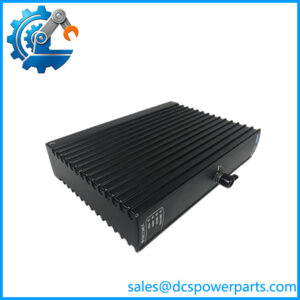
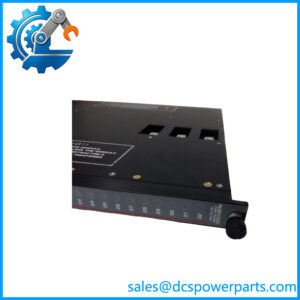
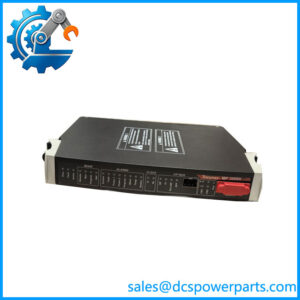
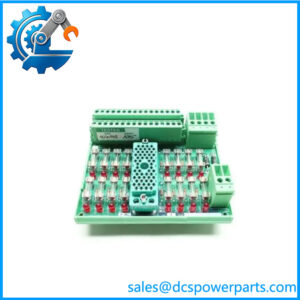
What a Trident baseplate actually is decides how much this matters in practice. It is the passive carrier that holds an I/O set: two slots, marked L and R, each able to accept the same module type, one active and one hot-spare. Field wiring lands on its compression terminals — 24 to 12 AWG, 0.2 to 3.3 mm² — and each baseplate ships with an I/O interconnect assembly (2921), a slot cover (2900) and a terminal cover (2901). The interconnect assemblies chain baseplates into a column and carry both I/O messages and logic power, and logic power originates on the MP baseplate, so an I/O column needs no separate logic supply. Because every terminal is on the baseplate, a module can be lifted out and replaced without touching a single field conductor.
Which baseplate model 7400213-100 corresponds to is not published in any source reachable outside Triconex’s own price book, and this article does not guess. The reliable way to settle it is on the hardware: the baseplate PCB carries a 3000-series assembly number, and that number maps unambiguously to a model. The official Product Specifications give the pairing — 3000671-100 for 2101, 3000673-020 for 2301, 3000675-010 for 2351, 3000675-020 for 2361, 3000719-100 for 2381, 3000659-130 for 2401, 3000676-310 for 2451, 3000674-010 for 2481, 3000852-020 for 2483, 3000851-010 for 2354, 3000851-110 for 2354A, 3000764-300 for 2480A, 3000721-100 for 2352, 3000721-130 for 2342 and 3000721-300 for the external-termination and high-voltage variants. Read the silkscreen, match the number, and the model is known — without trusting any reseller page.
That method matters because the reseller layer around this part number is unusually bad. The same 7400213-100 is sold as a 16-channel 24–230 VAC/DC digital output module, as a “termination board” measuring 85 × 45 mm and weighing 30 g, as a TMR processor with Modbus/EtherNet/IP/Profibus, as a chassis extender for multi-baseplate expansion, as a CIM extender with RS-485 and Ethernet ports, as an industrial control card at 220 V with 50 kHz output, and as the Model 2481 Analog Output Baseplate — which is actually 7400209-010. Six mutually exclusive identities for one number is the signature of a template filled in per page, not of a datasheet.
Technical Specifications
| Parameter | Value |
|---|---|
| Ordering number | 7400213-100 |
| Platform | Triconex Trident (Trident v2) safety controller, TMR |
| Number class | 7400-series ordering number for baseplates and I/O column hardware |
| Item class | I/O baseplate kit (passive carrier; no module electronics) |
| Kit contents (standard) | I/O baseplate; I/O interconnect assembly 2921; slot cover 2900; terminal cover 2901 |
| Slots per baseplate | 2 (L and R), forming one I/O set; active / hot-spare roles |
| Field terminals | Compression terminals, 24 to 12 AWG (0.2 to 3.3 mm²) |
| Column wiring | I/O interconnect assemblies carry I/O bus messages and logic power between baseplates |
| Logic power source | MP baseplate, redundant fused 24 VDC (19.2 to 30 VDC), no separate I/O column supply |
| I/O bus | TMR HDLC, 2 Mbit/s |
| Module form factor (all Trident I/O) | 44 × 220 × 169 mm (W × H × D) |
| Baseplate footprint | I/O baseplates 178 × 249 mm; MP and HART baseplates 229 × 249 mm |
| Ambient limit | 70 °C maximum for all Trident I/O modules |
| Corresponding baseplate model | Not published for this ordering number — read the 3000-series PCB assembly number |
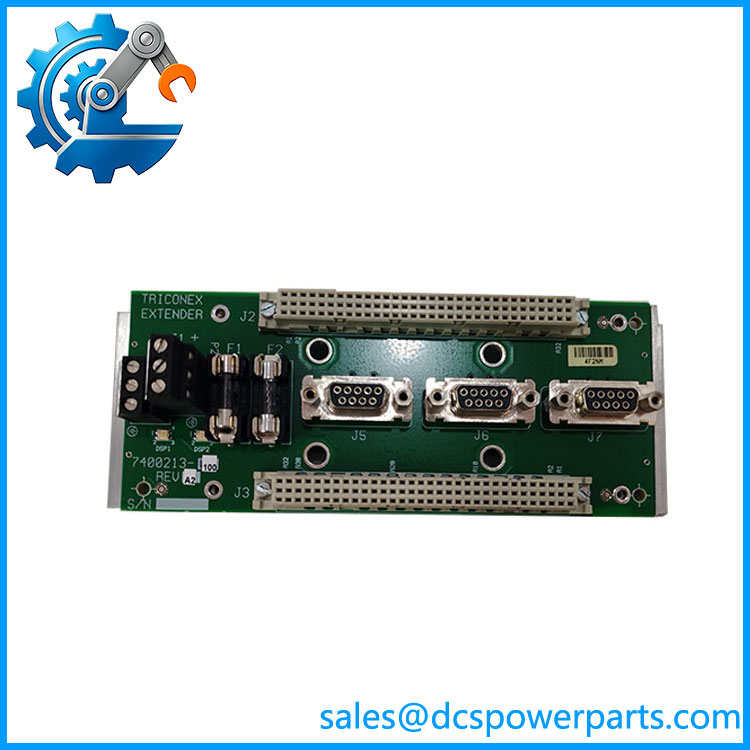
TRICONEX 7400213-100
Key Features and Advantages
Two naming layers, one part: Triconex separates the design model (2481, 2351, 2301) from the ordering number (7400xxx-xxx), which is why a site’s spare-parts list and its drawings often appear not to agree. 7400213-100 sits in the ordering layer; the Model designation it resolves to is the one that must match the slot, the module and the keying.
Identification from the board, not from the invoice: every Trident baseplate carries its 3000-series assembly number in silkscreen. Matching that against the published pairing table settles the model in about a minute and does not depend on any supplier’s description. On a part where six resellers offer six different products, this is the only check worth doing.
The baseplate is the asset that outlives the module: modules are consumables in a hot-spare architecture; the baseplate holds every field termination, the interconnect that ties the column together and the keying that prevents a wrong module being seated. A column’s wiring history lives on the baseplate, so replacing one is a wiring job, while replacing a module in it is a five-minute lift.
Service without disturbing the process: with terminals on the baseplate and each I/O set carrying an active and a hot-spare module, a module swap breaks no conductor and no loop. That is the design reason Trident baseplates are worth stocking as spares in their own right, not only as the thing a module happens to sit on.
Keying as a safety function: each module is mechanically keyed to its baseplate configuration. A baseplate of the wrong model will either refuse the module or accept it into the wrong circuit — which is why the model, not the ordering number, has to be confirmed before anything is ordered.
Power and bus handled in the carrier: logic power arrives from the MP baseplate over the interconnect, and the 2 Mbit/s TMR HDLC I/O bus runs on the same assemblies. No separate supply, no separate bus cable inside a column — fewer terminations, fewer failure points, less to get wrong during a panel build.
Whole-kit delivery: the kit arrives with interconnect, slot cover and terminal cover, so a replacement restores the dust, liquid and corrosion protection of the original assembly rather than leaving an open slot in a corrosive atmosphere.
Honest limits: this number does not by itself tell you which baseplate you have, and it carries no electrical ratings of its own — those belong to the module and to the baseplate model it resolves to. Treating 7400213-100 as a “module with 16 outputs” or as a processor, as several pages do, produces an order that will not fit anything in the cabinet.
Applications
Spare-parts reconciliation on an operating Trident column: a maintenance planner holds an invoice that says 7400213-100 while the drawings say Model 2351 or 2481 or 2301. Reading the baseplate assembly number against the official pairing table closes that gap before a purchase order goes out, and it is the step that prevents a wrong-model baseplate arriving during a turnaround window.
Column expansion and rebuild: adding an I/O set to an existing column means adding a baseplate, its interconnect assembly, slot cover and terminal cover, then carrying logic power and the I/O bus onward through the interconnect chain. The baseplate kit, not the module, is what the mechanical and wiring scope is built around.
Panel and cabinet replacement in brownfield plants: where an enclosure is being rebuilt or relocated, baseplates are re-terminated and modules are reused. Knowing which model each baseplate is — by board number, not by sticker — is what allows the field wiring schedule to be rebuilt correctly.
Obsolescence and long-lifecycle support: Trident columns run for decades, and the practical spares question is often which baseplate variants a site actually has. A baseplate inventory taken by assembly number is more useful than one taken by ordering number, because it maps directly to the modules and terminal covers that must be kept alongside.
Quality and traceability work ahead of a safety audit: auditors ask for the as-built configuration of each I/O set, including baseplate model, module model and keying. A number that resolves cleanly to a model — and a photograph of the silkscreen to prove it — is the evidence; a supplier’s product description is not.
Procurement de-risking on the secondary market: when a part number circulates with six different descriptions, the buyer’s defence is the physical board number plus the published pairing table, applied before payment rather than after delivery.
Related Products
7400207-001 — Model 2101 Main Processor Baseplate Kit; the baseplate that originates the column’s logic power and hosts the three MPs. 7400206-100 — Model 2201 Communication Module Baseplate Kit; carries up to two Communication Modules and their serial and Ethernet connectors. 7400210-010 — Model 2351 Analog Input Baseplate Kit; standard 4–20 mA input baseplate, and the classic neighbour of this ordering block. 7400209-010 — Model 2481 Analog Output Baseplate Kit; frequently mis-attributed to 7400213-100 by resellers, which is precisely the confusion to resolve first. 7400209-030 — Model 2401 Digital Output Baseplate Kit; standard 24 VDC output baseplate for the Model 3401 DO module. 7400219-030 — Model 2401H Digital Output Baseplate Kit, hazardous location; the variant to check for when the cabinet sits in a classified area. 7400208C-020 — Model 2301 Digital Input Baseplate Kit; 24 VDC discrete input baseplate for the Model 3301 DI module. 7400221-100 — Model 2381 Pulse Input Baseplate Kit; the baseplate for the Model 3381 PI module used on speed and flow inputs. 2921 I/O Interconnect Assembly — the passive link that chains baseplates into a column and carries I/O bus messages plus logic power; supplied with each kit. 2281 I/O Bus Extender Module Kit — used where the I/O bus must be carried to a separate column, with 2-ft I/O bus cable sets.
Installation and Maintenance
Before installation: identify the baseplate actually in hand by its 3000-series assembly number and confirm it against the intended Model — 7400213-100 is an ordering number and does not, on its own, tell you which baseplate you are holding. Check that the kit is complete: baseplate, interconnect assembly 2921, slot cover 2900, terminal cover 2901. Confirm the module type that will sit in the L and R slots, verify the mechanical keying, and establish that logic power reaches this position through the interconnect chain from the MP baseplate rather than from a local supply. In a classified area, confirm the hazardous-location variant before the panel is closed.
Installation: mount the baseplate vertically on the panel with clearance for airflow and for wiring channels along the column, then connect the interconnect assembly and carry the column onward. Terminate field wiring on the compression terminals at 24 to 12 AWG, keeping shields bonded at the cabinet entry, and fit the slot cover and terminal cover so the assembly keeps its protection against dust, liquids and corrosive atmospheres. Seat the module only after the field circuit has been checked with a meter; the baseplate is passive, so an open or shorted loop will otherwise be reported as a module fault.
Maintenance: the baseplate’s service life is decided by its terminations, not by electronics. On planned outages, inspect compression terminals for loosened strands, discolouration and corrosion, re-torque to specification, and check the interconnect assembly seating at both ends of the column — a partially seated interconnect produces intermittent I/O that reads like a module problem. Keep the terminal covers in place; an uncovered baseplate in a corrosive atmosphere is the usual origin of creeping terminal resistance. Photograph the silkscreen number of every baseplate during the inspection and file it with the as-built record, so the next 7400213-100 on an invoice can be matched to a real slot without a site visit.
Warranty and Quality
Every 7400213-100 is supplied as a Triconex Trident I/O baseplate kit and is identified before dispatch by the assembly number on the board, not by the seller’s description — because this ordering number circulates online as a digital output module, a TMR processor, a chassis extender, a communication extender and the Model 2481 baseplate, and none of those descriptions can be trusted. Each unit is inspected for baseplate flatness and connector condition, interconnect assembly presence and seating, slot cover and terminal cover completeness, terminal block integrity and corrosion, and any sign of prior re-termination or field repair. Where a Trident bench is available, the baseplate is populated with the matching module pair, powered through the column interconnect from an MP baseplate, and checked for clean active/hot-spare transfer and stable I/O across both slots. A 12-month repair, replacement or refund commitment applies. Technical support covers what this number actually raises: resolving an 7400-series ordering number to a Trident Model, reading a 3000-series assembly number, confirming keying and hazardous-location variants, and assembling the interconnect, slot cover and terminal cover that a complete column position requires.
免费
今天 10:48