Description
Product Overview
EPI3382 is a part number with no original documentation behind it, and the professional starting point is to say that plainly. Triconex publishes a complete module family for its Trident controller: 3101 main processor, 3201 communication, 3301 digital input, 3351 analog input, 3361 mixed input, 3381 pulse input, 3401 digital output, 3451 relay output, 3481 and 3482 analog output. There is no EPI prefix anywhere in that set, no module numbered 3382, and no product page, datasheet or specification section for this string. The number exists in the secondary market and in several dealer catalogues, and that is all that can be established with certainty.
What the number itself offers is a block reading. In this platform, the 33xx block is the input family, and the 338x sub-block is specifically the pulse input sub-block: Model 3381 is the documented pulse input module, six channel-isolated points, differential inputs, 32 kHz, 24-bit resolution, sold with the 2381 baseplate as the 5481 TriPak. The prefix in EPI3382 reads naturally as a compression of “enhanced pulse input”, and if that reading is correct then 3382 is a second member of the 338x block rather than a different family altogether. That is a hypothesis with a reason behind it, not a fact, and the difference between the two is what this article is about.
The secondary market does not help, because it disagrees with itself in five directions. One seller lists EPI3382 as a digital output module with eight channels at 2 A in a 148 × 230 × 41 mm housing, IP67, SIL 3, fed from 18 to 36 VDC. A second lists it as a high-performance processor module with a 32-bit 33 MHz CPU, 1 MB RAM, 4 MB flash, capacity for 1,000 analog and 2,000 digital points, 90 to 264 VAC input, IP67, SIL 2 certification. A third calls it a sixteen-channel digital output at 48 VDC and 0.5 A per channel with peak 1 A, non-commoned and optically isolated — then, in the same page, repeatedly calls the part 3607E instead. A fourth advertises it as a sixteen-channel enhanced pulse input at up to 50 kHz with TMR lanes and API 670 machinery-protection certification, and quotes an order code in ABB’s 3BSE format. A fifth indexes it as a main processor under the name EPI 3382S2.
Read against the platform’s own design grammar, most of those collapse. Triconex field power is 24 VDC nominal with a 33 VDC absolute maximum: a 48 VDC output stage cannot exist on this platform without a different field-power architecture. I/O modules do not take mains power — they take 24 VDC logic power from the MP baseplate through the interconnect, under 3 W, so a 90 to 264 VAC input belongs to a chassis power supply, not to a card. Point counts follow a consistent grammar — 32 discrete in, 32 analog in, 16 discrete out, 4 analog out, 6 pulse — so a sixteen-channel pulse card would be an outlier by a factor of nearly three. And a three-lane TMR module does not offer “IP67” protection as a card seated in an open chassis.
The residue that survives is narrow and useful: EPI3382 is a Triconex-platform part number whose function is not published, whose most plausible interpretation is a pulse or frequency input card in the 338x block, and whose actual identity can be settled in minutes by the module in hand — what baseplate it seats on, what the front panel says, what TriStation reports when the position is configured. That test is described below in enough detail to be executed, because it is the only route to a defensible answer.
Technical Specifications
| Parameter | Value |
|---|---|
| Model | EPI3382 (also listed as EPI 3382, EPI3382S2) |
| Manufacturer / platform | Triconex, Invensys; now Schneider Electric — Tricon / Trident safety system |
| Official documentation status | No datasheet, no catalogue entry, no product page, no specification section located |
| Number-block reading | 338x = pulse input sub-block of the 33xx input family; documented member is Model 3381; EPI read as “enhanced pulse input” |
| Documented family reference (Model 3381, not this part) | 6 points, channel-isolated, commoned ground; differential input; 0.5 Hz–32 kHz; 24-bit; ±0.01% (2–32 kHz), ±0.1% (0.5–2 kHz); minimum scan update 20 ms |
| Documented family carriers (Model 3381) | Model 2381 pulse input baseplate (7400221-100); packaged as the 5481 Pulse Input TriPak |
| Candidate functions claimed by sellers | Eight-channel 2 A digital output; sixteen-channel 48 VDC digital output; 32-bit processor module; sixteen-channel 50 kHz pulse input; main processor |
| Claims that contradict platform design | 48 VDC field output (platform field power is 24 VDC, 33 VDC max); 90–264 VAC card input (I/O takes 24 VDC logic power, < 3 W); 1,000 analog + 2,000 digital points (per-module grammar is 32 / 32 / 16 / 4 / 6); IP67 on a chassis-mounted card |
| Identity test 1 — carrier | Which baseplate the module physically seats and keys into: 2381 (pulse), 2301 (discrete in), 2401 (discrete out), 2351 (analog in), 2481 (analog out), 2101 (MP) |
| Identity test 2 — configuration string | Module type, revision and firmware reported by TriStation 1131 for that slot |
| Identity test 3 — front panel | Point count and per-point indication printed on the label and fascia |
| Identity test 4 — field connector | Pulse input expects differential sensor pairs; discrete out expects load terminals and a shared return |
| Certification | Not published for this number; do not inherit SIL 3 from the platform |
| Condition basis | Supplied against label, connector and carrier verification rather than a function description |
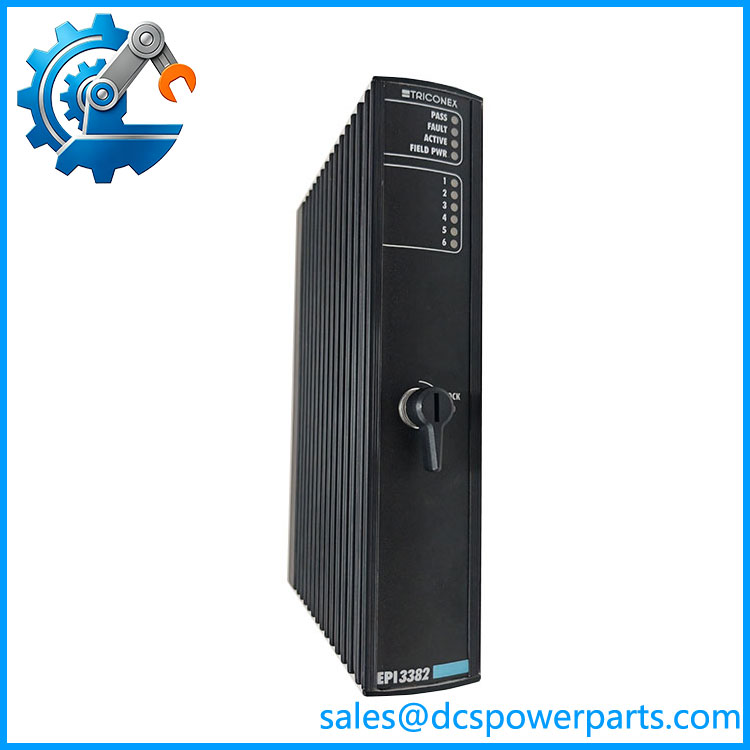
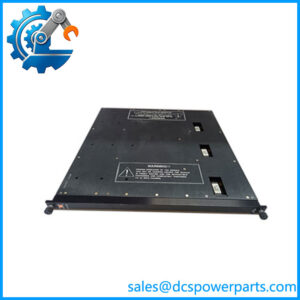
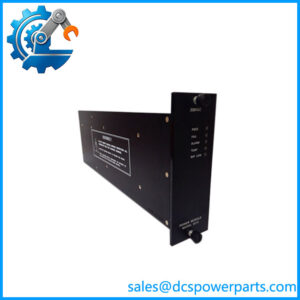
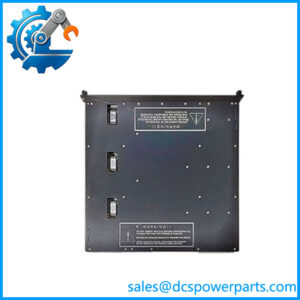
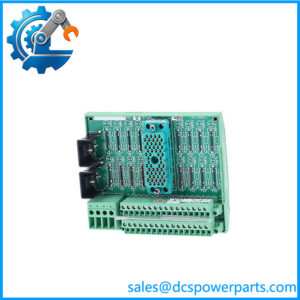
TRICONEX EPI3382
Key Features and Advantages
A number-block argument rather than a product claim: the 338x sub-block belongs to pulse input in this platform, and Model 3381 is its documented member. That makes “enhanced pulse input” the only reading of EPI3382 that is consistent with the platform’s own numbering — a reasoned hypothesis, clearly labelled as one.
A negative specification that is worth as much as a positive one: 48 VDC outputs, mains-fed cards and thousand-point capacities all violate this platform’s published electrical and point grammar. Ruling those out is engineering work, and it removes most of what the market says about this number.
The carrier as arbiter: a module either keys into a 2381 pulse baseplate, a 2301 discrete-input carrier, a 2401 output carrier, a 2351 analog carrier, a 2481 analog-output carrier, or the 2101 MP baseplate. There is no ambiguity in a mechanical fit, and it settles the family question before any negotiation starts.
TriStation as the second witness: the configured slot reports a module type, a revision and a firmware version. Those three strings are the OEM’s own identification of the card in the rack, and no marketplace listing can override them.
Point-count arithmetic as a cross-check: the platform’s module grammar is 32 discrete in, 32 analog in, 16 discrete out, 4 analog out and 6 pulse. A card claiming sixteen pulse channels contradicts a family that has shipped six-channel pulse input for the whole life of the product.
Documented reference values instead of invented ones: the Model 3381 figures — 6 channel-isolated points, differential inputs, 0.5 Hz to 32 kHz, 24-bit, ±0.01% above 2 kHz — are published and can be quoted. They belong to 3381, and the article says so rather than transferring them to a number that has never been documented.
Honest limits: no electrical rating, no certification, no lifecycle status, and no confirmation that a 3382 exists in any Triconex catalogue. What exists is a number, a plausible family, five contradictory listings and a test procedure.
Applications
Rotating-equipment speed monitoring, if the pulse-input reading holds: turbine and compressor overspeed protection uses magnetic speed pickups whose output frequency is proportional to shaft speed and gear-tooth count, and the documented Triconex pulse module is specified for exactly that sensor type — differential input, 0.5 Hz to 32 kHz, gear teeth from 1 to 255.
Custody transfer and flow totalising: pulse-output flow meters and positive displacement meters produce frequency proportional to volume, and a safety system that counts those pulses can cross-check a proving run against the control-system totaliser.
Compressor train protection packages: speed, keyphasor-class pulse signals and reverse-rotation detection on a platform where a trip on overspeed must not be defeated by a single failed input lane.
Retrofit and spares procurement for legacy Tricon and Trident racks: an offered as a spare for a pulse-input position should be matched to the carrier already installed, not to a description; where the position is a 2381 pulse baseplate, the family question answers itself.
Where this number must not be used: as a specification source for a new design, as evidence of a SIL rating, or as a substitute for a documented part on the strength of a listing that also quotes ABB-style ordering codes and chassis models that do not exist in the Triconex range. None of those survives an audit.
Due diligence in the secondary market: the correct use of this article is to force the seller to state the carrier, photograph the label and front panel, and quote the TriStation module string — before a purchase order is raised for .
Related Products
3381 Pulse Input Module — the documented member of the 338x block; 6 channel-isolated points, differential inputs, 0.5 Hz–32 kHz, 24-bit, ±0.01% above 2 kHz — the reference against which any 3382 claim should be judged. 2381 Pulse Input Baseplate Kit (7400221-100) — the carrier the 3381 seats on; the mechanical fit that would confirm a pulse-input family reading for . 5481 Pulse Input TriPak — packaged 3381 plus 2381 combination, the standard ordering route for a pulse position. 3511 Pulse Input Module — the Tricon v9/v10 pulse input, a different platform with different termination assemblies; not interchangeable with Trident pulse hardware. 3401 Digital Output Module with 2401 Baseplate (7400209-030) — the 24 VDC discrete output pair, relevant because two listings describe as a 48 VDC output card, a voltage this platform does not switch. 3008 Main Processor Module (Tricon) and 3101 Main Processor Module (Trident) — the MP class that one listing claims for this number; an MP seats on the MP baseplate and a controller needs three of them, which is a quick way to falsify that reading. 3301 Digital Input Module with 2301 Baseplate — the discrete input pair, the other family the carrier test distinguishes. 2921 I/O Interconnect Assembly — the passive link that carries I/O messages and logic power, and the reason every candidate family in this article draws under 3 W of 24 VDC from the column rather than from a mains feed.
Installation and Maintenance
Before installation: do not install it. Identify it first. Record the label text verbatim, photograph the front panel and the field connector face, count the terminal positions, and note any silkscreened assembly number on the board. Then seat it — without wiring — on a spare carrier of each candidate family and observe which one it keys into; the mechanical keying is the platform’s own statement of what the card is. Finally, with the position configured in a test chassis, read the module type, revision and firmware string that TriStation reports. Those three pieces of evidence together either confirm a pulse-input reading or settle the card into a different family entirely.
Installation, once the family is confirmed: if it proves to be a pulse input card of the 338x block, treat the wiring as the documented family demands — shielded twisted pair per channel, differential pairs kept together into the carrier, termination and pull-up resistors configured on the baseplate rather than improvised at the terminals, and sensor cable routed away from drive output cables. Ringing on a pulse input is counted as extra transitions, so a clean edge is not a refinement but a measurement requirement.
Maintenance: keep the identification record with the item — label photograph, carrier family, TriStation string — because a number without documentation cannot be re-identified from a bin label. On pulse positions, verify the configured gear-tooth count against the machine drawing before trusting a speed reading, and check for added transitions (ringing, noise, a failing sensor) rather than assuming module error when a speed value drifts. Where a card remains unidentified after the three tests, hold it as unconfirmed stock rather than shelving it as a spare; in a bin without a verified family is a future wrong installation.
Warranty and Quality
Every is supplied against physical identification rather than a product description, because no Triconex datasheet exists for this number and the secondary market describes it simultaneously as an eight-channel 2 A digital output, a sixteen-channel 48 VDC output, a 32-bit processor module with 1,000 analog and 2,000 digital points, a sixteen-channel 50 kHz pulse input quoting an ABB-format order code, and a main processor designated EPI 3382S2 — readings that contradict the platform’s published 24 VDC field power, its 3 W logic budget and its module point grammar. Each unit is photographed label-and-connector, measured, inspected for silkscreened assembly references and prior repair, keyed against candidate carriers to establish which family it physically belongs to, and, where a test chassis is available, read through TriStation for module type, revision and firmware. A 12-month repair, replacement or refund commitment applies to the item as identified and photographed. Technical support covers what this number actually raises: reading the 338x block convention and its documented 3381 reference, executing the carrier and configuration-string tests that settle the family, explaining why 48 VDC outputs and mains-fed cards cannot exist on this platform, and — where the pulse-input reading is confirmed — applying the documented differential sensor practice, gear-tooth configuration and 20 ms minimum scan update that the family specifies.
免费
今天 11:43