Description
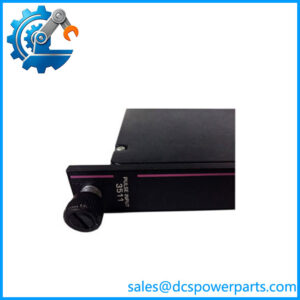
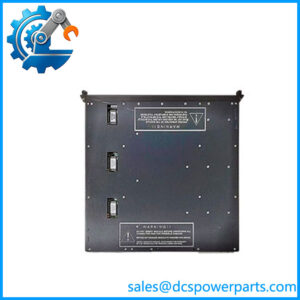
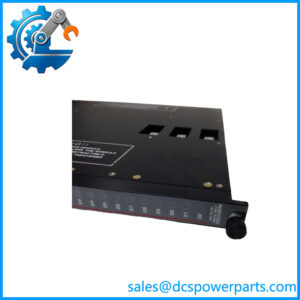
Triconex 3401S2 | Tri-GP 16-Point 24 VDC Digital Output Module
Product Overview
The Triconex 3401S2 is a 16-point digital output module for the Tri-GP general-purpose I/O architecture. It provides 24 VDC discrete outputs for field devices such as solenoid interfaces, relays, contactors, and other binary final-control circuits used within safety and industrial control applications. The module is part of the Tri-GP TMR architecture, where redundant processing paths and diagnostic mechanisms are used to detect faults and maintain system integrity. Published Tri-GP documentation identifies the 3401S2 specifically as a 16-point, commoned 24 VDC digital output module.
Electrical characteristics are worth checking carefully before specifying a replacement. The nominal output supply is 24 VDC, with a specified operating range of 19–30 VDC and an absolute maximum of 33 VDC. The output circuitry supports switching below 4.8 A with self-limiting protection and has a typical switching capability of 3.0 A, while the continuous carry specification is 700 mA maximum and self-limiting. Loop-back diagnostics monitor output behavior, while the published diagnostic specification limits the diagnostic pulse to less than 2 ms maximum, with 500 μs typical.
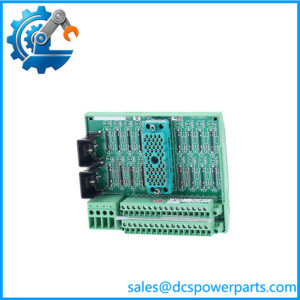
For an existing Triconex installation, the 3401S2 should be evaluated as part of the complete Tri-GP I/O assembly rather than as a generic 24 VDC output card. The corresponding 2401S2 baseplate is identified in the Tri-GP planning documentation, and the module’s commoned-output architecture has to match the field wiring arrangement. A physically similar Triconex output module with a different electrical function—such as the supervised 3411S2—is not automatically interchangeable.
Product Introduction
When a safety-system output card fails, the critical question is not simply whether the replacement provides 24 VDC. Channel architecture, baseplate compatibility, field-load characteristics, diagnostics, and TMR system revision all matter. The 3401S2 is designed specifically around the Tri-GP output architecture and its associated 2401-series baseplate.
For brownfield replacement work, the 3401S2 is particularly relevant where an existing Tri-GP installation requires the same 16-point commoned 24 VDC DO function. The module should not be substituted with a supervised or high-voltage variant without checking the original system design.
Key Technical Specifications
| Parameter | Specification |
|---|---|
| Product Model | 3401S2 |
| Brand | Triconex |
| Product Family | Tri-GP General Purpose I/O |
| Product Type | Digital Output Module |
| System Architecture | TMR |
| Output Points | 16 |
| Output Configuration | Commoned |
| Nominal Output Voltage | 24 VDC |
| Specified Operating Voltage | 19–30 VDC |
| Absolute Maximum Output Voltage | 33 VDC |
| Switching Current | <4.8 A, self-limiting |
| Typical Switching Current | 3.0 A |
| Carry Current | 700 mA maximum, self-limiting |
| Off-State Leakage | <1 mA |
| Output Loop-Back Scan | <1 ms for all 16 points |
| Diagnostic Glitch Duration | <2 ms maximum |
| Typical Diagnostic Glitch | 500 μs |
| Loop-Back Off Region | 0–5 VDC |
| Loop-Back Transition Region | 6–14 VDC |
| Loop-Back On Region | 15–30 VDC |
| Functional-Earth / Protective-Earth Isolation | 500 VDC minimum |
| Functional-Earth / Logic Isolation | 800 VDC minimum |
| Compatible DO Baseplate | 2401S2 |
| Application | Tri-GP safety/control digital outputs |
The specifications above are based on the published Tri-GP technical product guide and planning documentation.
Major Features / Practical Advantages
1. Sixteen 24 VDC digital outputs
The 3401S2 provides 16 discrete output points using a commoned architecture. That makes it appropriate for installations where multiple binary loads operate from the same field-output arrangement. The commoned configuration is an important wiring characteristic and should be confirmed before replacing another Triconex DO module.
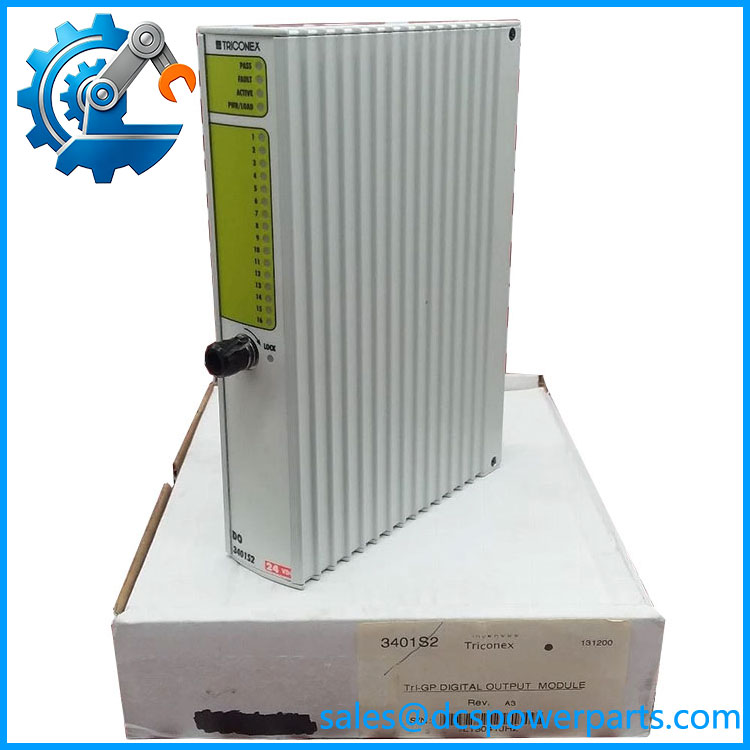
3401S2
2. TMR system architecture
The 3401S2 belongs to the Tri-GP family of modules used within Triconex’s fault-tolerant control architecture. The product documentation identifies it as a TMR digital-output module. This is not equivalent to saying that the individual field outputs are independently isolated or independently voted at the physical terminal level; those are separate engineering questions.
That distinction matters in safety-system engineering. A TMR module designation describes the system architecture, not automatically the electrical isolation arrangement of every field point.
3. 19–30 VDC operating range
The specified operating range is 19–30 VDC, with 24 VDC as the nominal value. The absolute maximum output voltage is 33 VDC. Field supply tolerance therefore needs to be considered when connecting inductive loads or equipment with its own voltage limitations.
4. Self-limiting output current
The published specification identifies switching current below 4.8 A with self-limiting protection, with 3.0 A given as a typical value. The continuous carry-current limit is 700 mA maximum and self-limiting. These figures should not be interpreted as a recommendation to operate a field load continuously at the switching limit. Actual load type, inrush, wiring, and system installation conditions need to be checked.
5. Output loop-back diagnostics
The module monitors its output state through loop-back circuitry. The published threshold regions are 0–5 VDC for OFF, 6–14 VDC as the transition region, and 15–30 VDC as ON. The complete 16-point loop-back scan is specified at less than 1 ms.
This provides useful diagnostic coverage because the system can compare commanded output behavior against the monitored electrical state rather than relying solely on the processor’s command signal.
6. Short-circuit and field-power diagnostics
Published documentation lists field alarms associated with loss of field power and output points being shorted ON or OFF. These diagnostics are particularly relevant during commissioning because a field wiring fault can otherwise look like a defective output module.
7. Controlled diagnostic pulse
The diagnostic glitch duration is specified as less than 2 ms maximum, with 500 μs typical. This is an important consideration when the module drives equipment that reacts to short pulses. Load compatibility should be verified rather than assuming every solenoid or relay will behave identically.
8. 2401S2 baseplate relationship
The Tri-GP planning documentation identifies 2401S2 as the digital-output baseplate kit associated with the 3401S2. Baseplate compatibility should therefore be checked before treating the module as a direct replacement for another Triconex output model.
9. Not the same as 3411S2
The 3411S2 is another 16-point, 24 VDC digital output module in the Tri-GP family, but it is identified as the supervised digital output variant. The 3401S2 and 3411S2 therefore should not be treated as interchangeable merely because their point count and nominal voltage are similar.
10. Legacy procurement considerations
The 3401S2 appears in published Triconex lifecycle documentation as a Tri-GP general-purpose I/O module. That documentation places it within the older Tri-GP product family, so procurement should focus on exact revision and system compatibility rather than assuming current-production availability.
For an existing plant, retaining the exact module type can also simplify validation because the replacement preserves the original output architecture and diagnostic behavior.
Related Products
- 2401S2 — Digital Output Baseplate Kit associated with the 3401S2. Verify the installed baseplate before ordering a replacement module.
- 3411S2 — Supervised 16-point 24 VDC digital output module. It adds supervised-output functionality and should not be treated as a generic substitute for 3401S2.
- 3301S2 — 32-point 24 VDC TMR digital input module in the Tri-GP family, providing the corresponding discrete-input function.
- 3311S2 — 32-point high-resolution 24 VDC TMR digital input module for applications requiring the enhanced DI architecture.
- 3351S2 — 32-point 0–5 VDC TMR analog input module used for analog process measurement rather than discrete output control.
- 3361S2 — Combined analog-input/digital-input module providing 16 analog and 16 digital input points in the Tri-GP family.
- 3382S2 — Enhanced pulse-input module covering pulse/frequency measurement applications rather than binary output control.
- 5401S2 — Digital Output TriPak assembly incorporating the 3401S2 digital output module.
- 5401LS2 — Low-current digital-output TriPak arrangement; the associated module/baseplate configuration should be distinguished from the standard 3401S2 arrangement.
FAQ
What is the Triconex 3401S2?
The 3401S2 is a 16-point, commoned 24 VDC digital output module for the Tri-GP TMR architecture. It interfaces the Triconex control system with discrete field loads.
Is the 3401S2 an isolated digital output module?
Not in the sense of having 16 individually galvanically isolated field outputs. The published Tri-GP technical guide specifies 16 commoned points. Some commercial listings incorrectly describe the module as individually isolated, so the original technical documentation should be used for engineering decisions.
What is the output voltage?
The nominal output voltage is 24 VDC, with a specified operating range of 19–30 VDC and an absolute maximum of 33 VDC.
What current can each 3401S2 output handle?
The published specifications identify a switching current of less than 4.8 A with self-limiting, with 3.0 A typical, and a 700 mA maximum self-limiting carry current. The actual field-load design should account for inrush, duty cycle, load type, and installation conditions rather than using the switching figure as a continuous-load rating.
Can I hot-swap a 3401S2?
Do not treat online replacement as a generic permission to remove any Triconex module under all operating conditions. The Tri-GP architecture supports maintenance strategies involving redundant modules/baseplates, but the applicable system procedure, chassis configuration, module status, and site safety procedure must be followed. A plant’s approved maintenance procedure takes precedence over a generic statement that a module is “hot-swappable.”
Does the 3401S2 support firmware v3.1?
The 3401S2 is an I/O module rather than a standalone PLC CPU. A blanket statement that the hardware “supports firmware v3.1” would therefore be misleading. Compatibility should be checked against the installed Tri-GP system revision, main processor, configuration software, and module revision.
Is 3401S2 interchangeable with 3411S2?
No—not automatically. Both are 16-point 24 VDC Tri-GP digital-output products, but the 3411S2 is the supervised digital-output variant, while the 3401S2 is the standard digital-output module. The field circuit and diagnostic requirements must be checked before substitution.
What should I verify before buying a replacement 3401S2?
For a brownfield Triconex installation, verify:
- Exact module number: 3401S2.
- Module revision and nameplate.
- Installed 2401S2 baseplate.
- Tri-GP system version.
- 24 VDC field supply and actual voltage range.
- Commoned-output wiring arrangement.
- Field-load type and inrush current.
- Output diagnostic requirements.
- Main processor and configuration revision.
- Whether the existing module is part of an approved redundant/online-maintenance arrangement.
Procurement Note
The Triconex 3401S2 is a safety-system I/O component where electrical details matter more than the broad product description. The key identifiers are 16 points, commoned outputs, 24 VDC nominal operation, and Tri-GP TMR architecture. Published documentation also establishes the 2401S2 baseplate relationship and the module’s loop-back diagnostic characteristics.
For replacement procurement, do not accept a generic “3401 digital output” description. Confirm the S2 revision, baseplate, system generation, output architecture, and field-load requirements. In particular, do not confuse the 3401S2 with the supervised 3411S2 or with high-voltage Tri-GP output configurations.
For new-surplus or previously installed stock, request photographs of the complete nameplate, front connector/keying arrangement, module revision, and condition of the connector pins. A bench power-up test alone does not verify the output loop-back diagnostics or compatibility with the installed Tri-GP system.