Description
Product Overview
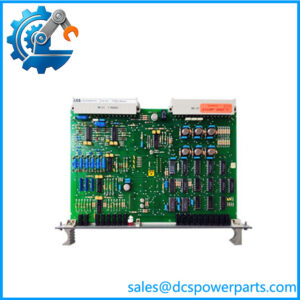
DSPU131 3BSE000355R1 is not an I/O module and not a power supply, and the first job in writing about it honestly is to say what ABB’s own product data says it is: the DSPU 131 MA200 Interface Board, an AT-bus board of full length, catalogued under Advant OCS with Master software, Engineering, MasterAid 200, Communication Modules — and again under Advant common hardware as a DSPU 131 Communication Unit. Its listed “where used” entry is the Advant Station 100 SEB-ISA Kit, ordering number 3BDS100335R2. That is a coherent identity: this is the interface card that sits inside an ABB engineering station and connects that station to the Advant system.
The context explains the form factor. MasterAid 200 was the engineering toolset for the Advant Controller 400 series generation, and it ran on an Advant Station 100 — a PC-class workstation, not a rack-mounted controller. In that era, connecting a workstation to a process control network meant a card in an expansion slot, and the AT (ISA) bus was the slot available. A length of 334.6 mm is the classic full-length ISA card; 121.9 mm is the standard board height; 21 mm of thickness and 0.42 kg of mass are what a full-length card with a bracket and a ribbon connector weighs. Nothing in those numbers suggests a field-mounted device, and that is the point: the physical data alone refutes most of what the secondary market says about this number.
Two smaller details in the product data are worth reading as engineering evidence rather than catalogue trivia. First, the RoHS entry records an exemption under Article 2(4)(c), (e), (f) and (j) of the 2011/65/EU directive, cited against the ABB Advant Master Process Control System declaration — the language used for equipment designed before lead-free and halogen-free requirements became routine, which places the design in the 1990s. Second, the customs tariff number is 85389091, the code for parts of electrical apparatus rather than a complete instrument, consistent with a board supplied as a component of a station. And the “number of batteries: 0” entry, dull as it looks, is genuinely useful for anyone storing one of these for a decade: there is no cell on the card to leak.
What this means practically is that DSPU131 is a support part for an engineering environment, not a control part for a plant. Its availability matters to organisations that still run Advant Master systems and still need to program, re-load or archive controller configurations from a station with an ISA slot. The failure mode is therefore not “the plant trips” but “we cannot connect the engineering tool”, and the recovery path is narrower than for an I/O card: you need a working board, a host with a compatible bus and slot, and the software that talks to it.
That is also why the marketplace descriptions of this number are so far off. One listing calls it a “unit interface board module” with 32-bit 200 MHz processing, 32 digital and 8 analog channels, RS-485 and Ethernet, and claims compatibility with AC 800M, AC 500 and Bailey INFI 90. Another describes 16 transistor or relay outputs at 1 A per channel with PNP/NPN selection and IP20 protection. A third quotes 24 VDC at 3 A, 16 digital inputs, 8 analog outputs, EtherCAT/CANopen/DeviceNet, 380 VAC supply in the same paragraph, a 178 × 100 × 90 mm housing and 1.2 kg. A full-length ISA card cannot be any of those things, and the ABB category path — Engineering, MasterAid 200, Communication Modules — says exactly what it is instead.
Technical Specifications
| Parameter | Value |
|---|---|
| Product ID | 3BSE000355R1 |
| ABB type designation | DSPU 131 |
| Catalog description | DSPU 131 MA200 Interface Board |
| Product function | Interface board for the MasterAid 200 engineering environment; links the engineering station to the Advant system |
| Bus and form factor | AT (ISA) bus, full-length board |
| Dimensions | 334.6 mm length × 121.9 mm height × 21 mm width |
| Net weight | 0.42 kg |
| Country of origin | Sweden (SE) / Germany (DE) |
| Customs tariff number | 85389091 — parts of electrical apparatus |
| RoHS status | Exempt under 2011/65/EU Article 2(4)(c), (e), (f), (j); declaration ref. 3BSE088609, ABB Advant Master Process Control System |
| Batteries | None on the board |
| Kit membership | Advant Station 100 SEB-ISA Kit, 3BDS100335R2 |
| Catalogue categories | Advant OCS with Master SW → Engineering → MasterAid 200 → Communication Modules; Advant Common Hardware → Communication Modules → DSPU 131 Communication Units |
| WEEE category | 5 — small equipment, no external dimension over 50 cm |
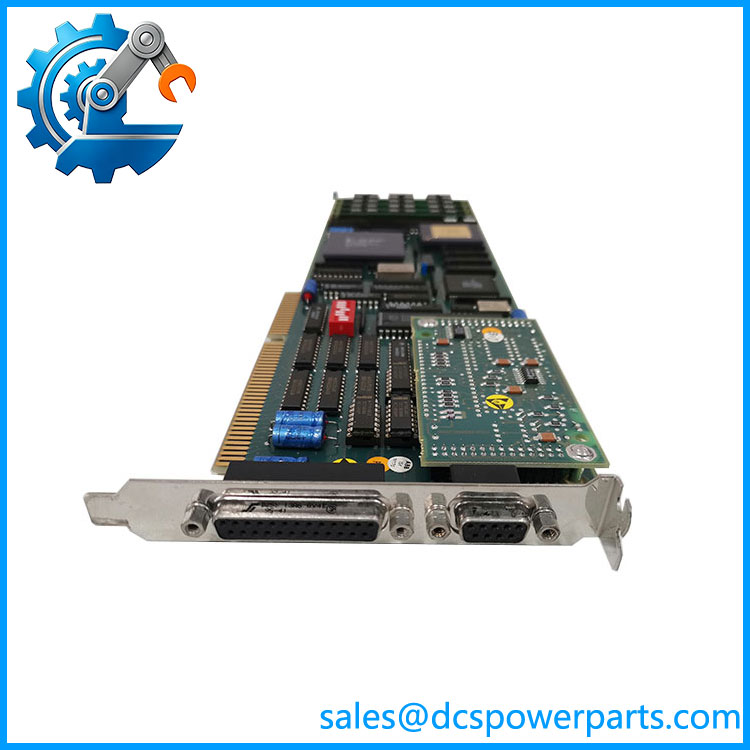
DSPU131 3BSE000355R1
Key Features and Advantages
A defined identity instead of a guess: ABB’s product data names this board, gives its catalogue path and its host station kit. For a legacy part that most listings describe as a generic “control module”, that documented identity is the single most valuable thing about it.
Physical data that settles arguments: a 334.6 mm full-length AT board weighing 0.42 kg cannot be a field I/O block, cannot have sixteen 1 A outputs, and cannot accept 380 VAC. Reading dimensions before reading descriptions is a discipline this number rewards.
The station, not the plant, is the asset it protects: losing a DSPU131 does not stop a controller, it stops engineering access — program loads, configuration archives, loop tuning and diagnostics from the MasterAid 200 environment. Knowing which asset is at risk changes the spares policy completely.
Kit-level ordering made visible: the product data ties the board to the Advant Station 100 SEB-ISA Kit, 3BDS100335R2. Where a whole station is being rebuilt, that kit reference is a better starting point than a single card number, because the station’s other components are as scarce as the board.
Design vintage stated rather than glossed: the RoHS exemption and the tariff classification point to a 1990s design supplied as apparatus parts. That is honest lifecycle information, and it is more useful than a dealer’s claim of “active, in production” for a board on an ISA bus.
No battery, no leakage: for long-term storage in a spares cage, the absence of an on-board cell removes the one failure mode that quietly kills boards kept for a decade.
Storage and handling that fit the object: 0.42 kg and 21 mm thickness mean it protects well in an antistatic bag inside a shallow carton, and the full-length bracket is the fragile part — the edge connector and the bracket are what get damaged in careless handling, not the electronics.
Honest limits: no published electrical specification, no firmware or software version data in the product record, no formal end-of-life notice located, and no functional substitute in the current portfolio. It is a legacy engineering-station board, and it should be bought as one.
Applications
Advant Master engineering stations still in service: keeping a MasterAid 200 station able to connect to Advant Controller 410 and 450 systems so that program changes, re-loads after a controller replacement and archive restores remain possible.
Configuration archiving and disaster recovery: an engineering station that can still reach the controllers is how a plant recovers a corrupted or lost controller program; a DSPU131 in the station is a prerequisite for that recovery path.
Migration projects with a legacy window: while a site moves from Advant Master toward System 800xA, the old station is typically kept alive for reference, documentation and last-resort re-loads, which means the interface board has to keep working through the transition.
Loop tuning and diagnostics on installed Advant controllers: engineering access for tuning, trend retrieval and fault investigation on systems that have been in service for decades and whose documentation lives in MasterAid 200 projects.
Test and training environments: benches and training rooms that reproduce an Advant Master station for engineers who need to learn the environment, where a working ISA-slot host and a working board are both required.
Where it must not be used: as an I/O card, as a power supply, as an AC 800M or AC 500 accessory, or as a substitute for a modern S100 I/O communication interface. Those roles belong to entirely different products, and a purchase based on such a listing ends with a board that fits nothing in the cabinet.
Spares strategy for legacy DCS sites: hold one board and, more importantly, one known-good host with an ISA slot and a working software image — because the board is only half of the interface.
Related Products
3BDS100335R2 Advant Station 100 SEB-ISA Kit — the kit this board belongs to; the correct reference when an entire engineering station is being rebuilt. DSAI 130A — S100 I/O high-level analog input board of the same Advant generation, 16 differential channels; a different role in the same system. DSDI 110AV1 — S100 I/O digital input board, 32 channels in four groups with input time filtering. DSDO 115A — S100 I/O digital output board family, 32 channels, available in transistor and relay-contact variants. DSDP 150 — S100 I/O pulse input board, 12 channels up to 10 kHz, for the counting and positioning tasks of the same era. CI846 (2PAA125748R1) — the modern S100 I/O Ethernet fieldbus communication interface module, hosted in a TU866 termination unit; the current path for connecting I/O to an AC 800M controller, and a different product class entirely. AC 450 / AC 410 controllers — the Advant Controller 400 series that MasterAid 200 was built to engineer; the reason the station exists. TU866 — the Ethernet FCI termination unit used with CI846, illustrating how the interface function migrated from a station card to a rack-mounted module.
Installation and Maintenance
Before installation: establish that the host actually has a free AT (ISA) slot of full length — a modern PC does not, and this is the most common reason a working board cannot be used. Record everything about the existing board before removing it: slot position, any address or interrupt selection present on the board, cable routing and connector orientation. Photograph the bracket and the edge connector, because reassembly is where damage happens. Image the station’s system disk first; the software image is as scarce as the hardware, and it is useless to restore a board into a station whose disk has died.
Installation: handle the board by the bracket and edges, in an antistatic bag until the moment it enters the slot, and never by the components. Seat it fully, fit the bracket screw, reconnect the interface cable without twisting it, and verify the station recognises the interface through the MasterAid 200 environment before attempting any controller connection. If the station has been reconfigured or its disk replaced, confirm the interface settings match what the software expects rather than what the previous owner used.
Maintenance: keep the whole station, not just the board — board, host, cable and software image together are the spare. Clean the edge connector with a lint-free wipe and contact cleaner only if a fault is suspected, never as routine maintenance. Store the card flat, in an antistatic bag, away from heat and from anything that can press on the bracket. When the station is mothballed, run it periodically: electrolytic capacitors and disk drives age faster in storage than in service, and a DSPU131 that has not been powered for five years is an unknown quantity. Where a fault appears, prove the host slot and the cable before condemning the board — legacy stations fail at connections far more often than at semiconductors.
Warranty and Quality
Every DSPU131 3BSE000355R1 is supplied as the DSPU 131 MA200 Interface Board — an AT-bus full-length board, 334.6 × 121.9 × 21 mm, 0.42 kg, catalogued under Advant Master engineering as a MasterAid 200 communication module and used in the Advant Station 100 SEB-ISA Kit — and identity is confirmed from the board’s own markings against ABB’s product data before dispatch, because this number is sold online as a 32-channel mixed I/O module, as a 16-output transistor card, and as a 24 VDC controller with EtherCAT and a 380 VAC supply in the same description. Each unit is inspected for edge-connector condition, bracket and connector-shell integrity, corrosion, signs of prior rework or heat damage, and for any address or interrupt selection recorded on the board. Where an ISA-capable station is available, the card is exercised in that host: bus recognition by the operating system, interface initialisation from the MasterAid 200 environment, and a verified connection to an Advant controller where a test system exists. A 12-month repair, replacement or refund commitment applies. Technical support covers what this part actually raises: confirming that it is an engineering-station interface rather than an I/O module, identifying the host bus requirement that decides whether a spare is usable at all, reading the SEB-ISA kit reference when a whole station must be rebuilt, and separating this board from the I/O hardware and from the modern CI846 Ethernet interface path.
免费
今天 14:22