Description
Product Overview
CMP1838 is not a generic DCS module, and the string that identifies it is not a single part number. It is the board code of a plug-in card belonging to Alstom’s ALSPA P320 power plant control system, and it travels with two further identifiers that mean different things: TRVCO62345000, the equipment or order number under which the card is procured, and CP00005202, a factory drawing number. Three layers, one piece of hardware. Anyone quoting only CMP1838 is quoting a board family designation; anyone quoting all three is quoting a configuration that can actually be traced against an Alstom or GE bill of materials.
The platform context is what makes the identification defensible. ALSPA 320 — the family designation used across Alstom’s French power automation lineage — is documented in the control literature as a real-time controller platform into which R-S-T digital control algorithms and data acquisition modules were implemented, with task cycles in the low single-digit milliseconds and turbine governing among its duties. That is not a dealer claim; it is how the platform appears in published control-engineering work. The P320 generation extended that base into a rack-based plant control system used in thermal, hydro and combined-cycle unit control cabinets, with euro-card boards on a backplane bus, front cable connectors, and fieldbus-level redundancy.
Where the record becomes thin is exactly where the trade pretends it is not. Alstom, and later GE, never published a board-level datasheet for CMP1838. There is no official PDF giving its supply current, its memory size, its channel count or its processor. What exists instead is a market of resellers who have each invented a different device. One calls it a generic DCS control module with 32 digital inputs, 16 analogue inputs, 16 digital outputs and 8 analogue outputs at 190 × 110 × 80 mm and 0.8 kg. Another calls it a railway traction communication module for the Atlas 4000 platform with 8 digital inputs, 6 analogue outputs, IP67 and a 1.2 kg mass. A third calls it a traction network controller accepting 750 to 3000 VDC and carrying a 4 MW dynamic load. A fourth files it under a high-frequency power controller for electrostatic precipitators. A fifth sells it as a 120 × 85 × 40 mm RS-485 and Ethernet communication card. Five identities, no two compatible, and in at least two cases the specification table is byte-identical between unrelated sellers — the signature of copied text rather than of a measurement.
The correct professional position is therefore narrower and more useful than any of them: CMP1838 is a control-rack board of the ALSPA P320 system, documented in the field as the central control board of a P320 cabinet and used alongside the STO1726KO1 (4022.437.1856) digital input/output board and the CS-TX3-3.81X2.54-64TW signal transfer terminal board. Its function class — central processing and control, as distinct from I/O or signal marshalling — is supported by the cabinet-level parts listings rather than by a single product page, and that is the level at which a spare can responsibly be bought.
Two coincidences are worth flagging because they explain some of the noise. The CMP183x numeric run also exists as a retail product code series for hand tools, and CMP1838 additionally appears as a music publisher’s catalogue identifier. A seller who lists “CMP1837, CMP1839, CMP1840” as same-series companions has not consulted an Alstom catalogue; those numbers belong to a completely different product universe.
Technical Specifications
| Parameter | Value |
|---|---|
| Model / board code | CMP1838 |
| Equipment / order number | TRVCO62345000 |
| Factory drawing number | CP00005202 |
| Manufacturer | Alstom (power automation division; control business transferred to GE, 2015) |
| Product type | Central control board for a rack-based plant control system (field-documented; no official datasheet) |
| Platform | ALSPA P320 / ALSPA 320 power plant control system |
| Rack format | Euro-card plug-in, DIN 41612 backplane connector, front-facing cable connectors |
| Backplane supply | 5 VDC class via rack backplane (platform-level figure, not board-verified) |
| Fieldbus | FIP / WorldFIP (platform-level) |
| Redundancy | Bus-level redundancy supported by the platform; module pairing rules not published |
| Operating environment | Cabinet interior class, approximately 0 to +55 °C (platform-level, not board-verified) |
| Ingress protection | IP20 — control cabinet installation only |
| Board-level electrical data | Not published by Alstom or GE |
| Lifecycle status | No official end-of-life notice located; market supply is dismantled or refurbished stock |
| Companion boards in the same cabinet | STO1726KO1 (4022.437.1856) DI/DO, CS-TX3-3.81X2.54-64TW signal transfer |
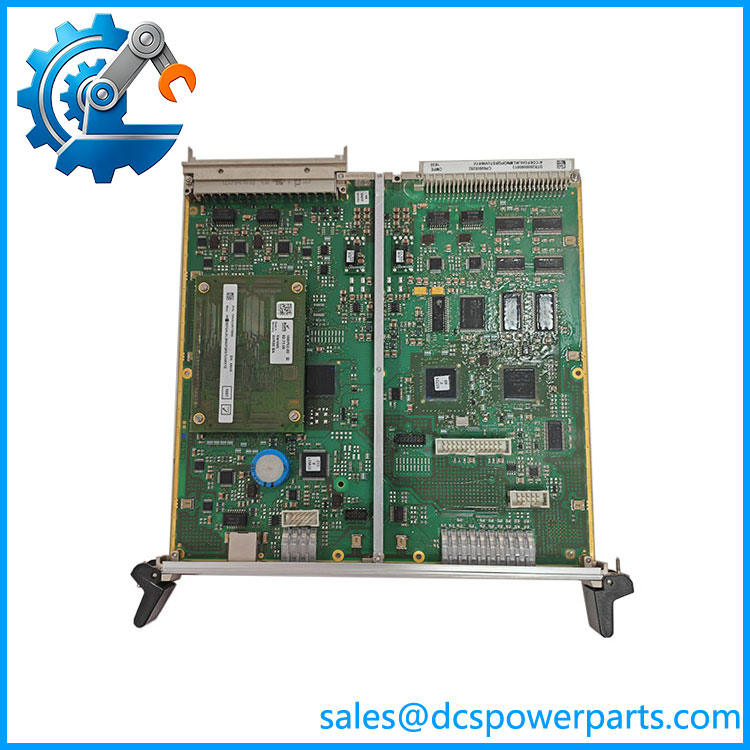
CMP1838
Key Features and Advantages
Three-layer identification that survives a bill-of-materials audit: names the board, TRVCO62345000 names the procured item, CP00005202 names the drawing. A spare sourced against all three can be reconciled with the plant’s own documentation. A spare sourced against the board code alone cannot, which is precisely how mismatched boards end up in cabinets.
Platform-level function class is documented, so the buying decision is defensible: the cabinet listings that name also name the STO1726KO1 I/O board and the CS-TX3 marshalling board, which brackets the card’s role as the control element rather than a signal-level device. That is enough to specify a replacement, and it is more than any of the conflicting datasheets offer.
Real-time control pedigree: the ALSPA 320 platform is cited in published control-engineering work as the implementation environment for R-S-T digital controllers and data-acquisition modules, with task cycles in the low milliseconds. A board from that rack sits in a deterministic control loop, not in a supervisory data path — which is the distinction that decides whether a substitute board is acceptable.
Backplane-bus architecture with fieldbus redundancy: the rack concentrates power and communication on a passive backplane, so the boards carry no separate power supply and no external network cabling of their own. In a plant control cabinet this reduces the number of failure points per loop and keeps the wiring harness confined to the front.
Euro-card mechanical standard: DIN 41612 connectors and guided insertion mean the board is located by the rack, not by the fitter. Extraction and insertion are repeatable, and a spare stored for a decade still mates correctly — a mechanical detail that matters more than it sounds when a cabinet is 25 years old.
Honest limits, stated as limits: there is no published schematic, no published memory map, no published channel count and no official end-of-life document for . Any figure beyond platform architecture should be treated as unverified. A supplier who cannot show the three-layer string on the board or on its label has not identified the part.
Applications
Thermal power unit control cabinets: the ALSPA P320 generation sits in the control room and the unit cabinet of coal, gas and oil-fired plants, running the governing, interlock and auxiliary control loops of the unit. is the control element in that rack, and its duty is the deterministic execution of those loops rather than data concentration.
Hydro plant unit control: gate logic, unit sequencing and auxiliary monitoring in older hydro stations built on Alstom power automation — a segment where the installed base outlived the supplier’s product line by a wide margin, and where spare boards are the only practical way to keep a unit on the bar.
Combined-cycle and gas turbine auxiliary control: the same platform family appears in combined-cycle cabinets handling auxiliary systems and unit interlocks, alongside dedicated turbine control electronics. When a board in the auxiliary rack fails, the turbine itself may still run; the plant’s availability problem is the interlock path, and that is what a spare restores.
Retrofit and life-extension programmes: plants operating ALSPA-era cabinets are routinely faced with a choice between a full control-system migration and a staged replacement of failed cards. The second path is only viable when the board can be identified against the plant’s own drawings — which is why the TRVCO62345000 / CP00005202 pair matters more in practice than the board code.
Where it does not fit: any application described in terms of traction converters, 3 kV catenary voltages, SIL 4 rail certification or electrostatic precipitator RF power. Those descriptions belong to other Alstom product lines and other Alstom part numbers, and boards procured against them will not match a rack.
Related Products
TRVCO62345000 — the equipment / order number under which is procured; required on any purchase enquiry. CP00005202 — factory drawing number for the same board; the layer that ties the physical card to Alstom’s documentation. STO1726KO1 (4022.437.1856) — digital input/output board used in the same ALSPA cabinet; the signal-level companion to the control board. CS-TX3-3.81X2.54-64TW — 64-channel signal transfer / marshalling board for the same cabinet, carrying field terminals on the front and a 64-pin connector to the I/O board on the back. N895609510K — a further ALSPA central processing assembly built as a carrier board with mezzanine sub-modules; a different CPU build of the same platform, not interchangeable with . MC1AB37 — DI/DO acquisition board referenced in the same cabinet listings as the control board. ALSPA rack and backplane assemblies — the mechanical and bus infrastructure the board depends on; a board without a healthy backplane is not a repair.
Installation and Maintenance
Before installation: confirm the three-layer identity on the board itself — silkscreen or label carrying , TRVCO62345000 and CP00005202 — and compare it against the plant’s cabinet drawings, not against a reseller’s title. Establish the hardware revision and firmware state of the board being replaced, because ALSPA-generation racks pair a control board with application software and with the I/O boards around it, and a board carrying a different revision can enumerate correctly and still refuse to run the application. De-energise the rack completely before extraction: this generation’s backplane connectors do not provide make-first-break-last grounding, so hot swap is not a supported operation on the platform. Take an application backup through the engineering station before touching anything, and record the DIP switch or address settings on the old board photographically.
Installation: wear a grounded wrist strap, release the extractor levers evenly rather than prying at one end, and slide the board on its guides until the DIN 41612 connector seats fully before tightening the retaining screws. Verify the backplane supply rails at the rack before first power-up — a control board that fails immediately after replacement is usually a backplane or regulator fault presented as a board fault. On power-up, watch for the platform’s run and fault indications, and confirm that the rack reaches a stable state instead of cycling.
Maintenance: keep the cabinet interior within its class temperature and treat filter fan failure as a control-system fault, not a housekeeping item. Re-seat nothing “to be safe” — every extraction on a 25-year-old connector is wear. Hold at least one verified spare against each cabinet in service, stored anti-static and labelled with its revision, because the supply channel for this generation is dismantled and refurbished stock rather than factory-new production, and matching a revision after a failure costs days the unit does not have.
Warranty and Quality
Every board is supplied as an Alstom ALSPA control-rack card and identified against all three reference layers before dispatch, with the board code, order number and factory drawing number reconciled against each other rather than against a reseller’s title. Units are inspected for connector condition on both the DIN 41612 backplane side and the front cable side, for extractor lever integrity, for PCB damage, rework evidence and corrosion, and for the presence of the correct revision marking; the board is checked for correct enumeration in a powered rack where a suitable test fixture is available. No electrical specification is asserted beyond what Alstom or GE published, and platform-level figures are stated as platform-level. A 12-month repair, replacement or refund commitment applies. Technical support is given at the level this part actually permits: decoding against and , distinguishing a cabinet board from Alstom rail and electrostatic-precipitator products, and explaining why the conflicting published datasheets for this board cannot all describe the same hardware.