Description
Product Overview
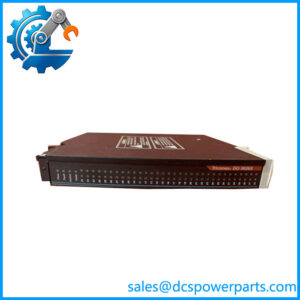
MP3101 is Model 3101, the main processor module of the Trident safety controller — one of the three CPUs that together make up a single logical controller. The architecture is the point of the part: each MP is an independent channel with its own processor, its own memory and its own I/O bus link, and the three of them scan the same application in parallel. At every scan the three compare their data across the TriBus, a proprietary high-speed bidirectional serial channel built for voting traffic. Nothing in the design depends on one processor being the master; the controller’s integrity comes from three channels that can disagree and be outvoted.
Each MP owns a channel of the TMR HDLC I/O bus, running at 2 megabits per second, with its own DB-9 connector per channel. That is why the I/O side of the platform is triplicated all the way to the field terminals: a discrete input card has three isolated sets of electronics, one per bus, and each transmits its data to the MP associated with that channel. The MPs vote the results before the application sees them. A single failed channel is an alarm and a degraded-but-operating controller, not a wrong answer.
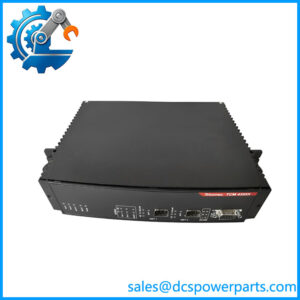
Two ports live on the module itself, and both are architecturally significant. One is an RS-232 or RS-485 Modbus port that provides a direct TMR connection to a DCS or other external host without any additional module in the rack. The other is a 10BaseT Ethernet port for the TriStation 1131 programming workstation. On this platform a controller can therefore be programmed, configured and connected to a host with nothing but its three MPs — no communication card required, which is the opposite of how the older Tricon generation is usually built, where a TCM normally carries the external links. Communication modules are added when more ports, more protocols, redundancy of links or network segregation are needed, not because the controller cannot talk without one.
Memory is published plainly: 16 MB of DRAM per MP, shared among the user-written application, the sequence-of-events buffer, I/O data, diagnostics and communication buffers. That figure defines the practical envelope of this platform. A Trident program is compact by modern DCS standards, and 16 MB is ample for logic, cause-and-effect and SOE capture — but it is a fixed envelope, not a scalable one, and application growth is a planning item rather than a purchase order.
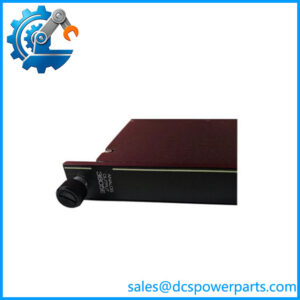
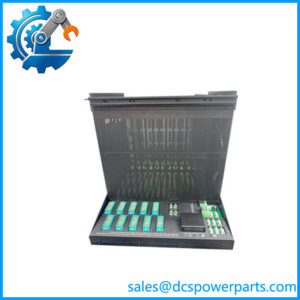
Physical and operational details matter at commissioning. The module carries a lock lever that indicates whether it is properly seated and locked on the baseplate, front-panel alarm indicators driven by fault-monitoring circuitry that is specified to detect all single faults and most multiple faults, and mechanical keying that prevents a wrong module being forced into a configured position. The MP baseplate itself is the wider 229 × 249 mm carrier, providing redundant fused 24 VDC logic power connectors; logic power taken there both operates the MPs and carries along the interconnect assemblies to the I/O baseplates, which is why an I/O column needs no separate supply of its own.
The packaged form is the 5101 Main Processor TriPak: three Model 3101 modules with one Model 2101 MP baseplate (ordering number 7400207-001, assembly 3000671-100). Three is not a quantity option. A Trident controller is three MPs, and the platform’s specifications also describe a dual mode in which the voted value passed to the application is the average rather than the mid-value — a mode that exists in the product literature, but not one to plan a new safety installation around.
System capacity follows from the I/O bus structure: up to fourteen I/O modules per controller, reduced to ten when analog output or pulse input modules are present. Baseplates connect end-to-end within a column, up to eight per column, with I/O bus length limited to 200 m and termination kits required beyond 6 m; further columns need extender modules. Those are MP-side constraints as much as carrier-side ones, because it is the MP’s bus channel that has to reach every position.
Where the market misreads this number, the error is usually structural rather than descriptive: the module is confused with the baseplate it sits on, so a buyer orders 2101 expecting a processor or 3101 expecting a carrier. The two numbers belong to different items in the same kit, and the kit number 5101 exists precisely to stop that confusion at the point of ordering.
Technical Specifications
| Parameter | Value |
|---|---|
| Model and platform | MP3101 — Triconex Model 3101 Main Processor Module; Trident (Trident v2) TMR safety controller |
| Module role | One voting channel of the controller; three MPs form one logical controller on a single MP baseplate |
| Memory | 16 MB DRAM per MP, covering user application, sequence of events, I/O data, diagnostics and communication buffers |
| Inter-processor bus | TriBus — proprietary high-speed, fault-tolerant, bidirectional serial channel; channels compare data every scan |
| I/O bus | TMR HDLC, 2 Mbit/s, one channel per MP with a DB-9 connector per channel |
| On-module ports | RS-232 or RS-485 Modbus port for direct TMR connection to a DCS or external host; 10BaseT Ethernet (IEEE 802.3) for TriStation 1131 |
| Logic power | 24 VDC nominal, 19.2–30 VDC range, supplied through redundant fused connectors on the MP baseplate; absolute maximum 33 VDC, reverse −0.6 VDC, 1 ms power interruption tolerance |
| Baseplate and packaging | Model 2101 MP baseplate, 229 × 249 mm, ordering number 7400207-001, assembly 3000671-100; packaged as the 5101 Main Processor TriPak (3 × 3101 + 2101) |
| Indication and keying | Lock lever showing correct seating and locking; front-panel alarm indicators from fault-monitoring circuitry detecting all single faults and most multiple faults; mechanically keyed |
| Bus limits and capacity | Up to 8 baseplates end-to-end per column; I/O bus ≤ 200 m (650 ft), terminators required beyond 6 m; up to 14 I/O modules per controller, 10 with AO or PI modules |
| Installation environment | 15 cm (5 in) minimum clearance between active modules and enclosure walls; MP and CM must be mounted in a metal enclosure for CE emission compliance |
| Related revisions | S2 revisions exist across this module family; match the revision marking on the label to the installed base before replacing an MP |
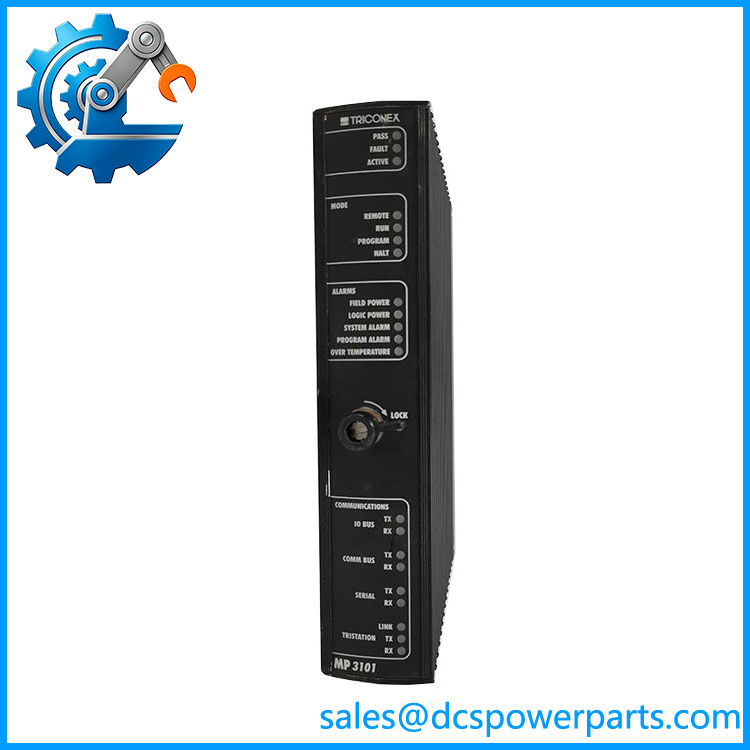
TRICONEX MP3101
Key Features and Advantages
Three CPUs, one controller, no master: each MP scans the application independently, and the three reconcile across the TriBus every scan. There is no single processor whose failure ends the run — that is the whole reason the platform exists.
Voting where it counts, not only in software: the triplicated I/O bus means each input card delivers three independent readings, one per MP, and the vote happens on data that already travelled separate paths. A fault in one channel’s electronics shows up as a disagreement rather than as a wrong value.
Programming and host links without a communication card: the Modbus port and the 10BaseT TriStation port live on the MP itself. Small skids and standalone packages can be engineered with three MPs and I/O only, and communication modules are then an expansion decision rather than a prerequisite.
Logic power distributed from the baseplate: redundant fused 24 VDC connectors on the 2101 feed the MPs and carry onward to every I/O baseplate through the interconnect assemblies. One power architecture for the column, no per-carrier supplies to fail.
16 MB stated honestly: enough for logic, cause-and-effect and SOE capture, finite for everything else. Treating that as a planning envelope rather than an unlimited resource is what keeps a controller from being re-engineered mid-life.
Front-panel diagnosis that names a channel: fault circuitry detects all single faults and most multiple faults, and the indicators report them at the module. Combined with the lock lever and mechanical keying, a maintenance technician can confirm seating and health without opening a drawing.
Clear capacity ceiling: fourteen I/O modules, ten with analog output or pulse input present, eight baseplates per column, 200 m of bus. Knowing the ceiling before the point list is frozen avoids discovering it during expansion.
Honest limits: this is not a hot-swap I/O card, its memory does not scale, and its dual-mode operating variant should not be treated as a design option for new safety work. The MP is the part of the system that gets engineered around, not field-replaced casually.
Applications
Emergency shutdown logic solving: the triplicated scan and vote is what allows a unit’s ESD matrix to be trusted between proof tests, with three independent channels reading the same triplicated input cards.
Burner management systems: burner sequencing and flame-failure timing executed in a controller whose three channels must agree before a fuel valve is permitted to open, on a platform small enough to sit inside a boiler house cabinet.
High-integrity pressure protection: fast, deterministic trip logic on a compact controller, where the direct Modbus link to the DCS carries the trip status without a separate communication module in the rack.
Fire and gas systems on remote or satellite facilities: three MPs, I/O carriers and a single 24 VDC supply architecture in a small enclosure, programmed over the on-board Ethernet port and reported to the control room over the on-board Modbus port.
Compressor and turbine package protection: overspeed and vibration trips handled on the same controller as the package’s shutdown logic, with pulse input modules counted against the ten-module ceiling that applies when AO or PI cards are present.
Legacy Trident spares and controller replacement: matching an MP3101 into an existing three-module set, where revision and firmware consistency across the triple matters more than the individual card’s condition.
DCS integration projects: pairing the MP’s Modbus port with communication modules only where link redundancy, protocol breadth or network segregation is genuinely required — rather than by default.
Related Products
2101 Main Processor Baseplate (7400207-001) — the 229 × 249 mm carrier for three MPs, with redundant fused 24 VDC logic power connectors; sold with the modules as the 5101 TriPak. 5101 Main Processor TriPak — three Model 3101 modules plus one 2101 baseplate; the only correct way to order a controller’s processor set. 3201 Communication Module with 2201 Communication Baseplate Kit (7400206-100) — adds serial and network ports, redundancy and protocol coverage beyond the MP’s own Modbus and TriStation links. 3301 Digital Input Module with 2301 Baseplate (7400208B-020 / 7400208C-020) — triplicated discrete input, one channel of data per MP. 3351 Analog Input Module with 2351 Baseplate (7400210-010) — 32 analog points, voted as mid-value in TMR mode and average in dual mode. 3401 Digital Output Module with 2401 Baseplate (7400209-030) — 16 discrete outputs voted through the platform’s hardware output voter. 3008 Main Processor Module (Tricon) and 4351B TCM — the previous platform generation; different chassis, different buses, not interchangeable with Trident MPs. 2921 I/O Interconnect Assembly and 2281 I/O Bus Extender Module Kit — the column link and the extender required beyond eight baseplates or 200 m of I/O bus.
Installation and Maintenance
Before installation: confirm the label reads MP3101 and not 2101, which is the baseplate, and confirm the revision marking matches the two modules already in service — a controller’s three MPs are a set, and mixing revisions or firmware across the triple is the failure mode that produces unexplained voting alarms. Check the lock lever and keying, verify the baseplate’s redundant 24 VDC feeds are both present and fused, and read the TriStation configuration to confirm the slot expects an MP before powering the position.
Installation: seat the module, engage the lock lever, and confirm the lever indicates locked. Bring up logic power and let the controller establish the TriBus and I/O bus links; verify that all three MPs reach the same state and that the I/O column enumerates fully rather than partially, because a missing position usually means a bus cable or terminator rather than a processor fault. Connect the TriStation workstation to the on-board Ethernet port and confirm module type, revision and firmware for all three, then archive the configuration as the as-built record. Where the I/O bus exceeds 6 m, fit terminators at both open ends before trusting enumeration.
Maintenance: treat MPs as a matched set. Keep a spare module of the same revision, not merely the same model number; replacing one channel of a triple with a different revision is a change to the controller, not a repair. Watch the front-panel indications and the controller’s fault log rather than the individual card alone: a channel fault is reported and outvoted, so the system keeps running and the fault is easy to postpone — which is exactly why the log should be reviewed on a schedule. Do not confuse MP replacement with I/O hot spare substitution; the I/O slots have a paired spare by design, the processor set does not, and the processor replacement procedure in the platform manual governs. Keep cabinet clearance at 15 cm around active modules and confirm the metal enclosure requirement is met where CE emissions compliance applies.
Warranty and Quality
Every MP3101 is supplied as the Triconex Model 3101 Trident Main Processor Module — one voting channel of a three-module controller, 16 MB DRAM, RS-232/RS-485 Modbus and 10BaseT Ethernet ports on the module, TMR HDLC I/O bus at 2 Mbit/s, TriBus inter-processor comparison every scan — and identity is confirmed by label, revision marking and firmware version before dispatch, because this number is routinely confused with the 2101 baseplate it seats on and because a controller’s three MPs must remain a matched set. Each unit is inspected for housing and front-panel condition, lock-lever and connector integrity, keying, indicator operation, battery- or capacitor-age indicators where present, and evidence of prior repair or heat damage. Where a Trident test chassis is available, the module is run as part of a three-MP set: controller boot and TriBus establishment, full I/O column enumeration, application download and scan verification, fault-injection response at the channel level, and confirmation that module type, revision and firmware read correctly through TriStation 1131. A 12-month repair, replacement or refund commitment applies. Technical support covers what this module actually raises: distinguishing 3101 from the 2101 carrier and from the 5101 kit, keeping a triple revision-matched, reading the on-board Modbus and TriStation ports against the platform’s communication-module options, and planning point counts and column length against the fourteen-module and 200 m bus ceilings.