Description
Product Overview
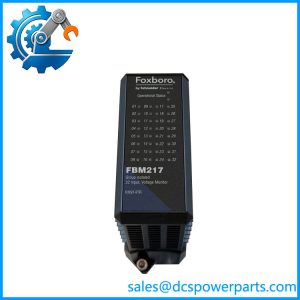
FBM231 P0926GV is a Field Device System Integrator module — the Foxboro answer to a problem that every brownfield plant knows: the DCS is modern, the instruments and packaged equipment around it are not, and half of them only speak a serial protocol. The four-port FBM231 sits between those devices and the control database, running a downloadable I/O driver that translates device data into DCI data types the control station can use directly. It is not an I/O card in the classic sense: there are no analog channels on the front, only serial links out to whatever the plant already owns.
The module belongs to the 200 Series Fieldbus Module family of the EcoStruxure Foxboro DCS and communicates upward over the redundant 2 Mbps module Fieldbus to an FCM100Et, FCM100E, FCP270 or FCP280 — the same path every 200 Series FBM uses. What distinguishes the P0926GV from its sibling FBM230 is redundancy and the dual-port assumption: FBM231 modules are deployed as a pair, one Master and one Tracker, each wired to its own termination assembly, serving field devices that present two ports. Input points in the control station follow the Master; output points, depending on the driver, are written by both modules. Role switching happens automatically when the I/O driver detects a real failure such as a lost heartbeat, and an engineer can also force the swap from SMDH.
The engineering value is in the port count and the per-port flexibility. Each of the four ports is configured in software for RS-232, RS-422 or RS-485 independently, so one card can serve, for example, two Modbus RTU analysers on RS-485, a gas chromatograph on RS-232 through a modem, and a dual-ported tank gauging system whose two cables are combined into a single logical port. That last capability is the one that repays the redundant configuration: ports 1 through 4 can be merged into one logical port with redundant cabling, which is exactly how dual-ported field devices are meant to be connected. For single-ported devices the official guidance is simply to use the non-redundant FBM230 instead.
Capacity is generous in the terms that matter for device integration. Up to 2 000 DCI block connections per module, up to 64 devices on RS-485 at 16 per port, and data that can be analog or digital — 2 000 analog values, or as many as 64 000 digital points when packed 32 to a connection, or any mixture across the four ports within the sizing limits of the control processor. Access frequency can be as fast as 500 ms, which sets the honest expectation: this is a device integration path for analyzers, skids, drives and meters, not a replacement for hardwired fast-trip I/O.
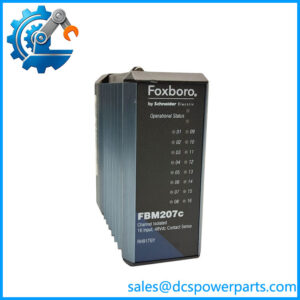
The card is a field-mounted, extruded-aluminium design rated for Class G3 harsh environments per ISA S71.04, 45 mm wide and 102 mm high, and it mounts on the same Modular Baseplate as the rest of the 200 Series — four or eight modules, DIN rail or 19-inch rack. No calibration is required, for the module or the termination assembly, which is the kind of detail that matters when a spare has to go in at three in the morning.
Technical Specifications
| Parameter | Value |
|---|---|
| Product ID | P0926GV |
| Model | FBM231 |
| Manufacturer | Foxboro (Schneider Electric) |
| Product type | Field Device System Integrator (FDSI) communication module, redundant |
| Serial ports | 4, each independently configurable in software |
| Interface standards | RS-232, RS-422, RS-485 (per port) |
| Baud rates | 300, 600, 1 200, 2 400, 4 800, 9 600, 19 200, 38 400, 57 600, 115 200 |
| Character format | 8-bit characters; odd, even or no parity; 1 or 2 stop bits |
| Capacity | Up to 2 000 DCI block connections; up to 64 RS-485 devices (16 per port) or 4 direct-connect RS-232/RS-422 devices |
| Data types | 2- or 4-byte signed/unsigned integers, 4-byte IEEE single-precision float, binary; packed digital up to 32 points per connection |
| Fastest ECB block period | 500 ms |
| Module Fieldbus | Redundant 2 Mbps, to FCM100Et / FCM100E / FCP270 / FCP280 |
| Channel isolation | Each channel galvanically isolated and earth-referenced; 600 V AC for 1 minute channel-to-earth withstand |
| Power requirements | 24 V DC +5 %/−10 %; 7 W maximum consumption; 7 W maximum heat dissipation |
| Dimensions (module) | 102 mm H (114 mm with mounting lugs) × 45 mm W × 104 mm D |
| Mass | 284 g (module); TA 363 g ring lug / 272 g compression screw |
| Termination assemblies | P0926PA (ring lug), RH926GH (compression screw, supersedes P0926GH) |
| Cable, module to TA | 1 m to 5 m, Type 5 |
| Field cabling limits | RS-232 up to 15 m (DB-25); RS-422/RS-485 up to 1 200 m |
| Mounting | Modular Baseplate, 4 or 8 FBMs; DIN rail or 19-inch rack, horizontal or vertical |
| Environment / enclosure | Field mounted, extruded aluminium, Class G3 harsh per ISA S71.04 |
| Compliance | EN 61326-1:2013 Class A; UL/UL-C Class I Div 2 Groups A–D T4; DEMKO Ex nA IIC T4 (Zone 2); ABS Type Approved; Bureau Veritas Marine EC31 |
| Calibration | Not required, module or termination assembly |
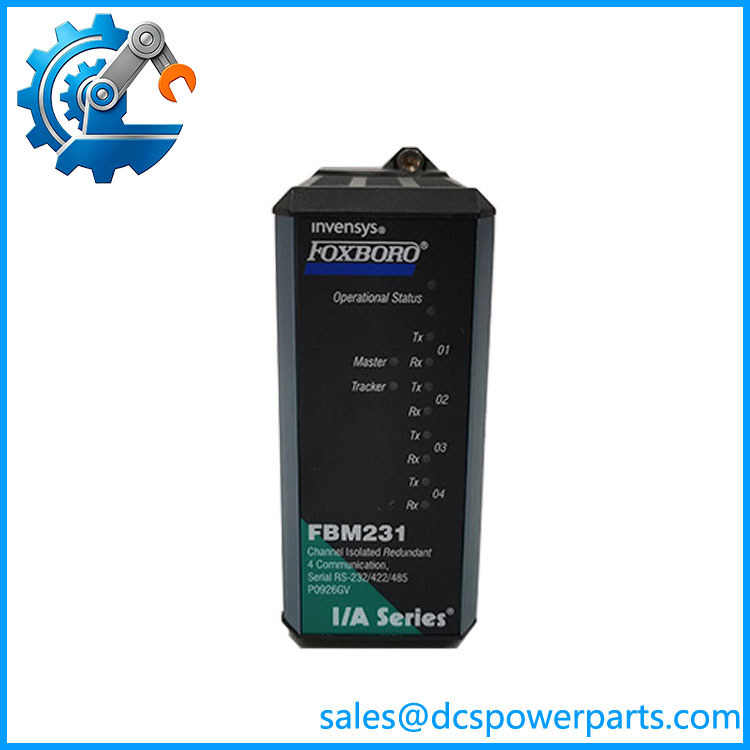
P0926GV FBM231
Key Features and Advantages
Redundancy that follows the device, not the card: the FBM231 pair exists because the field devices are themselves dual-ported. Master and Tracker each hold their own cabling to their own termination assembly, so a module can be pulled without removing field device termination cabling, power or communications cabling, and without disturbing the other module’s signals. That is a maintenance property, not a marketing phrase — it is the difference between a 20-minute swap and a unit shutdown.
Role switching with two paths: the I/O driver moves the Master role automatically on a detected problem such as a heartbeat loss, and an engineer can move it deliberately from SMDH. Both paths matter — the automatic one covers the failure nobody planned, the manual one covers the intervention somebody did plan.
Four protocols on one card, decided in software: RS-232, RS-422 and RS-485 are selectable per port, so a single P0926GV covers a mixed population of analyzers, meters, skids and drives. In a plant with forty serial devices of six different kinds, that collapses the spares list from a shelf of adapters to one module type.
Logical port merging for dual-ported devices: ports 1 through 4 can be combined into one logical port with redundant cabling, letting a dual-ported device be wired the way its vendor intended instead of through an external switch.
A capacity figure that survives scrutiny: 2 000 DCI block connections, 64 RS-485 devices, 64 000 packed digital points. Not every integration needs that, but the ones that do — a tank farm, a packaging line with dozens of small drives — do not have to be split across multiple cards.
Driver library instead of fixed firmware: the protocol lives in a downloadable I/O driver, so the same hardware serves Modbus RTU, vendor-specific serial protocols and DF1-style links without a hardware variant for each. It keeps the installed base upgradeable and the spare part number stable.
Isolation designed for plant wiring: every channel is galvanically isolated and earth-referenced, with a 600 V AC one-minute withstand between channel and earth. Foxboro states plainly that this is a withstand rating and not a permanent connection allowance — a useful discipline to keep in mind when a cabinet is rewired by someone in a hurry.
No calibration, no drift argument: neither module nor termination assembly needs calibration. The periodic work is inspection and driver management, not adjustment, which is what makes a serial integration path cheap to own over ten years.
Harsh-environment construction: extruded aluminium housing and G3 classification per ISA S71.04 place the FBM231 in field cabinets and shelters, not only in air-conditioned rooms.
Applications
Water and wastewater: integrating flow meters, chlorine analyzers, UV disinfection skids and packaged blowers over Modbus RTU into the plant DCS, where the instruments arrive with serial ports and the SCADA expects DCI points; the redundant pair suits unmanned sites where a module failure would otherwise mean a call-out.
Oil and gas gathering and terminals: tank gauging systems, gas chromatographs, odorant injection skids and burner management packages, frequently dual-ported and frequently serial. The FBM231’s logical-port merging is the direct answer to a dual-ported gauging head, and the 500 ms access rate is adequate for inventory and quality data.
Power generation balance-of-plant: boiler and turbine auxiliary packages — soot blowers, air compressors, water treatment, continuous emission monitoring — that expose serial interfaces and must land in the same control database as the rest of the unit. Redundancy at the module level keeps a comms card fault from becoming a reporting gap.
Chemical and pharmaceutical: batch skids and analysers whose vendor delivers a serial protocol and a manual, connected through a downloadable driver rather than a middleware PC; the 2 000-connection capacity covers a reactor train’s worth of small devices on one pair.
Pulp and paper and metals: drive systems, weigh scales, moisture gauges and quality scanners along the machine, integrated without replacing the devices — the classic brownfield case for FDSI hardware.
Where it should not be used: for single-ported devices, where the non-redundant FBM230 is the intended choice; for hardwired fast interlock signals, which belong on discrete I/O with deterministic scan; and for Ethernet-native devices, which belong on FBM232 or FBM233 rather than behind a serial converter.
Related Products
FBM230 — the non-redundant four-serial-port FDSI module; the correct choice for single-ported field devices. FBM233 (P0926GX) — redundant FDSI module with 10/100 Mbps Ethernet ports; same integration role over Ethernet instead of serial. FBM232 — non-redundant Ethernet FDSI variant of the same family. FCM100Et / FCM100E — fieldbus communication modules that host 200 Series FBMs on the module Fieldbus; the upward path for a P0926GV. FCP270 / FCP280 — control processors that can carry the module Fieldbus directly, without a separate FCM. P0926PA — termination assembly with ring lug terminals, three-tier compression terminals and per-port DIP-switch termination resistors. RH926GH — compression-screw termination assembly (supersedes P0926GH), the alternative TA for the same module. FBM228 — Foundation Fieldbus redundant interface module; different fieldbus, similar redundancy discipline. FBM222 — redundant PROFIBUS communication module, for plants standardising on PROFIBUS DP rather than serial devices. Modular Baseplate (4-slot / 8-slot) — the mounting platform shared across the 200 Series, DIN rail or 19-inch rack.
Installation and Maintenance
Before installation: confirm the application is genuinely a dual-ported one, because a redundant pair on a single-ported device is cost without benefit and the FBM230 is the intended module. Verify the baseplate has capacity for the pair, that each module has its own termination assembly and its own Type 5 cable of 1 m to 5 m, and that the field cabling suits the chosen interface — RS-232 within 15 m through the TA’s DB-25 connectors, RS-422 or RS-485 within 1 200 m on shielded twisted pair. Set the per-port termination resistors on the TA DIP switches, and for RS-232 use the 24-switch break-out bank to match the device’s pinout, including handshake lines if the device needs them. Confirm 24 V DC supply within +5 %/−10 % at 7 W per module.
Commissioning: load the correct I/O driver for the device protocol, then set baud rate and character format — 300 to 115 200 baud, 8-bit characters, odd/even/no parity, 1 or 2 stop bits — to match each device, not to what the previous cabinet used. Assign Master and Tracker in SMDH and verify heartbeat. Where ports are merged into one logical port for a dual-ported device, prove both cables before declaring redundancy, since a pair wired to one good and one dead cable will switch roles and then fail again.
Maintenance: no calibration is required for module or TA, so the routine is inspection — connector seating, shield and earth integrity, DIP switch positions after any cabinet work, and TA terminal condition. Track the driver version alongside the device firmware; most “module faults” on this card are protocol mismatches introduced by a device upgrade. Keep a spare P0926GV and one spare TA of the fitted type, and record whether the plant uses P0926PA or RH926GH, because the two are not interchangeable at the terminal. On a live swap, replace one module of the pair at a time and confirm the surviving module holds Master before touching the second.
Warranty and Quality
Every is supplied as a Foxboro 200 Series Field Device System Integrator module, with the part number confirmed against the official product specification PSS 41H-2S231 — module , ring-lug termination assembly P0926PA, compression-screw termination assembly RH926GH superseding P0926GH — so that the card, the TA and the cable are ordered as one coherent set rather than three guesses. Each unit is inspected for housing and connector condition, port pin integrity, corrosion, label legibility and evidence of prior rework, and where a bench arrangement is available it is powered at 24 V DC, its four ports are exercised against a serial device, and its module Fieldbus communication is verified before dispatch. A 12-month repair, replacement or refund commitment applies. Technical support covers the questions this module actually raises: choosing over FBM230 for dual-ported devices, merging ports into one logical port with redundant cabling, mapping RS-232 pinouts through the TA’s DIP switch bank, setting per-port termination on RS-485, sizing against the 2 000-connection and 64-device limits, and pairing the module correctly with FCM100Et, FCM100E, FCP270 or FCP280.
免费
今天 14:30