Description
Product Overview
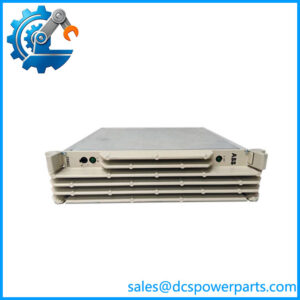
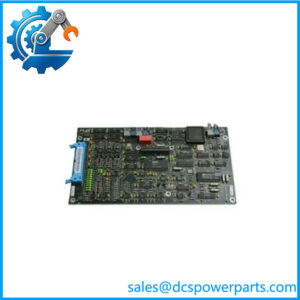
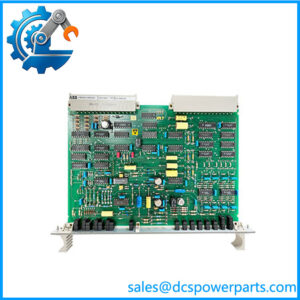
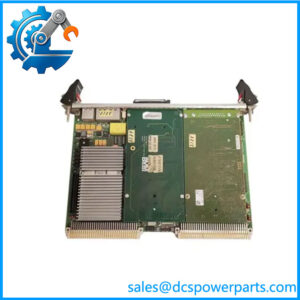
GFD233A103 3BHE022294R0103 has no ABB datasheet in public circulation, and the honest first statement is that its function is inferred rather than published. What is not in doubt is where the number lives. ABB’s 3BHE numbering is used for power-electronics hardware out of the System Drives and excitation organisation in Turgi, and the 3BHE0222xx block is the converter control rack of the current generation: the same block holds PP D113 processor boards (3BHE023584R2634), GDD830 gate-driver boards (3BHE022678R0105), and UCD240A01 converter control modules (3BHE022287R0001) used with UNITROL 6000 excitation. A board sitting at 3BHE022294 inside that block is a control-rack board on an AC 800PEC-based converter, not a field device.
That reading also explains the type designation. ABB labels these rack boards with a short three-letter functional code plus a number and a variant: GDD, GFD, UCD, PPD, and the item suffix — here 103 — distinguishes versions of the same function. Two numbers circulate under the same board name in the market, 3BHE022294R0101 and R0103, which is the familiar pattern of an engineering change: same board, later item, and not necessarily interchangeable without checking the drive’s documentation.
Two corroborating details point the same way. First, ACS6000’s control unit — the COU — is built around the AMC application and motor controller board, with fibre-optic communication to the phase modules and the S800 I/O station for peripherals. A board in that rack that carries optical links between control and power electronics is exactly what the architecture needs, and that is what resellers consistently, if vaguely, describe. Second, UNITROL 6000 excitation uses converter control modules in the same 3BHE0222xx block, so a board of this shape can serve both a drive cabinet and an excitation cabinet — which is why listings mention ACS6000 and excitation systems in the same sentence, sometimes confusing the two.
The market, however, has four incompatible stories for this number, and three of them can be excluded on structure alone. One calls it an analog I/O module for a static excitation controller, which does not match a 3BHE rack board. One calls it a door-unit power supply for 800xA and Symphony Plus with dual 100 Mbit Ethernet — a description assembled from a different product family entirely. One gives it a rated current of 230 A, a rated voltage of 690 V, a short-circuit breaking capacity of 100 kA and a “frame size 233 A”, which is a moulded-case circuit breaker datasheet wearing the wrong part number. One calls it a fieldbus gateway converting to PROFIBUS DP at 12 Mbps with two 820 nm ST fibre ports. The last is the closest to plausible in spirit — the board probably does carry fibre — but a 12 Mbps PROFIBUS master is not what a converter control rack boards does.
What survives as a defensible description is narrower and more useful: an ABB converter-control interface board, Euro-format, mounted in the control rack of an AC 800PEC-based drive or excitation system, supplied from the rack’s auxiliary 24 VDC, carrying high-speed links and signal conditioning between the controller and the power modules, with front-panel indication for commissioning and diagnosis, and paired in service with a processor board such as PP D113. Every one of those statements is inference from platform architecture and from the number’s neighbours, and this article labels it as such rather than presenting a reseller’s template as a specification.
The practical consequence is a procurement rule. This board is bought against a cabinet, not against a description: the drive’s own parts list — Appendix E in an ACS6000 project documentation set — identifies every component in the cabinet by part number, and the wiring diagram shows where each board sits. A GFD233A103 that matches that list is the right board; one offered with a 690 V rating on the listing is not the same product at all.
Technical Specifications
| Parameter | Value |
|---|---|
| Product ID | 3BHE022294R0103 |
| Type designation | GFD233A, item 103 (a 3BHE022294R0101 variant also circulates) |
| Manufacturer / organisation | ABB, Power Electronics (System Drives / excitation), Switzerland |
| Number block | 3BHE0222xx — AC 800PEC converter control rack boards |
| Platform (by block position) | ACS6000 medium-voltage drive control unit; UNITROL 6000 excitation; AC 800PEC-based converter control |
| Board class | Rack-mounted Euro-format control / interface board, front-panel indication |
| Function | Interface between converter control and power stage — signal conditioning and high-speed link to phase modules (inferred, not published) |
| Sibling boards in the same block | PP D113 processor 3BHE023584R2634; GDD830 3BHE022678R0105; UCD240A01 3BHE022287R0001 |
| Auxiliary supply | Rack auxiliary 24 VDC (reported by resellers; no official confirmation) |
| Interfaces | High-speed links to power modules and backplane communication to the processor board (inferred from platform architecture) |
| Official documentation status | No datasheet, no product page, no specification section located; ABB document lookup by part number returns nothing |
| Claims excluded by structure | 230 A / 690 V / 100 kA circuit-breaker data; door-unit 24 VDC power supply with dual 100 Mbit Ethernet; analog I/O module; PROFIBUS DP master at 12 Mbps |
| Identification route | Cabinet parts list (ACS6000 project documentation, Appendix E) plus wiring diagram device designation; PCB silkscreen type string; front-panel label |
| Lifecycle | No formal end-of-life notice located; the board is in service in installed ACS6000 and UNITROL 6000 cabinets |
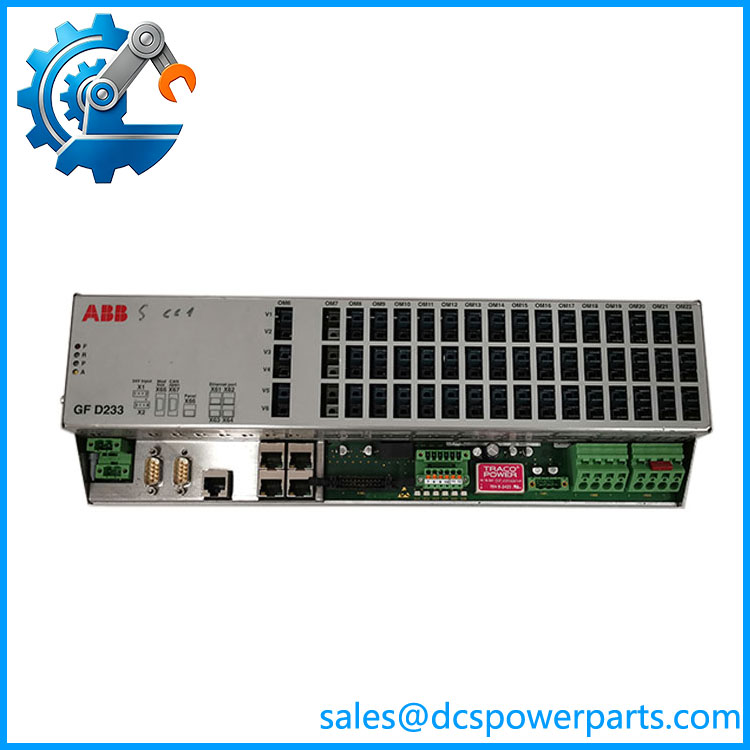
GFD233A103 3BHE022294R0103
Key Features and Advantages
A platform identity that can be defended: 3BHE0222xx is the converter-control block, and its neighbours — PP D113, GDD830, UCD240 — are documented board families on the same rack. That places this board in a real system, with real partners, without inventing a specification.
Structural exclusions do real work: a 690 V / 230 A / 100 kA rating belongs to a circuit breaker, not to a control board; a dual-Ethernet door-unit supply belongs to another product line; a 12 Mbps PROFIBUS master belongs to a fieldbus adapter. Ruling these out is how a buyer avoids paying for the wrong object.
Revision awareness built in: R0101 and R0103 circulate as the same board name. Treating the item suffix as a version to be matched against the cabinet documentation — rather than as a detail — is the difference between a working replacement and a board that fits but does not belong.
Fibre-based signal transfer as an architectural expectation: in an control unit the link to the phase modules is optical precisely because the power stage switches at medium voltage in a high-noise environment. A board in that role inherits the immunity of the link, and that is the plausible technical value it delivers — noise immunity, not protocol translation.
Cabinet-level documentation as the identification instrument: the drive’s parts list and wiring diagram name every board, and Appendix E of an project set exists for exactly this purpose. A board can be verified against the cabinet in minutes, without a datasheet.
Front-panel indication as a maintenance asset: rack boards in this class carry status LEDs that let a commissioning engineer confirm link health and board state from the front of the rack, which is how faults are localised before anyone reaches for a multimeter.
Honest limits: no published electrical specification, no confirmed supply voltage, no confirmed interface count, no lifecycle statement. Every operational figure in this article that is not structural is labelled as inference, and the article says so in each place where it matters.
Applications
Static excitation systems on UNITROL 6000 platforms: generator excitation cabinets where converter control boards manage firing and feedback to the power stage, and where the same 3BHE0222xx block appears alongside UCD240 converter control modules.
medium-voltage drive cabinets: the control unit of a drive feeding a mill main motor, a compressor or a mine hoist, where an interface board in this block carries signals and links between the controller and the phase modules.
Metals rolling mill main drives: high-torque, high-dynamic reversing duty on medium-voltage drives, an environment where the optical link between control and power electronics is the reason the control rack survives the electrical noise of the mill.
LNG and large compressor trains: synchronous motor drives on critical trains where a converter-control board fault is a production event and spares are held against the cabinet’s parts list rather than against a catalogue.
High-power rectifier and power-electronics installations built on AC 800PEC: plants that standardised on the PEC platform for converter control, where a mixed population of PP D113, GDD and GFD boards is normal and spares are managed by board type.
Where the number must not be used: as an analog I/O card, as a door-unit supply, as a fieldbus gateway, or as any device whose listing quotes 690 V and 100 kA. Those descriptions belong to other product classes, and a purchase against them ends with a board that matches nothing in the cabinet.
Related Products
PP D113 (3BHE023584R2634) — processor board in the same converter control rack; the partner board a GFD233A class interface works with. GDD830 (3BHE022678R0105) — gate-driver board in the same 3BHE0226xx block; the closest sibling in function and form. UCD240A01 (3BHE022287R0001) — converter control module of the 3BHE0222xx block used with UNITROL 6000 excitation. 3BHE022294R0101 — the earlier item of the same board name; verify the suffix against cabinet documentation before substituting. AMC circuit board ( control unit) — the application and motor controller at the heart of the drive control system, the board the interface ultimately serves. S-093H phase module (3BHB030478R0309) — the power-stage module on the other end of the link; note the 3BHB block is power semiconductors, a different numbering family from 3BHE control boards. S800 I/O modules with TB820 bus modem — the peripheral I/O of an control unit, a separate signal path from the converter interface. UNITROL 6000 excitation system — the second platform where this board block is used, which is why listings conflate drive and excitation applications.
Installation and Maintenance
Before installation: identify the board against the cabinet, not the listing. Read the type string and item suffix on the front panel and on the PCB silkscreen, then find that exact number in the drive’s parts list and confirm it against the wiring diagram’s device designation for the slot. Compare the fitted board’s suffix with the replacement: R0101 and R0103 are different items of the same name, and mixing them without checking the project documentation is the error that produces a board which physically fits and functionally does not belong. Photograph the fibre connectors and their assignment before removal.
Installation: isolate the control rack per the drive’s own procedure — converter control racks are not field I/O and are not hot-swapped on the bench assumption. Handle fibre ends with the caps on, keep the optical faces clean, and route fibres without bending them tighter than the drive documentation allows. Seat the board fully in its slot, confirm the front-panel indication at power-up, and verify link health from the control panel before returning the drive to service. Record the board’s type string, suffix and slot in the maintenance log, because that record is what makes the next replacement a lookup rather than an investigation.
Maintenance: keep spares matched to the cabinet’s parts list, by suffix, and keep one copy of that parts list with the spares — a board without its documentation is a board nobody can install with confidence. On planned outages, inspect fibre connectors for contamination and the rack for fan and filter condition, since optical links fail at dirty faces far more often than at the board. When a channel or link faults, prove the fibre and the partner board first: swapping a GFD233A103 to chase a fault caused by a contaminated connector is a common and expensive habit. Where the board is genuinely at fault, replace it and retain the failed unit for repair rather than discarding it — these boards are repaired, not manufactured, and the population is finite.
Warranty and Quality
Every GFD233A103 3BHE022294R0103 is supplied as an ABB converter-control interface board of the 3BHE0222xx block, with its type designation and item suffix confirmed from the front panel and the PCB silkscreen before dispatch, because this number circulates online as an analog I/O module, as a door-unit power supply with dual Ethernet, as a 230 A / 690 V circuit breaker and as a 12 Mbps PROFIBUS gateway — descriptions that belong to other product classes and none of which matches a rack board from an AC 800PEC converter cabinet. Each unit is inspected for board damage, connector and fibre-port condition, front-panel and label legibility, corrosion, evidence of prior rework, and for the suffix match against the customer’s cabinet parts list or supplied sample. Where a test rack is available, the board is powered in its slot, its front-panel indication and link status are verified, and its communication with the processor board is confirmed before return to service. A 12-month repair, replacement or refund commitment applies. Technical support covers what this number actually raises: placing 3BHE022294 in the 3BHE0222xx converter-control block alongside PP , GDD830 and UCD240, distinguishing the 3BHE control-board family from the 3BHB power-semiconductor family, treating R0101 and R0103 as different items of one board name, and using the drive’s parts list and wiring diagram as the identification instrument instead of a marketplace description.
免费
今天 14:25