Description
Key Technical Specifications
| Parameter | Specification |
|---|---|
| Manufacturer | MTL / Eaton MTL |
| Model | MTL831B |
| Product Type | Intrinsically Safe Analog Multiplexer Transmitter |
| Product Family | MTL830 Range |
| THC / mV Inputs | Up to 16 |
| RTD Inputs | Up to 15 |
| Input Types | Thermocouple, mV, potentiometer, 2/3/4-wire RTD |
| mV Measuring Ranges | ±10 mV, ±25 mV, ±60 mV, auto-ranging |
| RTD Range | -200 to +850°C, Pt100 |
| RTD Excitation | 100 µA |
| THC Accuracy at 20°C | <0.1% of measuring range ±0.7°C |
| mV Accuracy at 20°C | <0.1% of measuring range |
| RTD Accuracy at 20°C | <0.1% of measuring range |
| Data Highways | Dual redundant |
| Highway Function | Signal and power transmission |
| Power Source | Loop-powered through data highway |
| Typical Response Time | Approximately 1 s per transmitter |
| Hazardous-Area Rating | Zone 0, IIC, T4 |
| Operating Temperature | -20°C to +60°C |
| Storage Temperature | -40°C to +80°C |
| Typical Highway Distance | Up to 3 km, application dependent |
The official MTL documentation specifies 16 THC or mV sources, or 15 RTD/mixed inputs, with selectable input terminals. Each terminal block can be configured for mixed mV/THC, 2- or 4-wire RTD, or 3-wire RTD operation.
The transmitter does not require a separate hazardous-area power supply. Power is carried through the data highway from the receiver side.
Application Scenarios & Pain Points
Hazardous-area temperature measurement becomes difficult when every sensor needs an individual pair or multipair cable routed back to the control room. Cable count, intrinsic-safety interfaces, marshalling space, and maintenance time all increase quickly.
Typical Applications
- Petrochemical Processing: Multiple thermocouples and RTDs around vessels, heat exchangers, and process equipment can be concentrated into one MTL831B transmitter rather than individually routed over long distances.
- Refinery and Chemical Units: The Zone 0 capability allows the transmitter to be installed close to the field sensors, reducing the amount of hazardous-area signal wiring.
- Tank Farms and Process Heating: Mixed temperature inputs can be accommodated because the transmitter supports thermocouples, millivolt sources, and different RTD wiring arrangements.
- Existing MTL830B Installations: The MTL831B was part of the MTL830B multiplexing architecture, normally operating with an MTL838B receiver. Eaton now identifies the MTL830B family as discontinued and points users toward the MTL830C family as the replacement platform.
Field Case:
A common maintenance mistake is to replace an MTL831B transmitter without checking the receiver and highway arrangement. The transmitter may power through the highway and appear healthy, yet the control system can still show missing data if the MTL838B receiver, isolator, configuration, or highway wiring is incorrect.
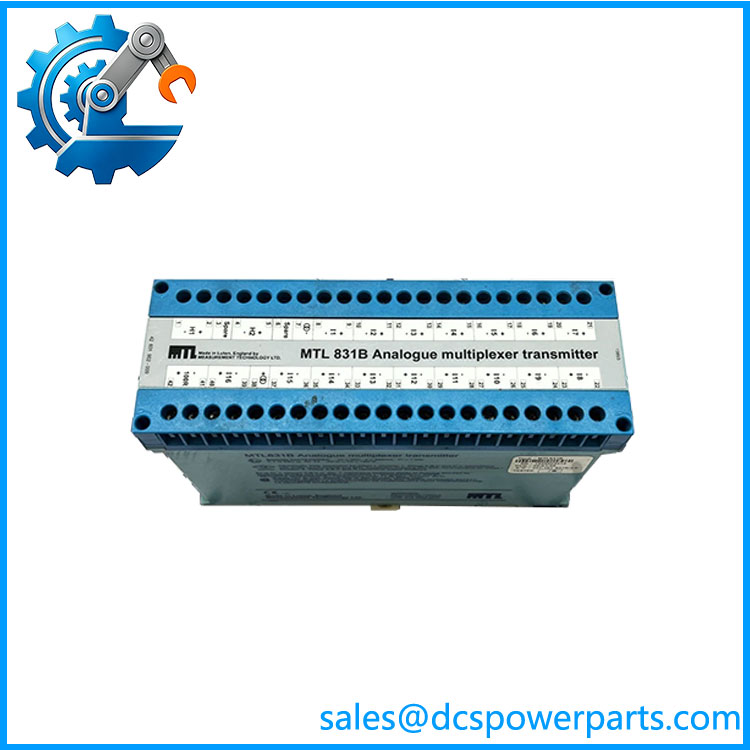
MTL831B
Related Products
- MTL MTL831C — The current successor to the MTL831B within the newer MTL830C family. It is the first model to investigate for a modernization project, but replacement should be treated as a system-level migration, not simply a blind card swap. Eaton identifies MTL831C as the replacement family for the discontinued MTL831B.
- MTL MTL838B-MBF — Modbus receiver for the system. It receives the transmitter data and provides an RS485/RS422 Modbus interface to the control system.
- MTL MTL838B-HON — Receiver variant intended for Honeywell LLMUX applications. It serves a different control-system interface than the Modbus-oriented MTL838B-MBF.
- MTL MTL3052 — Digital isolator used between hazardous-area transmitters and the safe-area data-highway infrastructure when required by the installation. The manual specifically describes the use of MTL3052 isolators for hazardous-area installations.
- MTL MTL832 — Another MTL830-series multiplexer transmitter designed for different input applications. It should not be treated as a direct replacement because the input signal architecture is different.
- MTL MTL830C System — Newer multiplexing platform intended to replace the discontinued MTL830B system. For a plant migration, evaluate the transmitter, receiver, isolators, configuration, and control-system interface together.
- MTL ENC8 / ENC8-SS — Enclosure options referenced for MTL830 transmitters when additional environmental protection is required. The itself can be mounted on 35 mm DIN rail or a flat surface.
The Engineer’s Guide: Field Pitfalls to Avoid
⚠️ Do Not Treat as a Standalone RS485 Temperature Module
The does not simply provide an ordinary RS485 temperature output. Its data highways carry multiplexed measurement data and power to a compatible receiver.
How to avoid it: Identify the complete architecture:
Sensors → → MTL3052 where required → Data Highway → MTL838B Receiver → Control System
The receiver determines the final control-system interface.
⚠️ Do Not Mix Sensor Types Without Checking Terminal Configuration
The transmitter supports mixed inputs, but the individual input terminals are user-selectable. RTD wiring is especially easy to get wrong because 2-, 3-, and 4-wire arrangements have different termination requirements.
How to avoid it: Record every terminal’s switch configuration before removing the old transmitter. For a mixed RTD/thermocouple installation, verify the channel configuration one point at a time.
⚠️ Do Not Assume the Old Certification Automatically Covers a New Installation
The has documented intrinsic-safety approvals for hazardous-area use, including Zone 0/IIC/T4 applications.
How to avoid it: Verify the actual nameplate, approval marking, entity parameters, installation drawing, isolator arrangement, and site hazardous-area classification. This is particularly important when purchasing older surplus equipment.
Frequently Asked Questions (FAQ)
What is the used for?
The is an intrinsically safe analog multiplexer transmitter for hazardous-area temperature measurement. It collects thermocouple, millivolt, and RTD signals and transmits the measurements over a data highway to an receiver.
It is particularly useful when many temperature points need to be brought out of a hazardous area without running a dedicated long-distance cable for every sensor.
How many temperature inputs does the support?
The published specification gives:
- Up to 16 THC or mV sources
- Up to 15 RTD or mixed inputs
The actual number depends on the sensor type and wiring arrangement.
Can RTDs and thermocouples be mixed on one ?
Yes. The documentation specifically states that each input terminal block is user-selectable and supports mixed mV/THC, 2- or 4-wire RTD, and 3-wire RTD configurations.
The important part is configuration. A physically correct sensor connected to a terminal configured for another input type will not produce a trustworthy measurement.
Does the need a 24 VDC power supply?
Not directly in the usual MTL830 architecture. The published specification states that the is loop-powered through the data highway from the receiver, so a separate hazardous-area power supply is not required.
This is one reason the MTL830 architecture can reduce field wiring.
Can I connect an directly to a PLC or DCS?
Not as a conventional standalone analog input device. The normal architecture uses an to translate the multiplexed transmitter data into the required control-system interface. The -MBF, for example, provides Modbus communication over RS485/RS422.
So when replacing an , check the receiver model as well.
Is the still manufactured?
The MTL830B system is a legacy/discontinued product family. Eaton’s discontinued-product support information identifies the under the MTL830 range and points to the MTL830C family as the replacement platform.
For an existing plant, an original may still be the more practical spare when the objective is to maintain the installed system without performing a broader migration.
What should I check when buying a used or surplus ?
For a hazardous-area spare, request:
- Actual nameplate photograph
- Complete identification
- Serial/date information
- Intrinsic-safety approval markings
- Terminal-block condition
- Configuration-switch condition
- Evidence of powered functional testing
- Highway communication test results
- Confirmation of the associated receiver model
- Warranty and test documentation
For this particular device, authenticity and approval marking matter as much as basic electrical operation. A transmitter that powers up on a bench is not automatically suitable for installation in a Zone 0 application.