Description
Product Overview
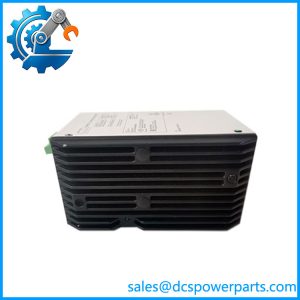
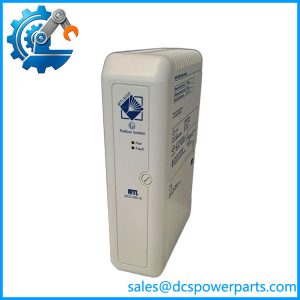
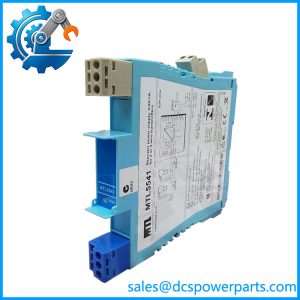
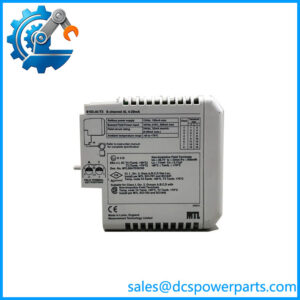
The MTL MTL5514D is a single-channel intrinsic safety switch and proximity detector interface designed for hazardous-area signal isolation applications. Part of the MTL5500 isolator family, the module allows a switch or NAMUR proximity detector located in a classified area to control two independent safe-area relay outputs. The MTL MTL5514D provides electrical isolation between field devices and control equipment while maintaining reliable discrete signal transmission for process automation, safety systems, and industrial monitoring applications.
Built for demanding process environments, the MTL5514D accepts input signals from Zone 0 hazardous locations and provides two single-pole changeover relay outputs in the safe area. The module supports line fault detection (LFD), allowing maintenance teams to identify open-circuit and short-circuit conditions in field wiring when the feature is enabled. Phase reversal selection is also available through configuration switches, providing flexibility when integrating different proximity detector arrangements. The unit operates from a 20–35 VDC supply and consumes approximately 29 mA at 24 VDC.
The MTL MTL5514D is commonly installed between hazardous field equipment and PLC, DCS, SIS, or relay-based control systems. Typical applications include valve position monitoring, speed detection, rotating equipment feedback, burner management signals, and emergency shutdown interfaces. Replacement planning should include verification of the sensor type, relay contact requirements, hazardous-area certification requirements, and existing cabinet wiring. To be completely transparent, intrinsic safety interfaces are highly dependent on the complete loop design; replacing the module without checking the safety documentation can create compliance issues even when the electrical connections appear identical.
Product Introduction (Non-Templated)
When a hazardous-area proximity switch must communicate with a control system without compromising area classification requirements, the interface module becomes a critical part of the signal chain. The MTL5514D provides that connection through intrinsic safety isolation and relay-based signal duplication.
Designed for Zone 0 applications, this 1-channel module delivers two changeover relay outputs, selectable line fault detection, and a 10 ms maximum response time for industrial monitoring and shutdown-related circuits.
Key Technical Specifications
| Parameter | Value |
|---|---|
| Product Model | MTL5514D |
| Manufacturer | MTL Instruments / Eaton Crouse-Hinds |
| Product Type | Switch / Proximity Detector Interface |
| Series | MTL5500 Intrinsic Safety Isolators |
| Number of Channels | 1 Channel |
| Input Type | NAMUR proximity detector / switch input |
| Hazardous Area Location | Zone 0, IIC, T6 applications |
| Sensor Supply | 7–9 VDC from 1 kΩ ±10% |
| Power Supply | 20–35 VDC |
| Safe Area Output | Two single-pole changeover relay contacts |
| Relay Contact Rating | 250 VAC, 2 A; 40 VDC, 2 A resistive |
| Response Time | ≤10 ms |
| Line Fault Detection | Selectable via side switches |
| Phase Reversal | Selectable |
| LED Indicators | Power, channel status, LFD alarm |
| Power Consumption | Approx. 0.7 W at 24 VDC |
| Safety Rating | SIL capable according to IEC 61508 assessment |
| Mounting | 35 mm DIN rail |
| Condition | New Surplus, Factory Sealed |
Related Products
- MTL5514 — Similar single-channel switch/proximity detector interface with relay output and line fault detection. The adds duplicated relay outputs for applications requiring two safe-area receiving circuits.
- MTL5514-T — Temperature-certified variant of the MTL5514 family. Used where the installation requires a specific environmental or application approval.
- MTL5516C — Two-channel digital input interface with changeover relay outputs. Suitable when multiple discrete signals are required in a single module position.
- MTL5517 — Two-channel digital input relay interface with line fault detection capability. Used for monitoring multiple field contacts.
- MTL5513 — Two-channel digital input interface with solid-state outputs instead of relay contacts. Selected when faster electronic switching is preferred.
- MTL5501-SR — Failsafe solid-state digital input interface with LFD capability. Used in safety applications where relay outputs are not required.
- MTL5526 — Two-channel switch-operated relay interface. Designed for discrete switching applications without the same proximity detector interface function.
- MTL5544D — Dual-output transmitter repeater module for analog transmitter signals. Used for 4–20 mA applications rather than discrete proximity inputs.
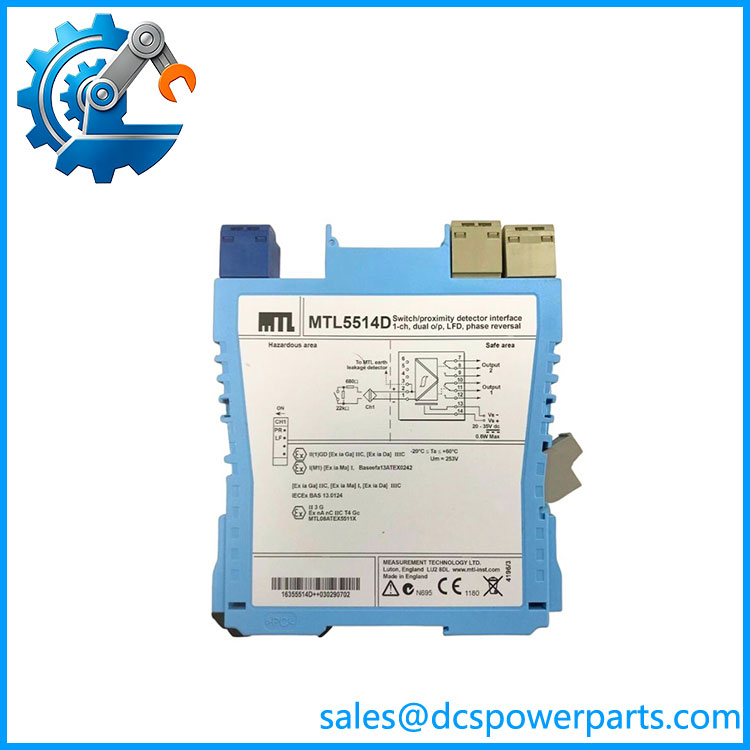
MTL5514D
Frequently Asked Questions (FAQ)
1. Is the compatible with my existing SIS or DCS system?
The can interface with many PLC, DCS, and SIS platforms because it provides relay contacts rather than a proprietary communication protocol.
Before replacement, verify:
- Existing hazardous-area sensor type
- Relay contact requirements
- Safety loop documentation
- Cabinet power supply voltage
- Required certification approvals
The complete signal loop must be reviewed, not only the module part number.
2. Can I hot-swap this?
The is DIN rail mounted, but live replacement depends on site procedures and hazardous-area installation rules.
Typical checks:
- Confirm the circuit is approved for maintenance
- Verify safe-area isolation requirements
- Remove field and supply connections according to procedures
- Install replacement module
- Test relay operation and field signal response
3. Does the support firmware v3.1?
No firmware version applies in the same way as a PLC or DCS controller.
The is a hardware signal interface device. Compatibility depends on:
- Electrical input characteristics
- Relay output requirements
- Hazardous-area certification
- Loop design
4. Will I lose my control logic when replacing the ?
No. The does not store application logic.
After replacement, verify:
- Relay contact operation
- Input sensor response
- Alarm behavior
- PLC/DCS/SIS input status
The control application remains in the connected controller.
5. How can I verify a New Surplus is authentic?
Recommended checks:
- Confirm model marking
- Inspect DIN rail housing condition
- Verify terminal labels
- Check certification markings
- Review available inspection records
For hazardous-area equipment, physical condition and certification information are important before installation.
6. Can the support a legacy replacement project?
Yes, it is commonly used for maintaining existing intrinsic safety signal interfaces.
Typical replacement scenarios:
- Failed proximity detector interface
- Relay output restoration
- Hazardous-area cabinet maintenance
- SIS loop repair
The existing safety documentation should be reviewed before commissioning.
7. What should engineers check before commissioning the ?
Key verification points:
- Confirm sensor compatibility
- Check hazardous-area wiring
- Verify supply voltage
- Test relay output states
- Confirm LFD settings
- Validate PLC/DCS/SIS indications
These checks help ensure the field device signal is correctly transferred into the control system.