Description
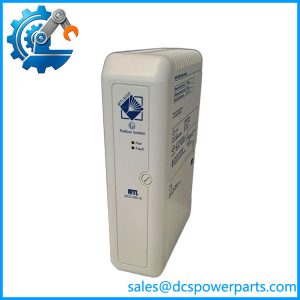
MTL MTL4544AS Two-Channel Current Repeater
Key Technical Specifications
| Parameter | Specification |
|---|---|
| Model | MTL4544AS |
| Manufacturer | MTL / Eaton |
| Product Family | MTL4500 |
| Product Category | Intrinsic Safety Isolator |
| Function | Current Repeater |
| Number of Channels | 2 |
| Input | Passive 4–20 mA |
| Transmitter Type | Separately powered / 4-wire transmitter |
| Output | 4–20 mA current sink |
| Maximum Current-Sink Load | 600 Ω |
| Maximum Safe-Area Voltage Source | 24 VDC |
| HART | Supported, bidirectional |
| Supply Voltage | 20–35 VDC |
| Power Consumption | Approx. 70 mA at 24 V with 20 mA signal |
| Transfer Accuracy | Better than 20 µA at 20°C |
| Temperature Drift | <1 µA/°C |
| Response Time | Settles within 200 µA of final value after 20 ms |
| Safe-Area Output Resistance | >1 MΩ |
| Safety Capability | SIL 2 single-device architecture; SIL 3 in suitable redundant configuration |
| Hazardous Area Application | Suitable for certified Zone 0/IIC applications |
| Status Indication | Green power LED |
The MTL4544AS differs from the MTL4544A primarily at the safe-area output: the AS version operates as a current sink, while the standard A version drives current into the load. That distinction is important when replacing one with the other.
Eaton’s current certification database continues to list MTL4544AS within the MTL4500 intrinsic-safety isolator family, including current IECEx and UKEX certification records.
Product Introduction
The MTL4544AS is a two-channel intrinsic-safety current repeater for separately powered 4–20 mA transmitters. It provides signal isolation between hazardous-area transmitter circuits and the safe-area control system while permitting bidirectional HART communication through the analog loop.
Its current-sink output makes the MTL4544AS different from the MTL4544A. The safe-area receiving device must therefore be compatible with a sinking 4–20 mA signal. This is not a generic analog signal isolator that can be substituted solely on the basis of channel count and current range.
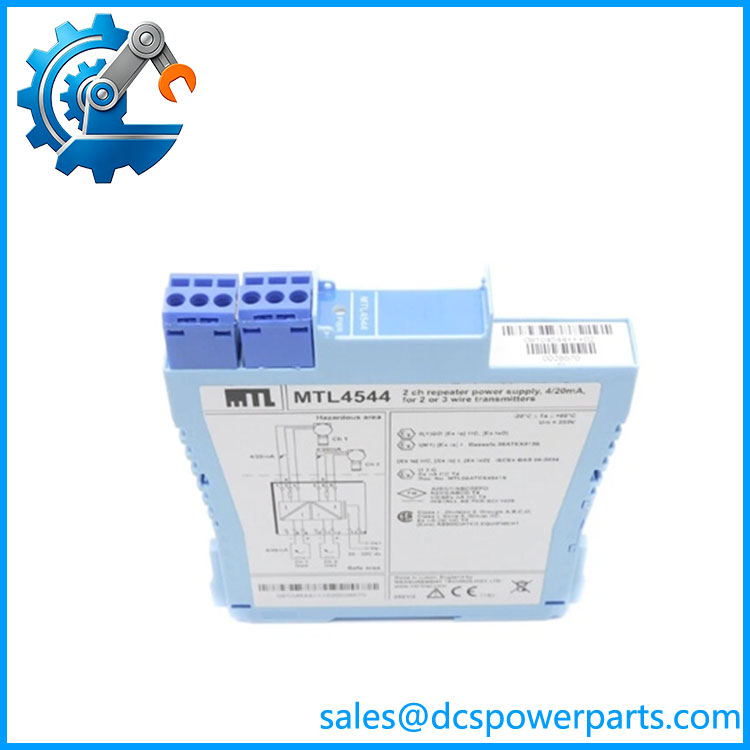
MTL4544AS
Application Scenarios & Field Pitfalls
The is normally found where hazardous-area transmitter signals have to cross an intrinsic-safety interface before reaching a DCS, PLC, recorder, indicator, or other safe-area system.
Typical applications:
- Hazardous-area 4–20 mA transmitter interfaces
- Process pressure, temperature, flow, and level transmitters
- HART-enabled instrumentation loops
- Oil and gas process facilities
- Chemical and petrochemical plants
- Legacy MTL intrinsic-safety interface cabinets
Engineer’s checks before replacement:
- Confirm the transmitter wiring. The is intended for passive-input interfacing with separately powered transmitters. It should not automatically be substituted for an MTL4544, MTL4544S, or MTL4544A without checking the transmitter loop architecture.
- Check the current-sink requirement. This is the most commonly overlooked distinction. does not provide the same safe-area output behavior as MTL4544A. Confirm that the receiving analog input or load is designed for a current-sink source.
- Verify HART loading. The unit passes HART communication superimposed on the 4–20 mA signal. HART communication performance depends on the complete loop impedance and connected devices, not just the isolator.
- Do not bypass intrinsic-safety calculations. Zone classification, entity parameters, cable characteristics, grounding, and associated apparatus requirements must be checked as part of the complete IS loop.
- Check the 20–35 VDC supply. The supply terminals are separate from the signal terminals. Incorrect supply voltage or polarity can prevent normal operation or damage associated equipment.
- Verify the safety architecture. The has functional-safety capability, but SIL capability applies to the complete safety loop and architecture. Installing a SIL-capable isolator alone does not make an instrumented function SIL-rated.
Related Products
- MTL4544A — Two-channel passive-input transmitter repeater; similar hazardous-area application but uses a driven safe-area output rather than the AS current-sink configuration.
- MTL4544S — Two-channel 2/3-wire transmitter repeater with current-sink output; transmitter power/interface architecture differs from the 4544AS.
- MTL4544 — Two-channel 2/3-wire transmitter repeater for conventional and smart transmitters.
- MTL4541AS — Single-channel version of the passive-input current-sink concept.
- MTL5544AS — Related MTL5500 version with the corresponding two-channel passive-input/current-sink function.
- MTL4546S — One-channel HART isolating driver for 4–20 mA analog output applications; function is different from the input/repeater role.
- MTL4549 — Two-channel smart isolating driver for analog output applications.
- MTL4599 — Dummy isolator used for unused positions rather than signal conditioning.
MTL’s product selector specifically distinguishes the 4544A, 4544AS, 4544S and related models by transmitter wiring, passive-input behavior, and current-sink function.
Procurement Note
For replacement, specify rather than simply “MTL4544.” The suffix AS is functionally significant because it identifies the passive-input, current-sink version.
Before installation, record the existing transmitter wiring, safe-area receiving-device type, HART requirements, power supply, hazardous-area classification, and IS loop calculations. A physically similar MTL module can have a materially different signal interface.
For safety-related service, use the applicable MTL safety manual and certification documentation for the complete loop rather than treating the module’s SIL capability as a standalone system rating.