Description
MOOG 800-336-2112 — Industrial Slip-Ring Assembly
Product Overview
The MOOG 800-336-2112 is identified in industrial parts listings as a slip-ring coil assembly used to transfer electrical connections across a rotating interface. A slip ring allows electrical power or signals to pass between stationary and rotating sections without requiring cables to twist continuously as the equipment turns. This function is useful in machinery where a rotating platform, shaft, indexing mechanism, or other moving assembly must retain electrical connections during operation. Unlike an electrohydraulic servo valve, this component is an electromechanical rotary connection assembly; its purpose is to maintain electrical continuity rather than regulate hydraulic flow.
Supplier descriptions associate the MOOG 800-336-2112 with a through-bore design and report a 1.5-inch central opening. A through-bore arrangement can accommodate a shaft or other equipment passing through the center, subject to the actual assembly’s mechanical dimensions and installation requirements. Fiber-brush contact technology is also described in supplier listings. However, available listings do not consistently identify the same AC-series designation, so the precise family and configuration should be verified from the physical nameplate or original equipment documentation. The base part number alone is not sufficient to establish every mechanical and electrical specification.
For maintenance and procurement teams, the MOOG 800-336-2112 should be selected against the installed unit’s actual requirements. The number of circuits, current per circuit, operating voltage, signal characteristics, rotational speed, lead length, mounting arrangement, and environmental sealing all affect suitability. Do not rely on specifications copied from another slip-ring assembly in the same family without checking the exact configuration. Before installation, inspect the housing, leads, contacts, and mounting surfaces; verify electrical continuity and insulation using an approved procedure; and confirm that the assembly can operate within the machine’s speed and electrical limits. These checks help prevent connection faults, premature contact wear, and avoidable downtime in rotating machinery.
Product Introduction — Practical Field Focus
The MOOG 800-336-2112 is relevant to equipment that needs electrical power or signal transfer across a rotating joint. The through-bore design reported by suppliers may suit machinery with a central shaft or passage, but the installed dimensions must be confirmed before replacement.
For procurement, request clear photographs of the part label and connections, the exact circuit configuration, and any available inspection or test records. For maintenance, verify continuity, insulation, lead routing, mechanical alignment, and the permitted rotational speed before returning the equipment to service.
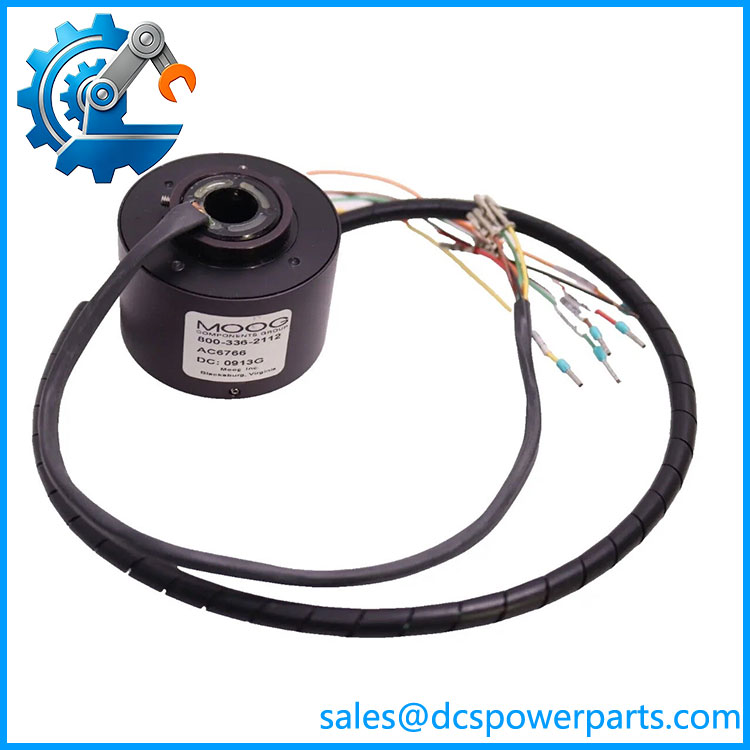
MOOG-800-336-2112
Key Technical Specifications
| Parameter | Details |
|---|---|
| Product Model | 800-336-2112 |
| Manufacturer | Moog Components Group |
| Product Type | Industrial slip-ring coil assembly |
| Primary Function | Electrical power and signal transfer across a rotating interface |
| Associated Series | AC4598 is cited by one supplier; exact family designation requires verification |
| Through-Bore Diameter | 1.5 inches reported by a supplier |
| Contact Technology | Fiber brush, as described in supplier listings |
| Number of Circuits | Confirm from the installed unit’s label and documentation |
| Current Rating | Verify for the exact circuit configuration |
| Working Voltage | Verify against the applicable assembly drawing |
| Maximum Rotational Speed | Verify against the applicable assembly drawing |
| Mounting Arrangement | Confirm from the physical unit and original installation drawing |
| Lead Configuration | Confirm wire count, gauge, length, and connector arrangement |
| Environmental Protection | Confirm sealing and environmental limits for the installed version |
| Typical Applications | Rotary tables, industrial positioning systems, and rotating machinery |
| Replacement Requirements | Match mechanical dimensions, circuit configuration, electrical ratings, and connections |
Related Products
These are related component categories or identification references for slip-ring procurement. They should not be treated as interchangeable without a configuration check.
- Moog AC4598 slip-ring family — Associated with the 800-336-2112 part number in one supplier listing.
- Moog AC6766 slip-ring assembly — Another product-family association appears in marketplace listings using the 800-336-2112 part number; verify the actual label.
- Moog AC6023 slip-ring assembly — A separate Moog Components Group slip-ring product family.
- Moog AC4831 slip-ring assembly — A related part-number reference in Moog stock listings.
- Moog industrial through-bore slip rings — Relevant when a rotating shaft or central passage must remain unobstructed.
- Moog multi-circuit slip rings — A category to evaluate when multiple power or signal circuits must cross a rotating interface.
- Moog custom slip-ring assemblies — May be relevant when the existing installation requires a specific circuit, connector, or mechanical arrangement.
Frequently Asked Questions
Q1. What is MOOG 800-336-2112?
It is listed as an industrial slip-ring coil assembly. A slip ring transfers electrical power or signals between stationary and rotating sections of machinery.
Q2. Is 800-336-2112 a servo valve?
No. The available part listings identify it as a slip-ring assembly, not a hydraulic servo valve. Confirm the complete model and nameplate before placing an order.
Q3. What is the reported through-bore size?
One supplier reports a 1.5-inch through-bore. Verify the actual dimensions against the unit drawing or a measured sample before approving a replacement.
Q4. Does the part number definitively identify the AC4598 series?
Not from the available listings alone. AC4598 is one reported association, while other listings associate the same part number with AC6766. The physical label and original equipment documentation should be used to resolve this discrepancy.
Q5. Can a similar Moog slip ring be used as a replacement?
Not solely because it has a similar appearance or belongs to a related product family. Confirm bore diameter, mounting, circuit count, current and voltage ratings, contact arrangement, lead configuration, and operating speed.
Q6. What should be checked during incoming inspection?
Inspect the housing and mounting features for damage, verify the part label, count and identify the leads, and review any supplied continuity, insulation, or functional test results. For used or refurbished equipment, request a clear condition report.
Q7. What information should procurement request from the supplier?
Request photographs of the actual unit, confirmation of the full manufacturer part number and series, circuit configuration, electrical ratings, mechanical dimensions, condition, test records, and warranty terms.
Q8. What are the risks of installing an incorrectly specified slip ring?
An incorrect assembly can cause electrical discontinuity, signal interference, overheating, excessive contact wear, mechanical interference, or premature failure. Confirm the configuration and test the unit using the equipment’s approved maintenance procedure before production use.