Description
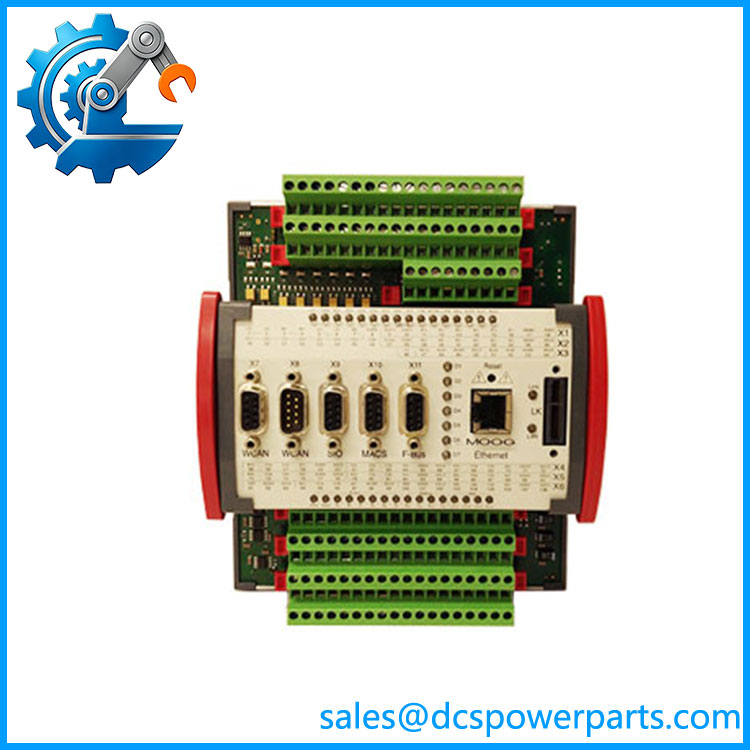
MOOG D136-001-008A | MSC I Motion Controller
Key Technical Specifications
| Parameter | Specification |
|---|---|
| Product Model | D136-001-008A |
| Manufacturer | Moog |
| Product Family | M3000 Automation System |
| Controller Family | MSC I Motion Controller |
| Controller Type | Multi-axis motion controller with PLC functionality |
| Processor | 32-bit PowerPC RISC with floating-point unit |
| RAM | 4 MB |
| Flash EEPROM | 4 MB |
| Digital I/O | 8, individually configurable as input or output |
| Analog Inputs | 8 × 16-bit |
| Analog Input Ranges | ±10 V, ±10 mA, or 4–20 mA, configurable in MACS |
| Analog Outputs | 2 × 16-bit |
| Analog Output Ranges | ±10 V; configurable as ±10 mA, ±50 mA, or 4–20 mA |
| Position Transducer Interfaces | 2 |
| CAN Interfaces | 2 independent CAN interfaces |
| Serial Interface | TIA/EIA-232 |
| Ethernet | 10Base-T |
| Extension Bus | E-Bus / Q-connectors for additional modules |
| Supply Voltage | 24 VDC, 18–36 VDC |
| Typical Current | 0.5 A idle; 2 A full load |
| Mounting | NS 35/7.5 DIN rail |
| Dimensions | 160 × 170 × 85.5 mm |
| Operating Temperature | +5°C to +55°C |
| Storage Temperature | −25°C to +70°C |
| Relative Humidity | 10–95%, non-condensing |
| Protection | IP20 |
| Protection Class | III |
Moog’s technical documentation confirms the 24 VDC supply range, DIN-rail mounting, dimensions, environmental limits, PowerPC architecture, Ethernet, CAN, position-transducer interfaces, configurable digital I/O, and analog I/O characteristics for the D136-001-008 MSC I platform.
Product Introduction
The Moog D136-001-008A is an MSC I Motion Controller used within the M3000 Automation System for multi-axis motion and closed-loop control. It combines PLC functionality with motion-control processing and provides analog, digital, CAN, serial, Ethernet, and position-transducer interfaces for hydraulic and electromechanical control applications. Moog specifies 4 MB RAM and 4 MB Flash for the D136-001-008 platform.
The controller is designed for expansion through its E-Bus and can interface with additional M3000 modules. The two position-transducer interfaces and configurable 16-bit analog channels make the controller suitable for applications where position, pressure, force, or other feedback signals form part of the closed-loop control strategy.
D136-001-008A
Application Scenarios & Field Pitfalls — Engineer’s Perspective
Engineering Pain Point
The main risk with D136-001-008A is confusing the MSC I hardware with later MSC II controllers. Several current listings incorrectly describe this part as a dual-core 1.8 GHz controller with gigabytes of RAM and EtherCAT/PROFINET interfaces. Those specifications belong to neither the documented D136-001-008 MSC I architecture nor its published product family.
Typical Applications
- Hydraulic servo control — closed-loop position, pressure, and force regulation.
- Multi-axis machinery — coordinated axis control using the MSC I motion-control platform.
- Industrial actuator systems — servo-valve and actuator applications requiring analog feedback.
- Legacy M3000 installations — replacement of an installed MSC I controller while retaining the existing application architecture.
Technical Pitfalls to Avoid
- Do not substitute an MSC II solely because the part number contains D136.
D136-002-xxx belongs to the later MSC II family and has a substantially different hardware architecture. Moog lists D136-002-002 as an MSC II with 128 MB RAM and 32 MB Flash, while D136-001-008 belongs to the older MSC I family with 4 MB RAM and 4 MB Flash. - Do not assume PROFIBUS-DP is included.
Moog identifies D136-001-007 as the MSC I version with an additional PROFIBUS-DP slave interface. The standard D136-001-008 does not have that interface. - Check the position-transducer interface configuration.
The two interfaces can be important to the machine’s feedback architecture. Confirm whether the installed application uses incremental encoder or SSI feedback before replacing the controller. - Preserve the application and license information.
Moog documentation states that the MSC platform requires a license key for operation. A hardware replacement should therefore be planned together with the existing MACS application, parameters, license key, and controller configuration.
Related Products
- D136-001-007 — MSC I Motion Controller with an additional PROFIBUS-DP slave interface.
- D136-001-001 — earlier Moog Servo Controller configuration; not automatically interchangeable with D136-001-008A.
- D136-002-002 — MSC II Motion Controller; later architecture with substantially different memory and interfaces.
- D136-002-003 — MSC II version with EtherCAT master interface.
- D136-002-004 — MSC II controller variant with a different interface configuration.
- D136-002-005 — MSC II motion-control configuration for specialized applications.
- D138-002-002 — associated M3000 controller/license hardware used with later MSC II installations.
- D137-001-011 — M3000 digital extension module used for expanding controller I/O.
Procurement Note
For a D136-001-008A replacement, specify the complete part number and hardware revision, then verify the existing application, MACS version, license key, feedback-device type, CAN configuration, analog I/O assignments, and E-Bus expansion modules.
One particularly important check is the suffix A. Moog’s published documentation identifies the base D136-001-008 rather than documenting every later suffix revision separately, so the nameplate revision should be matched against the installed controller before treating another variant as an exact replacement.