Description
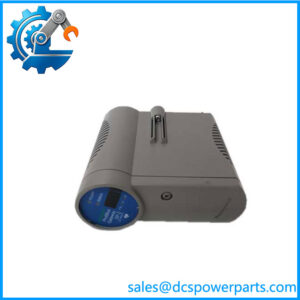
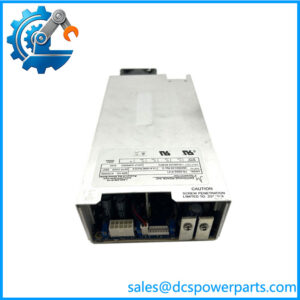
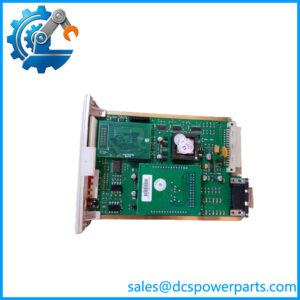
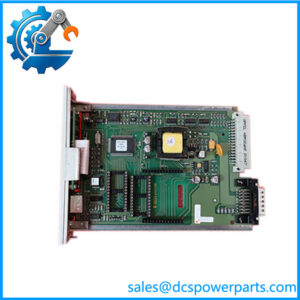
Honeywell CC-TAID01 | 16-Channel Differential AI IOTA | Experion PKS Series C
Key Technical Specifications
| Parameter | Specification |
|---|---|
| Manufacturer | Honeywell |
| Model | CC-TAID01 |
| Part Number | 51306733-175 |
| Product Type | AI IOTA |
| Series | Experion PKS Series C |
| Configuration | Non-redundant |
| Analog Channels | 16 |
| Input Arrangement | 16 differential inputs |
| Associated IOM | CC-PAIH02 |
| Input Types | Voltage / current |
| Input Ranges | 0–5 V, 1–5 V, 0.4–2 V, 4–20 mA via 250 Ω |
| A/D Resolution | 16 bit |
| Common-Mode Voltage | -6 to +5 V peak |
| IOTA Size | 9 in. |
| Redundant Counterpart | CC-TAID11 |
Honeywell’s Series C I/O specification identifies CC-TAID01 as the non-redundant IOTA for CC-PAIH02, with 16 channels and differential inputs on channels 1–16. The supported high-level analog input ranges include 0–5 V, 1–5 V, 0.4–2 V, and 4–20 mA through a 250 Ω termination.
Product Introduction
The Honeywell CC-TAID01 is a Series C Analog Input IOTA designed for the Experion PKS I/O architecture. It provides the field-side termination and signal arrangement for the CC-PAIH02 high-level analog input module, supporting 16 differential input channels.
The distinction between the IOM and IOTA is important during procurement. CC-TAID01 is the termination/interface assembly; CC-PAIH02 performs the analog input processing. Ordering the IOTA alone does not replace the associated IOM.
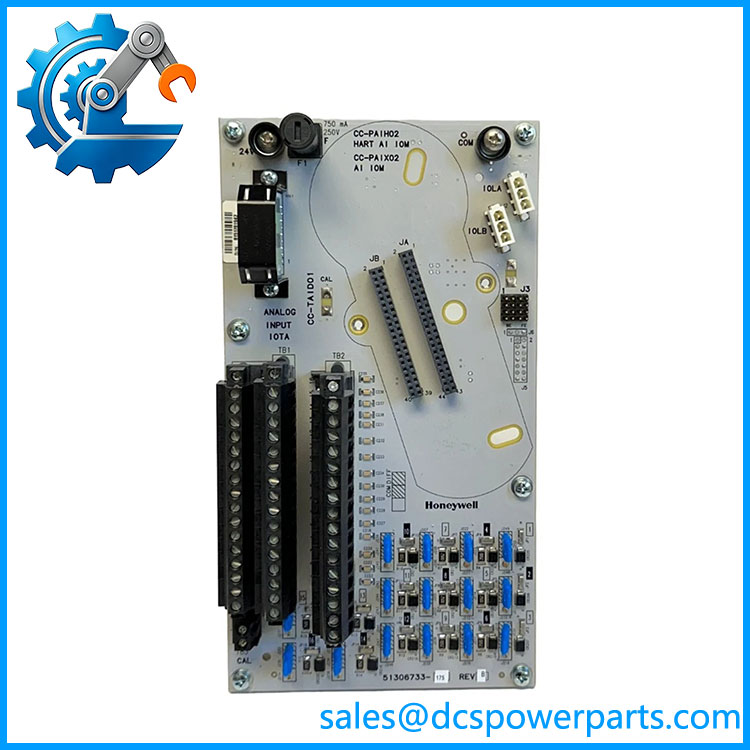
CC-TAID01
Application Scenarios & Field Pitfalls — The Engineer’s Perspective
Engineering Pain Point
When a Series C analog channel shows unstable or incorrect PV values, the IOTA is not automatically the failed component. Field wiring, transmitter configuration, the CC-PAIH02 IOM, termination quality, and the differential signal arrangement all need to be checked. Honeywell specifically notes that the differential configuration is implemented internally by the IOTA, so external rewiring is not required simply to establish the differential arrangement.
Typical Applications
- Experion PKS Series C analog signal termination
- Differential pressure transmitter inputs
- Process pressure and temperature measurement
- Flow and level transmitter interfaces
- Voltage-output process instrumentation
- 4–20 mA high-level analog signals
Technical Pitfalls
- Do not call CC-TAID01 a processor. Honeywell classifies it as an AI IOTA – 16 Channel Differential.
- Do not confuse it with CC-TAIN01. CC-TAIN01 is the standard AI IOTA associated with conventional 16-channel analog input applications, while CC- is specifically the differential-input IOTA.
- Match the IOM. Honeywell’s compatibility matrix pairs CC-/CC-TAID11 with CC-PAIH02 for the full 1–16 differential configuration.
- Redundancy matters. CC- is the non-redundant version. CC-TAID11 is the corresponding redundant IOTA. Do not substitute between them without checking the Series C system design.
- Check the signal range before commissioning. The associated CC- supports 0–5 V, 1–5 V, 0.4–2 V, and 4–20 mA through 250 Ω. The transmitter configuration and channel engineering should match the intended signal type.
- Do not confuse differential I/O with isolated I/O. The Honeywell documentation describes CC- as a differential configuration. It should not automatically be specified as channel-to-channel galvanically isolated hardware.
Related Products
- — High-level analog input IOM associated with CC-.
- CC-TAID11 — Redundant 16-channel differential AI IOTA.
- CC-TAIX01 — Non-redundant AI IOTA for the corresponding non-differential configuration.
- CC-TAIX11 — Redundant AI IOTA.
- CC-TAIN01 — Non-redundant standard analog input IOTA.
- CC-TAIN11 — Redundant standard analog input IOTA.
- CC-PAIH01 — Earlier high-level analog input module; Honeywell documentation identifies CC- as its successor.
- CC-PAIX02 — High-level analog input module without HART, with applicable Series C IOTA configurations.
- CC-UAXA01 — Universal analog SCA adapter identified by Honeywell as a functional replacement path for CC-/11 in the SCA architecture.
Procurement Note
For , specify the complete part number and the associated CC- IOM when requesting a spare. The critical checks are non-redundant vs. redundant architecture, 16-channel differential configuration, and the actual transmitter signal range. Honeywell’s Series C documentation should take precedence over supplier pages that incorrectly describe CC- as a CPU, digital I/O module, or standalone analog input card.