Description
Product Overview
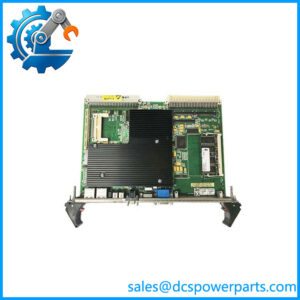
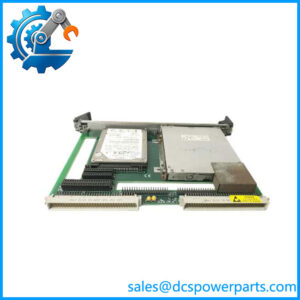
IS220PAICH1B is the analog pack of the Mark VIe distributed I/O architecture, and understanding it starts with what it is not: it is not a terminal board. Mark VIe split the field interface away from the electronics. The terminal board owns the terminals, the suppression, the identification device and the signal routing; the pack owns the acquisition, the conversion and the network connection. PAIC is the analog pack that sits on such a board, conditioning and digitising the field’s analog signals, powering the transmitters that produce them, and exchanging the result with the controller across the I/O Ethernet network.
The channel complement is ten inputs and two outputs, and the inputs are not all the same range. Channels 1 through 8 accept −10 to +10 V DC or 0–20 mA DC, while channels 9 and 10 accept −5 to +5 V DC or −1 to +20 mA DC. That asymmetry is not a limitation to work around; it is the reason a pack of this kind can serve a cabinet’s mixed measurement list — wide bipolar voltage and current loops on the majority of points, and a narrower bipolar span on the last pair where a small-signal device or a sensor with its own scaling sits. The two analog outputs are current outputs, and the terminal board variant determines whether the field sees 0–20 mA or the 0–200 mA option that the TBAI board supports.
The pack carries the loop power as well as the measurement. It provides 22.8 V DC transmitter excitation, which is what lets a two-wire transmitter be wired to the terminal board and read by the pack with no separate loop supply — the pack’s own supply input has a documented minimum of 22.5 V DC, so a marginal 24 V rail is a measurement problem before it is a power problem. Field devices may be two-, three- or four-wire, or externally powered; the terminal board handles the wiring arrangement and the pack handles the signal.
The network side is deliberately redundant. The pack serves as the electrical interface between one or two I/O Ethernet networks and the analog terminal board, so a simplex cabinet uses one network and a redundant cabinet uses both, and the pack’s place in a TMR architecture is a physical one: on the IS200TBAIH1C board, a simplex installation uses one pack at connector JR1, while a TMR installation uses three packs for the R, S and T signal paths, with each input fanned to the three controllers and the three output drivers combined. That is why the same pack appears one, two or three at a time in the same cabinet.
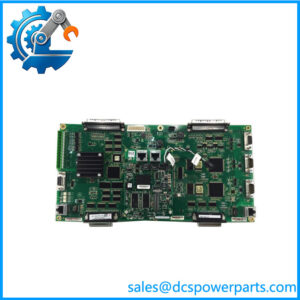
The approved partner list is short, and it is the single most important compatibility fact about this part. GE’s hazardous-location documentation identifies three accessory boards for this pack — IS200STAIH1A and IS200STAIH2A, the compact simplex boards with 48 Euro-style box terminals (fixed in H1A, pluggable in H2A), and IS200TBAIH1C, the full-size board with two removable 24-point barrier blocks and three pack positions. The same documentation excludes others: the DTAI board and IS200TBAIH2C are not compatible with the PAIC pack, and earlier TBAIH1A/TBAIH1B revisions may accept the connector but do not deliver full analog accuracy because their circuits differ. A mating connector proves mechanical fit and nothing else.
Two generations appear in the same certificate. IS220PAICH1B is the IS220-generation pack; IS42yPAICH1C is the newer catalog form with a new processor board, listed on the same approved terminal boards ISx0ySTAIH1A, ISx0ySTAIH2A and ISx0yTBAIH1C. The field interface is therefore unchanged between them, while the computing side is not — which makes the pair an upgrade path on paper and a site-release question in practice.
Hazardous location is certified at the combination level, not the pack level. IS220PAICH1B carries the marking Ex ic ec [ic] IIC T4 Gc at −30 to +65 °C, under IEC 60079-0:2017, 60079-11:2011 and 60079-7:2017, and the conditions of use include a transient protection level not exceeding 140 % of peak rated voltage, pollution degree not more than 2, installation in an enclosure of at least IP54, supply through a power distribution board certified for the location, and a switched-mode supply with output current limited to 20 A. Those conditions attach to the installation as a whole — a certified pack on an unapproved board is not a certified assembly.
Technical Specifications
| Parameter | Value |
|---|---|
| Model | IS220PAICH1B — IS220 pack, PAIC analog I/O, revision H1B |
| Manufacturer | GE (General Electric); certificate holder Nexus Controls LLC, 1800 Nelson Rd., Longmont, CO |
| Product type | Analog I/O pack (pack only — terminal board supplied separately) |
| Functional acronym | PAIC, Mark VIe Control Analog I/O Module |
| Analog inputs | 10 channels: 1–8 at −10 to +10 V DC or 0–20 mA DC; 9–10 at −5 to +5 V DC or −1 to +20 mA DC |
| Analog outputs | 2 channels, current output; terminal-board variant determines 0–20 mA or 0–200 mA field range |
| Transmitter power | 22.8 V DC excitation supplied to field transmitters |
| Pack supply | Nominal 24 V DC; minimum 22.5 V DC documented |
| Field device types | Two-wire, three-wire, four-wire, or externally powered transmitters |
| Network interface | One or two I/O Ethernet networks (simplex or redundant) |
| Approved terminal boards | IS200STAIH1A, IS200STAIH2A, IS200TBAIH1C — also ISx0ySTAIH1A/H2A, ISx0yTBAIH1C for x = 2 or 4 |
| Incompatible boards | DTAI; IS200TBAIH2C; earlier TBAIH1A/TBAIH1B do not deliver full analog accuracy |
| TMR arrangement | IS200TBAIH1C: 1 pack simplex at JR1; 3 packs for R, S and T in TMR |
| Diagnostics | Per-channel out-of-range and delta-of-span monitoring; Alarm 66–67 flags an individual output current too high relative to total current; board-identification mismatch fault |
| Hazardous location | Ex ic ec [ic] IIC T4 Gc; IEC 60079-0:2017 / 60079-11:2011 / 60079-7:2017; −30 to +65 °C |
| Conditions of use | Transient protection ≤ 140 % of peak rated voltage; pollution degree ≤ 2; enclosure ≥ IP54; certified power distribution board; SMPS limited to 20 A |
| Non-hazardous certification | UL E207685 |
| RoHS construction | Built with acquisition board IS400BPAIH1A or IS400BPAIH2A plus IS400STAIH1A / IS400STAIH2A / IS400TBAIH1C |
| Newer catalog form | IS42yPAICH1C — new processor board, same approved terminal boards |
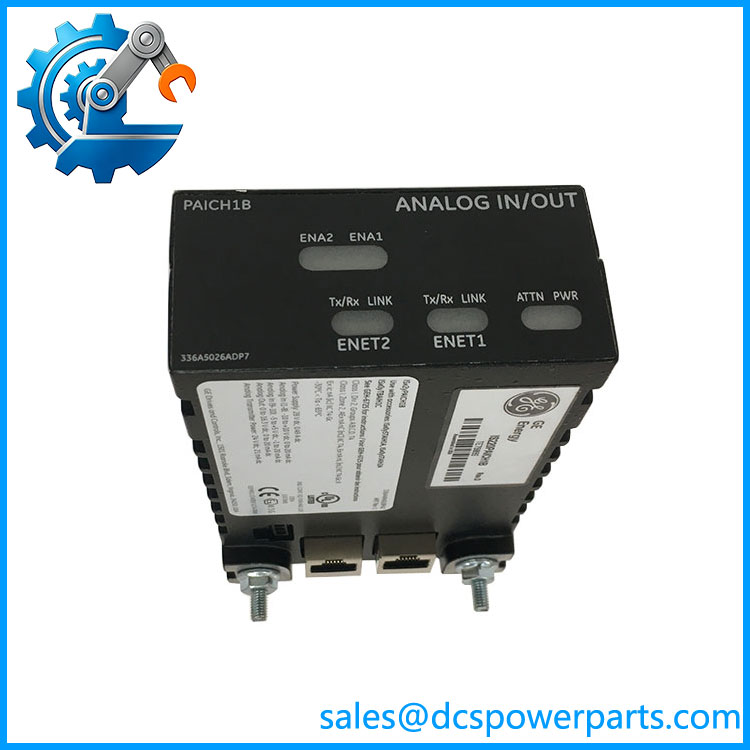
IS220PAICH1B
Key Features and Advantages
Ten inputs and two outputs in one pack: a cabinet’s mixed analog list — pressure, flow, level, position, valve feedback, plus two current outputs for a recorder or a positioner — handled without a second pack type.
Two range groups instead of one compromise: bipolar voltage and current loops on channels 1–8, and a narrower ±5 V or −1 to +20 mA span on 9–10, so small-signal devices do not have to be scaled into a wide-range channel.
Transmitter excitation on board: 22.8 V DC loop power from the pack, which removes an external supply per transmitter and centralises the loop’s power source where it can be measured.
Pluggable architecture: acquisition and termination separated, so a failed pack is replaced without disturbing the field wiring, and the terminal board can be worked on without a pack on it.
Redundancy that reaches the signal: one or two I/O Ethernet networks per pack, and on the TBAI board a TMR arrangement with three packs is a documented topology rather than a field improvisation.
Certificate-level pairing: the approved combinations are published as complete pack-plus-board assemblies, which turns compatibility from an opinion into a document check.
Two generations on one field interface: IS220PAICH1B and IS42yPAICH1C share the approved terminal boards, so the acquisition electronics can be renewed without re-terminating the cabinet.
Hazardous-location coverage: Ex ic ec [ic] IIC T4 Gc at −30 to +65 °C, with the installation conditions stated rather than implied.
Applications
Gas and steam turbine auxiliaries: lube oil pressure, fuel gas pressure and differential pressure, bearing and seal measurements, and valve position feedback into the controller.
Transmitter-fed process loops: two-wire 4–20 mA transmitters powered from the pack’s 22.8 V DC excitation, including three- and four-wire devices where the loop arrangement requires it.
Bipolar position and command signals: ±10 V actuators, positioners and drives on channels 1–8, and smaller bipolar signals on the dedicated 9–10 pair.
Analog outputs for setpoint and positioning: two 0–20 mA outputs for a positioner, a recorder or an external controller, with the 0–200 mA option on the TBAI board where a higher-current device requires it.
Compact simplex panels: IS200STAIH1A or IS200STAIH2A with 48 Euro-style terminals, the pluggable H2A variant chosen where pre-wired field plugs speed a replacement.
Full-size and TMR cabinets: IS200TBAIH1C with barrier terminals and three pack positions, where R, S and T each need their own analog path and the outputs must be voted.
Hazardous-area installations: gas turbine packages inside classified boundaries, where the pack-plus-board combination carries the Ex marking and the installation conditions are met as a set.
Retrofit and obsolescence management: cabinets holding IS220PAICH1B where a route to the IS42yPAICH1C generation is being planned without re-terminating the field.
Related Products
IS200STAIH1A — approved compact simplex analog terminal board, 48 Euro-style box terminals fixed in place. IS200STAIH2A — approved compact simplex board with a removable Euro-style plug at the field interface. IS200TBAIH1C — approved full-size board, two removable 24-point barrier blocks, one pack in simplex or three in TMR. IS200TBAIH2C — same family, but documented as not compatible with the PAIC pack; the trap this part’s compatibility list exists to prevent. IS220PAOCH1B — analog output pack from the same IS220 generation, the dedicated output partner where output count exceeds two. IS220PDIAH1B — discrete input pack of the same generation, sharing the pack housing and network interface but not the analog boards. IS220PDOAH1B — discrete output pack, driving relay terminal boards from the same I/O network. IS42yPAICH1C — the newer catalog form with a new processor board, on the same approved terminal boards; the forward path rather than a like-for-like swap. IS220PCLAH1B — core analog module of the same platform, paired with the SCLS/SCLT boards, where the architecture calls for a different analog role. IS400BPAIH1A / IS400BPAIH2A — the RoHS-construction acquisition boards used inside this pack model.
Installation and Maintenance
Before installation: confirm the terminal board on the cabinet matches IS200STAIH1A, IS200STAIH2A or exactly, and treat DTAI, IS200TBAIH2C and the earlier TBAIH1A/TBAIH1B revisions as non-starters regardless of connector fit. Confirm the topology — one pack at JR1 for simplex, three packs for R, S and T on a TBAI board in TMR — and check that the pack’s supply can hold at least 22.5 V DC at the pack, not merely at the cabinet’s source. Map every field wire by channel, signal type, polarity, shield and power source before disturbing the terminations.
Installation: seat the pack on its connector position fully; the pack has no field terminals of its own, so a poor seating shows up as a channel offset or a board-identification fault rather than as an obvious open circuit. On the compact boards, land field wiring on the 48 Euro-style points and keep the pluggable variant’s plugs matched to their own board, since a plug prepared for one board does not belong on another. Bring cable shields to the board’s shield provision rather than to a convenient cabinet screw. After power-up, verify each channel against a known source in the mode it will run in — voltage channels checked for reference and impedance, current channels checked for burden and return routing — and confirm the two outputs into their loads before the loop is returned to service.
Maintenance: a drifting measurement on this pack is more often a loop problem than a converter problem — check transmitter excitation at the device, burden and return routing on current loops, and shield integrity before condemning the pack. Board-identification faults point at seating or at a substitution someone made earlier. Alarm 66–67, an individual output current too high relative to the total, is the pack telling you the output circuit is drawing more than its share; trace the field load rather than resetting the alarm. Keep a pack and a matching terminal board as a pair in spares, because a spare pack without the right board is not a spare assembly, and record the revision and the internal acquisition board number with the terminal board’s part number in the panel documentation.
Warranty and Quality
Every unit is supplied as the Mark VIe analog I/O pack, functional code PAIC, revision H1B, and is described from GE-issued documentation for this exact catalog number (IECEx UL 21.0067X, Issue 6, holder Nexus Controls LLC): ten analog inputs with channels 1–8 at −10 to +10 V DC or 0–20 mA DC and channels 9–10 at −5 to +5 V DC or −1 to +20 mA DC, two analog outputs, 22.8 V DC transmitter excitation with a documented 22.5 V DC pack supply minimum, two-, three-, four-wire and externally powered transmitter support, an interface to one or two I/O Ethernet networks, approved use with IS200STAIH1A, IS200STAIH2A and only, one pack at JR1 for simplex or three packs for TMR on the TBAI board, marking Ex ic ec [ic] IIC T4 Gc to IEC 60079-0:2017, 60079-11:2011 and 60079-7:2017 at −30 to +65 °C, installation conditions of ≤ 140 % transient protection, pollution degree ≤ 2, IP54 enclosure, certified power distribution board and a 20 A-limited switched-mode supply, UL E207685 for non-hazardous applications, and RoHS construction using the IS400BPAIH1A/IS400BPAIH2A acquisition board. Units are inspected for connector and pin condition, housing and label integrity, revision and internal board marking, identification-device contact cleanliness, and for evidence of heat damage or prior repair. Where the public record does not state a figure — channel update rate, accuracy class, isolation rating — this description does not invent one: the ranges, the loop power and the approved pairings are reported as documented, and the rest belongs to the system documentation. A 12-month repair, replacement or refund commitment applies. Technical support covers what this part actually raises: confirming the installed terminal board is one of the three approved types before shipment, distinguishing a pack fault from a loop fault when a channel drifts, interpreting a board-identification fault as a seating or substitution issue, and advising on the IS42yPAICH1C generation where a cabinet is being renewed rather than repaired.