Description
Hilscher PKV-30-DPS | PROFIBUS-DP Protocol Converter | Modbus RTU Gateway
Key Technical Specifications
| Parameter | Specification |
|---|---|
| Manufacturer | Hilscher |
| Model | PKV 30-DPS |
| Device Type | Protocol converter |
| PROFIBUS Interface | PROFIBUS-DP slave |
| PROFIBUS Physical Layer | Isolated RS-485 |
| PROFIBUS Baud Rate | Up to 12 Mbit/s |
| Serial Interface | RS-232 / RS-422 / RS-485 |
| Serial Interface Isolation | Non-isolated |
| Modbus Mode | RTU master or slave |
| Modbus Transfer Rate | Up to 19.2 kbaud |
| Supply Voltage | 18–30 VDC |
| Typical Supply | 24 VDC |
| Power Consumption | Max. 0.15 A at 24 V |
| Operating Temperature | 0 to +50°C |
| Protection | IP50 |
| Dimensions | 105 × 105 × 80 mm |
| Mounting | DIN rail, EN 50022 |
The technical values above come from the Hilscher manual and ABB’s documentation for its Advance Optima PROFIBUS-DP interface. ABB specifically describes the PKV 30-DPS as a PROFIBUS-DP slave and Modbus master, with an isolated PROFIBUS RS-485 interface, 18–30 VDC supply, and 0–50°C operating range.
Product Introduction
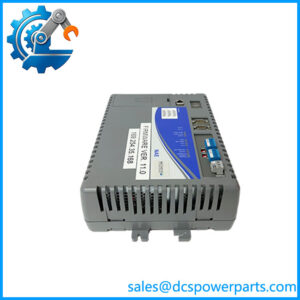
The Hilscher PKV-30-DPS is a legacy industrial protocol converter designed to connect serial equipment with a PROFIBUS-DP control network. On the PROFIBUS side, it functions as a slave; on the serial side, the interface can be configured for RS-232, RS-422, or RS-485 operation. Modbus RTU can operate as either master or slave, allowing older drives, instruments, controllers, and remote devices to exchange process data with a PROFIBUS-based PLC or DCS.
The device uses shared process-data images between the two communication sides. This makes it useful in retrofit installations where replacing the existing serial equipment is less practical than adding a protocol conversion layer. ABB also documented the PKV 30-DPS specifically for connecting an Advance Optima analyzer system to a PROFIBUS-DP network through Modbus.
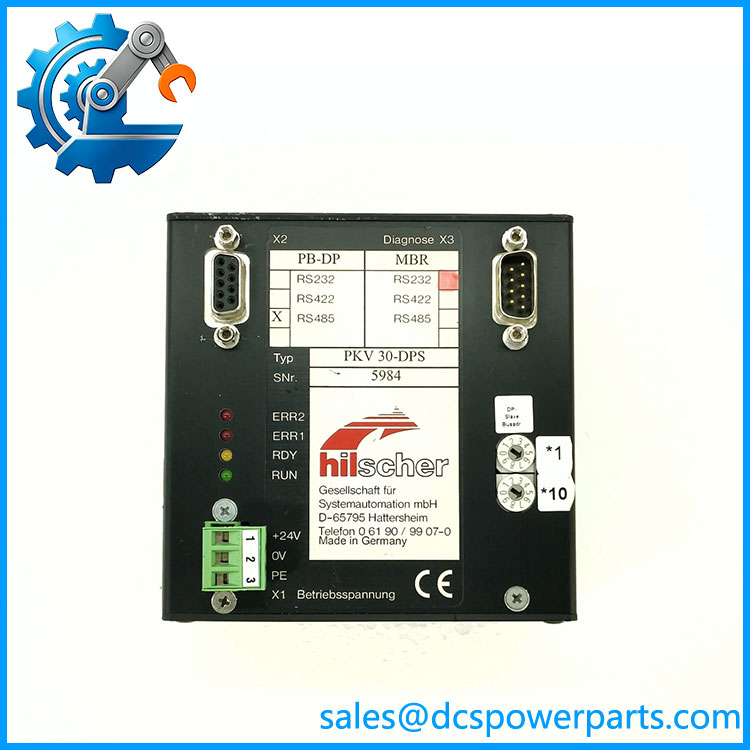
PKV-30-DPS
Application Scenarios & Field Pitfalls — The Engineer’s Perspective
Engineering Pain Point
When a legacy Modbus device has to communicate with a PROFIBUS-DP PLC, the difficult part is rarely the physical wiring alone. Data mapping, master/slave roles, baud-rate settings, PROFIBUS configuration, serial framing, and process-image limits all have to agree. The PKV 30-DPS sits directly in that interface boundary.
Typical Applications
- PROFIBUS-DP PLC connected to Modbus RTU drives
- Legacy serial instruments integrated into a PROFIBUS network
- Process analyzers communicating through Modbus
- DCS/PLC retrofit projects where existing RS-232/422/485 equipment must remain in service
- Industrial communication spare-parts replacement
Technical Pitfalls
1. PROFIBUS and Modbus roles are different.
The PKV 30-DPS operates as a PROFIBUS-DP slave. On the Modbus side, the converter can be configured as master or slave. Do not configure both sides as though they use the same master/slave relationship.
2. Watch the process-data limit.
The PKV 30-DPS has a significantly smaller process-data capacity than the standard PKV 30. Hilscher technical information specifies a maximum of 244 input bytes and 244 output bytes per PROFIBUS telegram, with a combined input/output limit of 368 bytes. This becomes important when integrating equipment with a large register map.
3. The serial interface requires correct hardware configuration.
The serial interface can be configured for RS-232, RS-422, or RS-485. The original manual identifies hardware configuration provisions for selecting the interface type. Verify the actual jumper/configuration before connecting field equipment.
4. RS-485 does not automatically mean multidrop operation will work.
The physical interface is only one part of the communication setup. Addressing, termination, biasing, baud rate, parity, and protocol timing must match the connected devices.
5. Check the configuration files before replacing the unit.
The original device uses configuration data and firmware stored in flash memory. A replacement unit may require restoration of the correct application configuration rather than simply installing the hardware and expecting the previous mapping to appear automatically.
6. Do not confuse PKV 30-DPS with a general-purpose gateway.
The DPS variant has a defined PROFIBUS-DP slave architecture and process-image limitations. It should be evaluated against the actual PLC data requirements before being selected for a retrofit.
7. Verify legacy software availability.
The PKV 30-DPS is an older product generation. The original documentation references configuration/diagnostic tooling and firmware-management procedures. For a replacement project, confirm that the required configuration files and engineering tools are available before removing the existing unit.
Related Products
- Hilscher PKV 30 — related protocol-converter platform with substantially larger process-data capacity than the PKV 30-DPS.
- Hilscher PKV 30-DPS 9604001 — earlier documented device-number/revision variant.
- Hilscher PKV 30-DPS 9604002 — later documented device-number/revision variant with selectable PROFIBUS-DP slave addressing.
- Hilscher COMPRO configuration software — associated with configuration of PKV-series devices in legacy applications.
- PROFIBUS-DP master interface — required on the PLC/DCS side because the PKV 30-DPS operates as a DP slave.
- Modbus RTU master/slave devices — serial equipment that can be connected according to the selected PKV configuration.
- ABB Advance Optima PROFIBUS-DP interface — documented application using the PKV 30-DPS as the protocol-conversion component.
Procurement Note
For a PKV-30-DPS replacement, do not specify the model number alone. The most useful information is the device number/revision, PROFIBUS configuration, Modbus device type, serial interface mode, baud/parity settings, and existing configuration files.
If the unit is being replaced in an operating plant, preserve the original configuration before removing it. The 244-byte input / 244-byte output and 368-byte combined process-data limits should also be checked against the existing PLC data map before approving the PKV 30-DPS for a new integration.