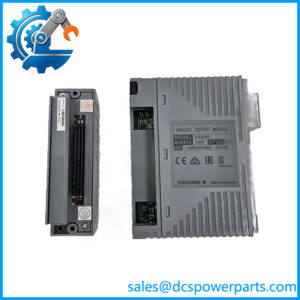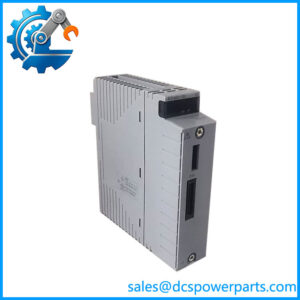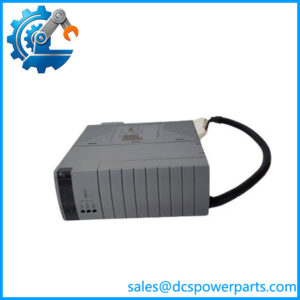
Description
Key Technical Specifications
| Parameter | Value |
|---|---|
| Manufacturer | Yokogawa |
| Model | YNT511D |
| Product Type | ER Bus Terminator |
| System Platform | CENTUM VP / CENTUM CS 3000 |
| Network Type | Extended Remote I/O Bus (ER Bus) |
| Configuration | Dual / redundant bus termination |
| Bus Compatibility | ER Bus using 10BASE-2 coaxial cable |
| Termination Impedance | 75Ω |
| Connector Type | BNC |
| Installation Position | End of ER Bus segment |
| Supported Redundancy | Yes, A/B redundant bus lines |
| Transmission Medium | Coaxial communication cable |
| Operating Temperature | Approx. -20°C to +70°C |
| Application | Remote I/O communication network termination |
Product Introduction
Yokogawa YNT511D Overview
The Yokogawa YNT511D is an ER Bus terminator used in Yokogawa CENTUM VP and CENTUM CS 3000 distributed control system architectures. It is installed at the end of an Extended Remote I/O Bus segment to match line impedance and reduce signal reflection on the communication network.
The Yokogawa YNT511D is a passive communication component, but its role is critical in maintaining stable remote I/O communication. Incorrect termination can create intermittent network faults that are difficult to diagnose because controllers and I/O modules may continue operating normally while communication quality degrades.
YNT511D
Application Scenarios & Field Pitfalls (The Engineer’s Perspective)
Engineering Pain Point
A remote I/O station starts dropping communication intermittently. The FCU is healthy, power supplies are normal, and no obvious module failure is reported. The problem appears only during high network loading or after long operating periods.
This is a classic communication-layer issue. Engineers often replace interface modules first, but the physical bus layer should be checked as well. A missing or incorrect terminator can create reflections and unstable signal conditions across the ER Bus.
The YNT511D is a small component with a large impact on network reliability.
Typical Applications
- Oil & Gas Facilities – ER Bus termination for remote I/O nodes located near process units, compressor areas, and field equipment.
- Chemical Plants – Remote analog and digital I/O communication between field control units and distributed cabinets.
- Power Generation Plants – CENTUM-based control systems connecting remote instrumentation panels and auxiliary equipment.
- Water Treatment Facilities – Distributed I/O networks requiring long-distance communication between control rooms and field locations.
Technical Pitfalls to Avoid
- Install Only at the Correct Bus Location
The YNT511D is designed as an end-of-line terminator. Installing it incorrectly on the middle of the bus segment can create communication problems.
- Verify Redundant Bus Configuration
The “D” version is associated with duplex/redundant bus arrangements. Confirm whether the existing system uses redundant ER Bus wiring before replacement.
- Inspect Coaxial Cable and Connectors
Communication faults are frequently caused by aging coaxial cable, loose BNC connections, or incorrect cable impedance. Do not assume the terminator is the only possible failure point.
Related Products
- Yokogawa YNT511S
Single bus version of the ER Bus terminator family. Used where redundant communication is not required. - Yokogawa YNT512D
ER Bus repeater/communication component for redundant bus applications. Used when additional bus extension capability is required. - Yokogawa YNT522D
Optical bus repeater designed for longer-distance redundant communication applications. - Yokogawa EB401
ER Bus interface master-side component used between FCU systems and remote I/O networks. - Yokogawa EB501
ER Bus slave-side interface module installed with remote I/O systems. - Yokogawa YCB141
75Ω coaxial communication cable used with ER Bus networks. - Yokogawa CENTUM VP FCU
Field Control Unit platform that communicates with remote I/O nodes through Yokogawa bus architectures. - Yokogawa CENTUM CS 3000 System Components
Legacy DCS hardware family using ER Bus communication infrastructure.