Description
Product Overview
Abaco XVB603 6U-VME-SBC is an embedded computing controller designed for VME-based systems that require increased processing capability while maintaining compatibility with established VME infrastructure. The board combines an Intel Xeon E3 processor platform, DDR4 ECC memory, PCI Express connectivity, and VMEbus communication functions into a single 6U form-factor computer module.
The Abaco XVB603 6U-VME-SBC provides the computing core for industrial automation equipment, simulation platforms, test systems, and specialized embedded control installations. It can operate as the main system controller or as a processing node within a larger VME-based architecture. The board communicates with other VME modules through the backplane while handling application software, data processing, device control, and system management functions.
A typical architecture:
VME I/O Modules → XVB603 6U-VME-SBC Controller → Application Software → External Devices / Automation Network
The XVB603 6U-VME-SBC includes one PMC/XMC mezzanine expansion position, allowing additional functions such as high-speed data acquisition, communication interfaces, or specialized processing capability to be added according to system requirements.
Typical applications include:
- Industrial automation controllers
- Automated test equipment
- Defense and aerospace embedded systems
- Scientific instrumentation
- Communication systems
- Legacy VME computer upgrades
The board was developed as an upgrade path for earlier VME computing platforms, providing improved processor performance, storage capability, and I/O availability while preserving VME system compatibility.
For replacement projects, engineers should verify the existing VME chassis, backplane configuration, transition module, operating system image, application software, and I/O mapping. A processor board replacement often requires software migration or BIOS configuration checks before returning the system to service.
Technical Specifications
| Parameter | Specification |
|---|---|
| Manufacturer | Abaco Systems |
| Model | XVB603 6U-VME-SBC |
| Product Type | 6U VME Single Board Computer |
| Processor | Intel Xeon E3-1505M v6 / E3-1505L v6 |
| Processor Core | Quad-core Intel Xeon |
| Chipset | Intel CM238 |
| Memory | Up to 16 GB DDR4 SDRAM ECC |
| Cache | Up to 8 MB shared cache |
| Storage | Up to 256 GB M.2 SSD |
| VME Interface | 2eSST VME |
| VME Format | 6U single-slot board |
| Ethernet | Gigabit Ethernet |
| USB Interface | USB 3.0 |
| Serial Ports | Multiple serial interfaces |
| Graphics Output | VGA / DVI / DisplayPort |
| Expansion | 1 × PMC/XMC |
| Operating Systems | Linux, VxWorks, Windows 10 |
| Cooling | Air cooled |
| Installation | VME chassis backplane |
Specifications are based on Abaco XVB603 product documentation.
Main Features and Advantages
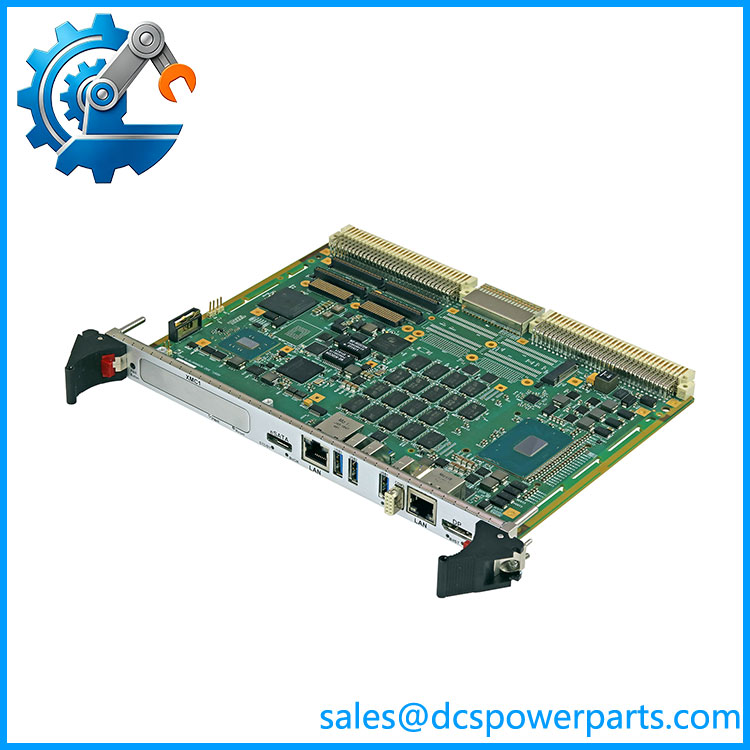
XVB603 6U-VME-SBC
Intel Xeon Embedded Processing Platform
The Abaco 6U-VME-SBC uses Intel Xeon E3 processor technology to provide higher computing capability for VME systems requiring increased processing performance.
Typical workloads include:
- Real-time control applications
- Data acquisition processing
- Simulation tasks
- Industrial computing
- Test system management
The processor platform includes integrated graphics and PCI Express capabilities through the Intel CM238 chipset.
ECC Memory for Industrial Reliability
The board supports DDR4 SDRAM with ECC capability.
ECC memory helps detect and correct certain memory errors, which is important for systems operating continuously in industrial or mission-critical environments.
Typical applications benefiting from ECC memory:
- Long-duration test systems
- Embedded controllers
- Data acquisition systems
- Automated equipment
VMEbus Compatibility
The 6U-VME-SBC maintains compatibility with established VME architectures.
It supports:
- Existing VME chassis
- Legacy I/O modules
- Industrial backplane systems
- Existing software frameworks
This allows system upgrades without completely redesigning installed VME platforms.
Flexible I/O Expansion
The integrated PMC/XMC expansion site allows additional functionality.
Possible expansions:
- High-speed communication
- Data acquisition
- Specialized interfaces
- Additional processing resources
Modern Storage and Connectivity
The board provides updated storage and communication resources while remaining within the VME ecosystem.
Available interfaces include:
- Gigabit Ethernet
- SATA
- USB
- Serial communication
- Display interfaces
Long-Life Embedded System Support
Many industrial systems continue using VME because of long equipment lifecycles.
The 6U-VME-SBC supports modernization projects where replacing the entire control platform is impractical.
Common replacement considerations:
- Existing software environment
- VME module compatibility
- Driver availability
- Hardware revision differences
Application Scenarios
Industrial Automation Systems
Used as:
- Machine controller
- Data processing computer
- Supervisory embedded computer
Automated Test Equipment
Applications:
- Semiconductor testing
- Laboratory automation
- Hardware verification systems
Defense and Aerospace Equipment
Used in:
- Embedded mission computers
- Simulation platforms
- Control systems
Scientific Instruments
Applications:
- Data acquisition
- Research equipment
- Measurement systems
Related Components
| Model | Function |
|---|---|
| VMIVME-7750 | VME Pentium-class single board computer |
| XVB602 | Previous-generation VME SBC platform |
| VTM29 | transition module |
| PMC/XMC Expansion Modules | Additional I/O and processing functions |
| VMEbus I/O Modules | Industrial interface modules |
Engineer’s Guide: Field Pitfalls
⚠️ Verify Software Compatibility
Hardware replacement is only one part of an SBC migration.
Check:
- Operating system version
- VME drivers
- Application software
- BIOS configuration
- Boot media
⚠️ Confirm Transition Module Compatibility
Rear I/O depends on the selected transition module.
Verify:
- Rear connector mapping
- Existing cable assemblies
- Serial and Ethernet routing
⚠️ Check VME Backplane Configuration
Before installation confirm:
- VME slot assignment
- Bus arbitration settings
- Address mapping
- Interrupt configuration
⚠️ Preserve Storage and Configuration Data
Before replacing the SBC:
- Backup SSD contents
- Record BIOS settings
- Save network configuration
- Document installed drivers
⚠️ Refurbished Board Testing Requirements
A proper evaluation should include:
- Power-up test
- BIOS operation verification
- Memory diagnostics
- VME bus communication test
- Ethernet and I/O testing
- Storage verification
- Operating system boot test
A board that reaches BIOS does not confirm complete system compatibility.
Frequently Asked Questions
What is Abaco 6U-VME-SBC?
It is a 6U VME single board computer designed for embedded industrial computing applications.
What processor does use?
It uses Intel Xeon E3-1505M v6 or E3-1505L v6 processor options.
Does support ECC memory?
Yes. It supports up to 16 GB DDR4 SDRAM with ECC.
Is a PLC module?
No. It is an embedded VME computer board used as a system controller or processing platform.
What should be checked before replacement?
Verify:
- Exact model: 6U-VME-SBC
- VME chassis compatibility
- Transition module
- Operating system image
- Application software
- PMC/XMC expansion requirements
- Network configuration