Description
Product Introduction
When an older industrial computer fails, replacing it is rarely just a matter of matching the board dimensions. The replacement must fit the existing VME chassis and support the required processor architecture, backplane connections, operating system, and application software. A mismatch can prevent the system from booting or communicating with the rest of the equipment.
The VME7865RC V7865-23003 embedded computer board is associated with the VME7865 family of VMEbus computing hardware. Before procurement, verify the exact CPU revision, memory configuration, rear-I/O arrangement, and complete part number. These details are more important than a generic listing description when maintaining a legacy industrial control system.
Key Technical Specifications
| Parameter | Specification |
|---|---|
| Product model | VME7865RC |
| Associated model | V7865-23003 |
| Additional part number | 350-9300007865-230003 M |
| Manufacturer attribution | GE Fanuc / VMIC family; confirm from physical label |
| Product type | VME single-board computer |
| System bus | VMEbus |
| Form factor | Single-slot Eurocard configuration is documented for the V7865 family |
| Processor | Unconfirmed for the exact VME7865RC suffix; available sources conflict |
| Memory | Depends on board revision and installed configuration |
| Storage | Depends on revision and installed configuration |
| Network interfaces | Verify against the actual board and matching manual |
| Serial interfaces | Verify against the actual board and matching manual |
| Rear I/O | Configuration-dependent |
| Operating system | Depends on processor architecture, firmware, and software image |
| Installation | Compatible VME chassis and backplane |
| Power requirements | Confirm using the exact hardware manual |
| Operating temperature | Confirm using the matching revision’s technical documentation |
| Condition and warranty | Seller-specific; request written confirmation |
The V7865 manual documents an Intel Core Duo-based board with a VMEbus interface, while other product listings describe the VME7865RC using a different processor. These details should not be combined into a single specification sheet without confirming the exact hardware variant.
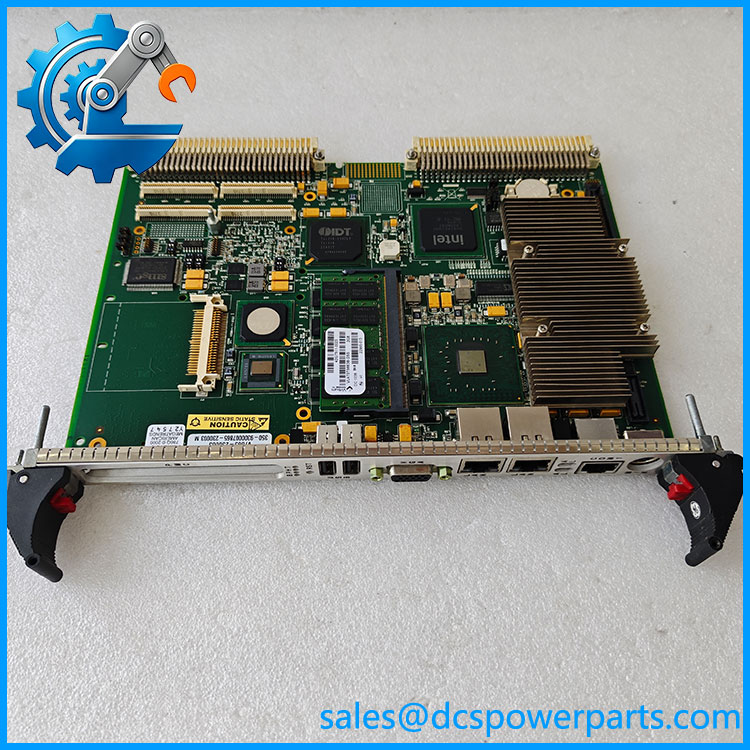
VME7865RC V7865-23003 350-9300007865-230003 M
Application Scenarios & Pain Points
A legacy VME computer may still be central to a test system, industrial controller, or specialized machine. When sourcing a replacement, the main challenge is preserving the existing software and hardware interfaces—not simply obtaining a board with the same general product-family name.
- Legacy industrial control systems: Replace a failed embedded computer while retaining the existing VME chassis and system design.
- Automated test equipment: Support real-time computing and control where software depends on a specific processor and bus architecture.
- Data acquisition systems: Maintain communication between the host computer, VME backplane, and installed peripheral cards.
- Industrial equipment refurbishment: Source discontinued computing hardware for repair, restoration, or continued operation of established machinery.
Field note: Before removing the original board, document the board revision, CPU marking, memory modules, firmware version, connector layout, and boot configuration. If the application uses a legacy operating system, preserve its boot media and software image where permitted. A physically compatible board can still be unusable if its processor architecture differs.
Related Products
These products belong to related VME computing or embedded-processing categories. They are reference points for evaluating an architecture, not guaranteed substitutes.
- GE Fanuc V7865 — VME single-board computer family documented with an Intel Core Duo processor; confirm the exact suffix and hardware revision.
- GE Fanuc VMIVME-7750 — Legacy VME embedded computer with a different processor generation and hardware architecture.
- GE Fanuc VMIVME-7807 — VME computing platform to evaluate for legacy embedded-computing applications; compatibility depends on the chassis and software.
- Motorola MVME2300 series — PowerPC-based VME processor-board family; processor architecture and I/O arrangements differ from the documented V7865 platform.
- Motorola MVME2303 — A member of the MVME2300 family; not a direct substitute without system-level compatibility review.
- GE Fanuc VMIVME-5565 — VME reflective-memory hardware for inter-system data sharing, rather than a general-purpose replacement computer.
- GE Fanuc VME7865RC -23003 — The specified board and associated part-number combination; use the original label as the primary matching reference.
Engineer’s Guide: Three Replacement Pitfalls
1. Resolve the processor identity first. Warning: The available descriptions disagree about the processor architecture associated with this exact model string. Confirm the CPU marking and matching manual before ordering. PowerPC and Intel-based systems are not interchangeable simply because they use the same bus family.
2. Match the full hardware configuration. Verify the board revision, memory, storage, front-panel ports, rear-I/O connections, and any installed mezzanine or expansion hardware. The suffix and assembly number may distinguish configurations that share a family name.
3. Preserve software and boot compatibility. Check the operating system, boot firmware, device drivers, application dependencies, and VME peripheral configuration. A replacement board may fit mechanically but fail to run the existing software image or communicate with installed cards.
Frequently Asked Questions
Q1: What is the VME7865RC -23003 used for?
It is associated with the VMEbus embedded-computing family. Such boards provide processing within a VME chassis for industrial, test, and specialized computing applications. Confirm the exact board revision before assigning more specific functions.
Q2: Is this a digital input/output module?
The stronger identification from the available product references is a VME single-board computer. Some listings describe it as a digital I/O module, but the descriptions are inconsistent and should not be treated as authoritative without matching technical documentation.
Q3: Does the use an Intel or PowerPC processor?
That is unresolved for the exact supplied part-number string. The manual identifies an Intel Core Duo-based computer, while a reseller identifies -23003 with a PowerPC 604e processor. Request a clear photo of the board’s CPU and identification label before specifying the processor in procurement documents.
Q4: Can I replace it with another VME single-board computer?
Not based on bus compatibility alone. The processor architecture, memory map, firmware, operating system, rear-I/O arrangement, and application software must all be considered. A different VME computer may require significant engineering changes.
Q5: What should I request when buying a used or refurbished unit?
Ask for photographs of the actual board, its complete part number, revision and serial labels, CPU marking, connector condition, and available functional-test results. Request the seller’s written condition declaration and warranty terms. A power-on test alone does not establish compatibility with your system.
Q6: What information is needed to confirm a replacement?
Provide the original board’s full label, CPU marking if visible, chassis model, required rear-I/O connections, operating system, and application requirements. If the board came from a working system, photographs of its installation and connector arrangement can also help resolve variant ambiguity.
Q7: What should be checked before returning the equipment to service?
Verify the board is recognized by the system, confirm boot firmware and software compatibility, check all required network and serial connections, and test communication with the installed VME peripherals. Complete the site’s approved functional checks before relying on the replacement in production.