Description
FLPS-7 Fire-Lite / Notifier Regulated Power Supply
Product Overview
The Fire-Lite FLPS-7 is a regulated power-supply module designed for compatible Fire-Lite and Notifier fire alarm control panels. Its primary job is straightforward but safety-critical: provide the panel with the 24 VDC power capacity required for notification appliances, supervised auxiliary circuits, annunciator interfaces, and other listed system loads. Manufacturer documentation identifies the FLPS-7 as providing 7.0 amps of total 24 VDC output capacity in the applicable panel configurations.
This distinction matters during replacement. The FLPS-7 should not be treated as a generic 24 VDC industrial power supply. It belongs to a listed fire-alarm-panel architecture, where output distribution, supervision, battery charging, circuit loading, and fault reporting are coordinated with the host FACP. For example, the RP-2002 series documentation specifies up to 3.0 A per individual NAC while maintaining a 7.0 A maximum panel alarm load. The same documentation identifies separate 0.5 A maximum circuits for certain resettable/non-resettable and ANN-BUS power functions.
The module appears in several related panel configurations. Honeywell documentation identifies FLPS-7 in RP-2002/E agent-release panels and in SFP-5UD/SFP-10UD fire alarm panels. MS-5UD/MS-10UD configurations also use the FLPS-7 in their 7 A versions. This means the model number alone is not enough to establish interchangeability: the host panel model, revision, AC input arrangement, battery system, and listed wiring configuration should all be checked before a replacement is installed.
For maintenance teams, the practical value of an spare is continuity of the original panel architecture. Replacing the correct power module avoids redesigning field circuits around an unrelated external supply and preserves the intended relationship between the panel’s AC input, 24 VDC distribution, battery system, and supervised outputs.
Product Introduction
A fire alarm power supply is not an ordinary DC converter. In an installation, the 7.0 A capacity is shared across defined panel circuits, so battery calculations and connected notification loads must be considered before replacement.
For legacy fire alarm panel maintenance, the critical check is the host FACP model and exact power-supply configuration, not simply whether another supply produces 24 VDC.
Key Technical Specifications
| Parameter | Specification |
|---|---|
| Model | |
| Brand / Manufacturer | Fire-Lite / Notifier |
| Product Type | Regulated fire alarm power supply module |
| DC Output | 24 VDC nominal |
| Total Output Capacity | 7.0 A maximum, depending on host-panel configuration |
| Typical Individual NAC Capacity | Up to 3.0 A per circuit in documented RP-2002 architecture |
| Auxiliary / ANN-BUS Power | 24 VDC nominal; 0.5 A maximum per documented circuit |
| Application | Compatible fire alarm control panels |
| Battery System | Host-panel controlled sealed lead-acid battery system |
| Installation | Internal panel-mounted assembly |
| Protection / Supervision | Determined by host fire alarm panel architecture |
| Firmware | No independently verified user firmware specification |
| Hot-Swap | Not assumed or recommended |
| Operating Temperature | Host-panel dependent; RP-2002 documentation specifies 0–49°C system operation |
| Status | Legacy / replacement-maintenance component |
The 7.0 A figure should not be interpreted as 7 A available simultaneously to every terminal. In the RP-2002 architecture, the documentation allocates maximum currents by circuit and specifies a 7.0 A maximum panel alarm load.
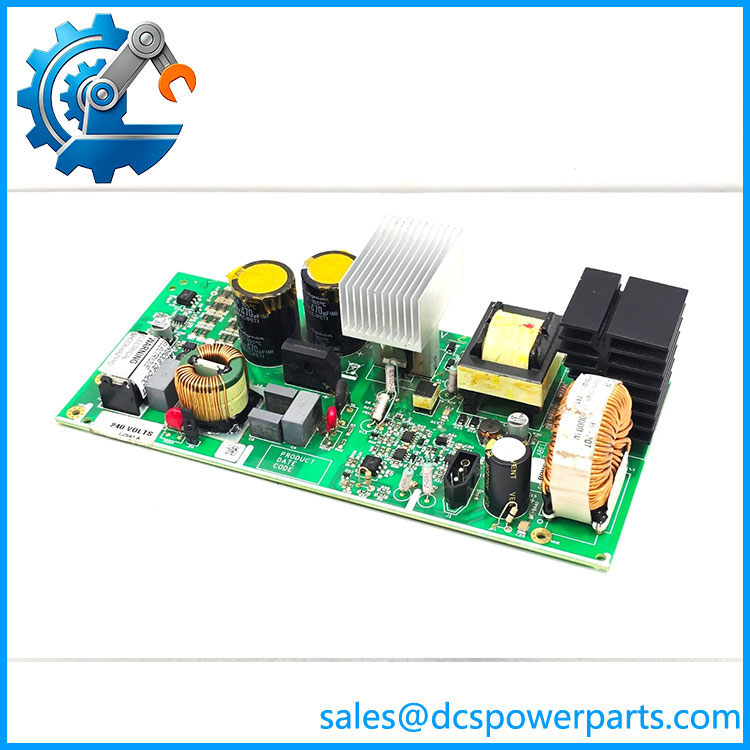
FLPS-7
Major Features / Practical Advantages
7.0 A 24 VDC Power Architecture
The defining characteristic of the is its 7.0 A total 24 VDC capacity. This provides considerably more system power than the lower-capacity FLPS-3 used in some related panel configurations. Honeywell’s SFP and MS documentation explicitly distinguishes the FLPS-3 3.0 A configuration from panels providing 7.0 A total 24 VDC output.
Designed Around Fire Alarm Panel Loads
The supply is intended to operate as part of the host FACP rather than as a general-purpose DIN-rail power source. Notification appliance circuits, annunciator power, resettable power, non-resettable power, and standby battery functions have defined relationships within the panel design.
That matters during troubleshooting. A panel showing a power-related trouble condition does not automatically mean the itself has failed. Excessive NAC loading, battery problems, wiring faults, grounding problems, or another supervised circuit can produce symptoms that appear to be power-supply related.
Suitable for Legacy Panel Maintenance
The appears across multiple Fire-Lite/Notifier product families. Documented examples include RP-2002/E agent-release panels, SFP-5UD/SFP-10UD panels, and MS-5UD/MS-10UD configurations.
For procurement, that broad application range is useful but also creates a trap: compatibility should be verified against the exact panel model rather than inferred from the part number alone.
Supports Supervised Fire-System Power Distribution
In the documented RP-2002 architecture, the power system provides separate circuits for resettable/non-resettable power, ANN-BUS power, and notification appliance circuits. Maximum current limits are specified for each circuit.
This is why substituting a generic 24 VDC supply is not an equivalent engineering solution. The power supply participates in the listed fire alarm system architecture.
Procurement-Relevant Construction
When purchasing an for a legacy installation, the useful verification points are the module markings, host panel model, board revision, connector arrangement, and existing wiring documentation. A surplus module that physically fits the enclosure is not automatically equivalent to a listed replacement.
Related Products
- FLPS-3 — Lower-capacity Fire-Lite/Notifier power-supply configuration providing 3.0 A total 24 VDC output in documented panel families.
- RP-2002 — Six-zone agent-release control panel using an power-supply configuration with 120 VAC input.
- RP-2002E — 220/240 VAC version of the RP-2002 agent-release panel using the architecture.
- RP-2001 — Agent-release control panel family documented with .
- SFP-5UD — Five-zone fire alarm control panel; certain variants use for 7.0 A 24 VDC output.
- SFP-10UD — Ten-zone fire alarm control panel family using in specified versions.
- MS-5UD-7 — Five-zone Fire-Lite panel configuration with .
- MS-10UD-7 — Ten-zone Fire-Lite panel configuration with .
- N-ANN-80 — Remote LCD annunciator used with compatible ANN-BUS fire alarm panels.
- N-ANN-RLY — Relay module used with compatible Notifier/Fire-Lite panel architectures.
FAQ
Is a standalone 24 VDC industrial power supply?
No. It is a fire-alarm-system power-supply module intended for compatible Fire-Lite/Notifier control panels. Its electrical function is only one part of the overall listed system architecture.
What is the output rating of ?
The documented configuration provides 7.0 A total at 24 VDC. Individual circuit limits are lower; for example, the RP-2002 documentation specifies up to 3.0 A per NAC and 0.5 A for several auxiliary power circuits.
Can I replace with another 24 VDC power supply?
Not as a direct assumption. The replacement must be compatible with the host fire alarm panel’s electrical, supervision, battery, and listing requirements. A generic supply with a matching voltage and current rating does not establish system equivalence.
Is compatible with RP-2002E?
Yes, the RP-2002E documentation specifically identifies the panel as using an power supply. The RP-2002E uses 240 VAC input, while the standard RP-2002 uses 120 VAC.
Can I hot-swap the ?
Do not assume hot replacement. This is part of a fire alarm control system with AC power, standby batteries, supervised circuits, and potentially active notification/releasing functions. Replacement should follow the host panel’s approved service procedure and required system isolation.
Does have firmware version 3.1?
There is no reliable model-specific evidence establishing an independently configurable firmware version such as v3.1. Firmware questions should normally be directed to the host control-panel assembly rather than treating as a programmable controller.
What should I verify before ordering a replacement?
At minimum, verify the host panel model, marking/revision, connector arrangement, AC input configuration, battery arrangement, and existing panel documentation. For a releasing panel, preserve the existing cause-and-effect configuration and verify the complete system after replacement.
Does New Surplus condition prove the is factory equivalent?
No. New Surplus generally describes physical commercial condition, not guaranteed configuration history. For a fire-protection application, inspect the identification label, revision, connector condition, and compatibility with the installed panel before commissioning.
Procurement Note
should be purchased as a system-specific fire alarm replacement component, not simply as a 24 VDC power module. The 7.0 A rating is well documented, but the surrounding circuit allocation and supervision are controlled by the host panel.
For a legacy replacement, record the existing panel model and all markings before ordering. After installation, verify AC operation, battery charging, trouble supervision, auxiliary power, notification circuits, and any releasing functions required by the site commissioning procedure. For life-safety equipment, a successful power-up is not sufficient evidence that the replacement is correctly integrated.