Description
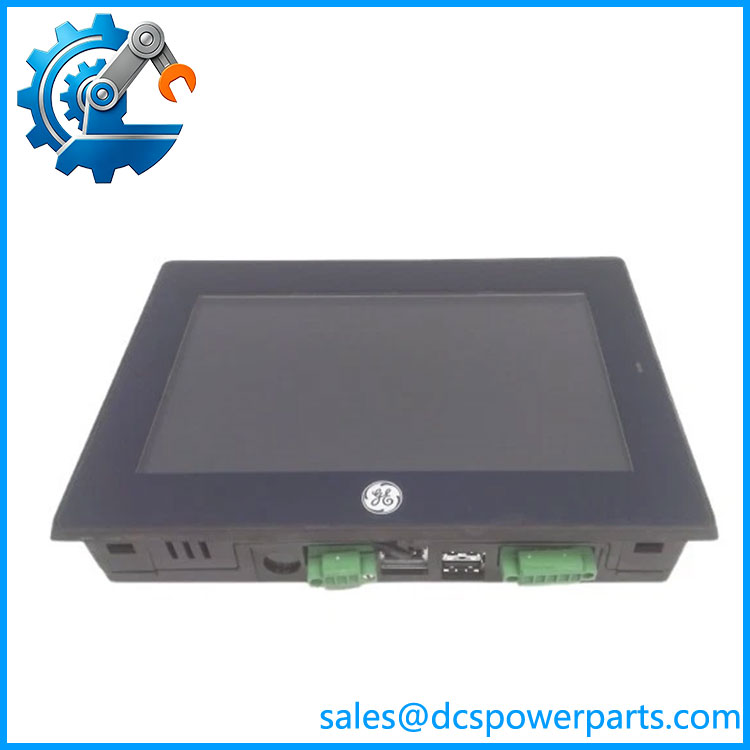
GE IC755CSW07CDA QuickPanel+ 7-Inch HMI
Product Overview
The GE IC755CSW07CDA is a 7-inch QuickPanel+ View & Control operator interface designed for industrial machine and process-control applications. GE documentation specifies a Freescale i.MX535 processor running at 1 GHz, with 512 MB DDR2 SDRAM, 256 MB SLC NAND Flash, and 512 KB battery-backed SRAM. The front panel uses a 7-inch widescreen TFT display with 800 × 480 WVGA resolution and projected-capacitive two-point multi-touch operation.
From a controls perspective, the GE IC755CSW07CDA sits above the PLC or controller rather than replacing it. It provides the operator-facing visualization layer: process graphics, alarm displays, trends, data entry, machine commands, and diagnostic information. Communication is available through one 10/100Base-T Ethernet port and one RS-232 serial interface, while two USB 2.0 Type-A ports and a Mini-B USB connection support service and peripheral functions. An SD/SDHC slot can provide removable storage.
The unit is part of the QuickPanel+ platform and was designed to be programmed with the Proficy Machine Edition View environment. Depending on the application, it can communicate with controllers and I/O over Ethernet or serial connections and can also operate as a gateway between control equipment and higher-level systems. Published QuickPanel+ material also describes OPC functionality, alarms, trends, data collection and visualization objects, with application capacity described in terms of up to approximately 8,000 variables.
One procurement issue deserves attention: IC755CSW07CDA is a revision-sensitive product. Emerson’s release history records multiple hardware/firmware revisions from the original 2014 releases through later Build 41/41D upgrade packages. Therefore, the base model number alone does not tell you the installed firmware generation.
Product Introduction
A 7-inch HMI failure can stop an otherwise healthy PLC system from being operated safely, particularly when the original application depends on the QuickPanel runtime, alarm history, recipes, or controller communications. The IC755CSW07CDA provides the operator layer while leaving the underlying control logic in the PLC or automation controller.
For a legacy HMI replacement, the important data are the complete suffix/revision, firmware build, project backup, communication drivers, screen resolution, and PLC protocol configuration. Physical compatibility alone is not enough.
Key Technical Specifications
| Parameter | Specification |
|---|---|
| Product Model | IC755CSW07CDA |
| Product Family | QuickPanel+ View & Control |
| Manufacturer | GE Intelligent Platforms / General Electric / Emerson |
| Product Type | Industrial HMI / operator interface |
| Display | 7-inch color TFT |
| Display Resolution | 800 × 480 WVGA |
| Touch Technology | Projected capacitive, 2-point multi-touch |
| Processor | Freescale i.MX535, 1 GHz ARM Cortex-A8 |
| L1 Cache | 32 KB instruction + 32 KB data |
| L2 Cache | 256 KB unified |
| Graphics | 2D/3D graphics processing capability |
| RAM | 512 MB DDR2 SDRAM |
| Flash | 256 MB SLC NAND Flash on the base specification |
| Battery-Backed SRAM | 512 KB |
| Ethernet | 1 × 10/100Base-T RJ-45 |
| Serial | 1 × RS-232 COM port |
| USB | 2 × USB 2.0 Type-A plus 1 × USB 2.0 Mini-B |
| Removable Storage | 1 × SD/SDHC slot |
| Audio | Line-out and microphone input |
| Power Supply | 24 VDC nominal |
| Power Consumption | Less than 15 W |
| Operating System | Windows Embedded Compact 7 |
| Programming | Proficy Machine Edition / View |
| Status Indicator | Tri-color LED |
| Audible Indicator | On-board buzzer |
| Operating Temperature | 0 to +55°C |
| Storage Temperature | -10 to +60°C |
| Humidity | Up to 85% RH, non-condensing at 30°C |
| Enclosure / Front Rating | Versions documented with IP65F / Type 4X characteristics |
| Mounting | Panel mounted |
| Approx. Panel Dimensions | 192 × 137 × 36 mm |
| Panel Cutout | Approximately 183.5 × 128.5 mm |
| Firmware | Revision dependent; do not assume a specific build |
The base hardware specification comes from GE’s QuickPanel+ documentation. Environmental and enclosure data are supported by published QuickPanel+ technical material.
Major Features / Practical Advantages
7-Inch Industrial Visualization
The 7-inch 800 × 480 display provides a compact operator station for machines, skids, utility systems and smaller process-control applications. The projected-capacitive screen supports two-point multi-touch rather than the older resistive touchscreen approach found on many legacy industrial HMIs.
For an existing installation, however, screen technology is only one part of the replacement calculation. The existing application project and runtime environment remain more important than the panel’s physical display specification.
IC755CSW07CDA
1 GHz ARM-Based Processing Platform
The uses a Freescale i.MX535 processor with a 1 GHz ARM Cortex-A8 core, together with dedicated graphics processing capability and hardware caching. This gives the QuickPanel+ enough processing capability for graphical HMI applications, trends, alarms and operator interaction without requiring a separate industrial PC for the local interface.
The processor specification should not be interpreted as equivalent to a PLC CPU. Control sequencing and deterministic machine logic remain functions of the connected controller.
Ethernet and Serial Controller Communications
The panel provides a 10/100Base-T Ethernet port together with an RS-232 serial port. This allows it to interface with both Ethernet-based and serial-based automation equipment, depending on the installed application and supported communication driver.
That flexibility is useful when maintaining older machines. A legacy project may rely on a serial driver even when the replacement HMI itself has Ethernet capability. Simply moving the cable to Ethernet will not reproduce the original communication configuration.
Windows Embedded Compact 7 Platform
The QuickPanel+ platform uses Windows Embedded Compact 7. This is significant for long-term maintenance because application behavior can depend on the installed runtime, firmware build and project version rather than only the hardware part number.
Emerson’s release history documents numerous firmware generations for , including Builds 16, 17, 20, 21, 25, 31, 34, 35, 37, 38, 39, 40 and 41, along with corresponding upgrade packages.
USB and Removable Storage
Two USB 2.0 Type-A ports, a Mini-B USB connection and an SD/SDHC card slot provide service and data-storage options. These interfaces can be useful during project transfer, maintenance and data-handling tasks, but their actual availability to the application depends on the installed software configuration.
Gateway and SCADA Integration
The QuickPanel+ platform can serve as more than a local display. Published technical information describes OPC functionality and the ability to bridge controller/I/O communications toward higher-level SCADA systems.
This makes the relevant in retrofit applications where the HMI also performs data collection or supervisory communication. The exact protocol stack, however, depends on the installed project and software licensing/configuration.
Revision History Matters
The most important procurement issue with this model is revision matching.
Emerson’s documentation shows that later hardware revisions changed memory technology and firmware. For example, the 2019 Build 35 revision changed the RAM specification to 512 MB DDR3 and the ROM to 512 MB NAND Flash, while later revisions introduced Builds 38–41.
Therefore, do not assume that every physical unit has identical internal hardware simply because the base part number is the same.
Related Products
- IC755CSS12CDA — 12-inch QuickPanel+ View & Control panel with 800 × 600 display and a larger memory configuration; suited to applications requiring more screen area.
- IC755ACC07GAS — Replacement gasket for the 7-inch QuickPanel+ panel.
- IC755ACC07MNT — 7-inch QuickPanel+ mounting/accessory kit.
- IC755ACC07PRO — Replacement screen-protector accessory for the 7-inch panel.
- IC755ACCBATT — Replacement battery pack for compatible QuickPanel+ units.
- IC755CSS12CDA — Larger QuickPanel+ family member using the same general View & Control concept but a 12-inch display.
- Proficy Machine Edition View — Engineering environment used for QuickPanel+ visualization application development.
- QuickPanel+ View & Control — Product platform containing the and related operator-interface models.
FAQ
What is the ?
It is a GE QuickPanel+ 7-inch industrial HMI/operator interface. It provides visualization and operator-control functions for automation systems rather than acting as a standalone PLC CPU.
What PLCs can the communicate with?
That depends on the communication driver installed in the HMI project. The hardware supports Ethernet and RS-232 communications, while QuickPanel+ software supports multiple controller communication methods. Do not infer a specific PLC protocol solely from the hardware part number.
Is the a 24 VDC device?
Yes. GE’s ordering information identifies the as a 24 VDC-powered QuickPanel+ unit. Published technical specifications give the input as 24 VDC with ±20% tolerance.
Can I hot-swap the ?
Do not assume hot-swapping. The panel is an electronic HMI containing internal storage, battery-backed memory and an operating system. Follow the machine’s shutdown procedure, isolate the applicable supply, and preserve the existing project before replacement.
Does the support firmware v3.1?
There is no evidence that v3.1 is the relevant firmware designation for this model. Emerson’s release history instead identifies numbered firmware builds, including Builds 16 through 41 and associated D variants.
Does the base number guarantee the same hardware revision?
No. This is an important procurement issue. Emerson documents multiple revisions and firmware releases, including changes to memory technology. Match the complete suffix and revision whenever possible.
Can I replace an older with a later revision?
Potentially, but this should be treated as a project-compatibility check rather than a guaranteed drop-in replacement. Confirm the firmware/runtime generation, project file, communication drivers, application behavior and any required web upgrade package.
What software is used to program this HMI?
The QuickPanel+ documentation identifies Proficy Machine Edition View as the development environment for the panel’s visualization applications.
Does the panel have battery-backed memory?
Yes. The published base specification identifies 512 KB of battery-backed SRAM. The unit also has an internal battery arrangement documented in the QuickPanel+ product family.
Is New Surplus condition enough to verify a replacement?
No. For this model, the complete revision is particularly important because the family underwent multiple firmware and hardware changes. Inspect the label, revision, firmware build, display/touch condition, battery status and connector condition before approving a replacement.
Procurement Note
For a replacement, obtain the complete identification from the existing panel rather than ordering from the base model number alone. Record the suffix/revision, firmware build, project-development version, PLC communication driver, and any installed expansion or storage media.
The revision history is not trivial. Emerson records hardware and firmware changes across the lifecycle, including changes to RAM and NAND flash and firmware builds extending through Build 41/41D.
Before commissioning a replacement, back up the original HMI project and verify screen operation, touchscreen calibration, PLC communications, alarms, trends, recipes, data logging and any gateway/OPC functions used by the machine. A panel that boots correctly is only the first check; the real acceptance criterion is successful operation of the original HMI application and controller communications.