Description
Product Overview
PM891 is the largest processor in the AC 800M range: a 450 MHz MPC8270 with 256 MB of memory, of which 208.985 MB is available to the application — four times what a PM866A offers. In an 800xA plant it is the CPU chosen when the application has simply outgrown the mid-range units: plant-wide logic with hundreds of loops, dozens of applications, sequence and batch logic in the same controller, or programs that must be downloaded as a single database rather than split across CPUs.
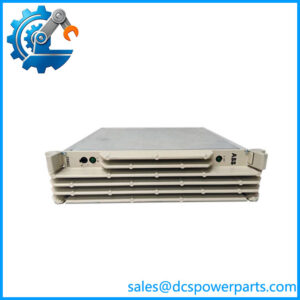
What distinguishes it from every other AC 800M processor is not the memory figure but the construction. The PM8xx family is a two-part device — a baseplate that stays wired in the cabinet and a processor module that slides onto it. PM891, by contrast, is a monolithic unit: power supply, CPU boards and unit termination in one housing, with the CEX-bus mounted on the unit itself and its Ethernet address label on the right-hand side of the housing rather than on a separate baseplate. There is no TP830 behind it and nothing to slide it onto.
That single design decision propagates through everything else. The unit is 174 mm wide, not the 119 mm of the PM8xx family, so a cabinet slot laid out for a PM864 or PM866 has to be re-planned rather than reused. It dissipates 15.8 W, with an 18 W maximum, against roughly 5 W for a PM866A — which is a thermal question for the enclosure, not a footnote. It carries two RJ45 Ethernet ports and one serial port, COM4, isolated and intended for a configuration tool; there is no COM3, and therefore no modem-capable port. The ModuleBus is optical only — seven clusters of S800 I/O, up to 84 modules — with no electrical ModuleBus on the unit at all.
The absence of an internal battery is the least obvious and most consequential difference. ABB states plainly that the PM891 contains no internal battery; ABB’s own product data for the related kit lists zero batteries. Retention of the application does not depend on a lithium cell the way it does on a PM8xx, where a dead battery plus a power interruption means a lost program. Instead the unit carries a 16 MB flash PROM for firmware, flash storage for the application, and a Secure Digital interface for plug-in backup media — a card format change from the Compact Flash used elsewhere in the family, and a detail that matters to anyone maintaining a stock of programmed backup media.
Redundancy is built for this class of unit specifically. Two PM891s form a redundant pair with a maximum switchover of 10 ms, and they are joined by two links rather than one: an RCU Control Link and an RCU Data Link, using the TK856 and TK855 cables respectively. ABB’s redundant kit, PM891K02, contains two processor units and both cables — but not the BC810K02 CEX-bus interconnection unit, which must be ordered separately and is what makes hot replacement of a PM891 possible. That missing line item is the most common procurement error on this CPU.
The environment ratings are industrial with two additions worth noting. The unit is rated IP20 with no enclosure required, conformally coated to ISA 71.04 G3, approved for Zone 2 under UL 60079-15 as Ex nA IIC T4 Gc, and — unlike most of the family — carries marine certificates from ABS, BV, DNV, LR and CCS, which is why it turns up on vessels and offshore installations where the rest of the AC 800M range would need additional justification.
Technical Specifications
| Parameter | Value |
|---|---|
| Model and order code | PM891, 3BSE053240R1 |
| Manufacturer | ABB |
| Product type | Processor unit, monolithic (power supply, CPU and termination in one unit) |
| Processor | MPC8270, 450 MHz |
| Performance | 0.043 ms per 1000 boolean operations |
| Memory | 256 MB, 208.985 MB available to application |
| Program storage | 16 MB flash PROM for firmware, flash for application, SD card interface |
| Ethernet | 2 × RJ45, 10/100 Mbit/s (CN1, CN2), MMS and IAC protocols |
| Serial | 1 × RJ-45 RS-232C, isolated (COM4, configuration tool); no COM3 |
| CEX-bus | 12 communication modules, max. 2.4 A supply |
| ModuleBus | Optical only, 7 clusters, max. 84 S800 I/O modules |
| Supply and dissipation | 24 V DC (19.2–30 V), typ./max. 660/750 mA, 15.8 W (18 W max.) |
| Redundancy | Pair of units, RCU Control Link + RCU Data Link, switchover ≤10 ms, no internal battery |
| Environment | 0 to +55 °C operating, −40 to +70 °C storage, G3 coating, IP20, 2 000 m |
| Approvals | UL 60079-15 Zone 2 Ex nA IIC T4 Gc, EN 61000-6-4/-6-2, UL 61010-1/-2-201, marine ABS/BV/DNV/LR/CCS |
| Dimensions and mass | 174 × 186 × 94 mm, 1 600 g (single unit); 4 kg for the redundant kit |
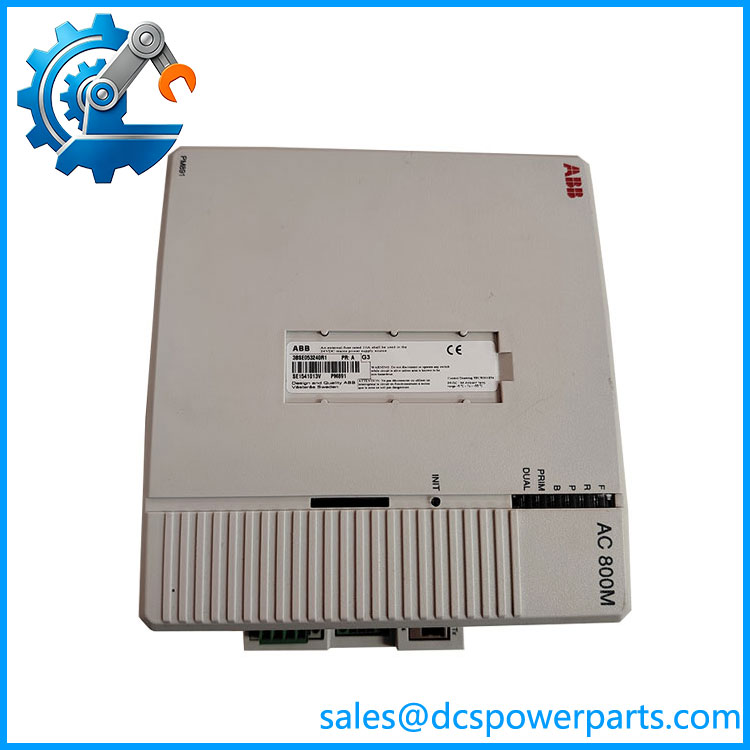
PM891 3BSE053240R1
Key Features and Advantages
Memory that ends the split-CPU conversation: 208.985 MB available to the application is not a marginal increase over 51.389 MB but a different class of budget. A plant that has been dividing its logic across several controllers to stay inside the memory ceiling can consolidate onto one PM891 and keep a single database, which removes the inter-controller communication that existed only to work around memory limits.
Capacity figures that are stated, not implied: 32 applications per controller, 64 programs per application, 128 diagrams per application, 32 tasks and 32 distinct cycle times, with cycle times down to 1 ms. Those numbers define how a large program must be partitioned, and they belong in the engineering file before the CPU is ordered rather than after the first download refuses.
A monolithic construction that simplifies the spare but complicates the swap: there is no baseplate to inherit and no sliding fit to preserve, so a replacement is a complete unit exchange — clean in principle, but it also means the mechanical envelope is fixed at 174 mm and the cabinet must already accommodate it. Plants migrating from a PM864 or PM866 need to plan the slot, not just the part number.
No battery to fail quietly: the usual AC 800M failure mode — a dead lithium cell discovered only when a power interruption takes the application with it — does not exist here. Firmware lives in flash, the application is stored in flash, and backup media is a Secure Digital card, so a unit that has been de-energised for a year still knows what it is when it is powered up.
Deterministic redundancy with its own wiring: two links rather than one, 10 ms maximum switchover, and control-network clock synchronisation of 1 ms between controllers over CNCP. Combined with the BC810 segmenting the CEX-bus, this is the configuration that keeps communication modules and S800 I/O available through a CPU failure rather than merely surviving it.
Power and heat that must be engineered, not assumed: 660 mA typical and 750 mA maximum at 24 V, with 15.8 W dissipated and 18 W at the ceiling, plus up to 2.4 A supplied onward to CEX-bus modules. A cabinet that powered a PM866A adequately will not necessarily power a , and the internal temperature rise is the first thing to check after a retrofit.
Applications
Plant-wide 800xA control in continuous process plants: refinery and petrochemical units where hundreds of loops, sequence logic and batch recipes share one controller and where consolidating several mid-range CPUs onto one reduces the number of databases to be maintained.
LNG and gas processing: liquefaction trains, compressor stations and export terminals, where the cycle-time and memory headroom allow anti-surge, metering and utilities to sit in a single controller and where the marine certificates help on near-shore and floating installations.
Power generation: combined-cycle and large fossil plants with boiler, turbine auxiliary and balance-of-plant logic in one CPU, and where the 1 ms clock synchronisation across controllers keeps sequence-of-events records consistent.
Marine and offshore: vessels, drillships and platforms, where ABS, BV, DNV, LR and CCS approvals make the the AC 800M processor that can be specified without a separate marine justification process.
Pulp and paper and metals: large mills and rolling plants where the application has grown across decades of additions and where a 208 MB application budget avoids re-architecting the control hierarchy.
Water and infrastructure: large treatment works and pumping networks with distributed optical ModuleBus clusters across a site, where 84 I/O modules per controller and seven optical clusters cover the geography.
Replacement of a failed unit in an existing redundant pair: the case where the bare 3BSE053240R1 code is the correct purchase, provided the BC810K02 arrangement and both RCU cables are already in place in the cabinet.
Related Products
PM891K01 (3BSE053241R1) — the single-unit package for this processor, the usual ordering path for a new installation. PM891K02 (3BSE053242R1) — redundant package: two processor units plus the TK850V007 CEX-bus extension cable, TK855 RCU Data Link cable and TK856 RCU Control Link cable. BC810K02 (3BSE031155R1) — CEX-bus interconnection unit that segments the bus and enables hot replacement; not included in the redundant kit, must be ordered separately. TK855 (3BSC950356R1) — RCU Data Link cable, 1 m, used between paired units. TK856 — RCU Control Link cable, the second link in a redundant pair. PM866A (3BSE076359R1) / PM866AK01 (3BSE076939R1) — the 133 MHz, 64 MB class this unit supersedes in memory terms; 119 mm wide and baseplate-based. PM864AK01 (3BSE018161R1) — the 32 MB mid-range processor most often replaced when an application outgrows its controller. PM867K01 (3BSE076355R1) — High Integrity processor for SIL applications; a different certification track, not interchangeable with . TP830 — the baseplate used by the PM8xx family and deliberately not used by ; keeping a spare TP830 on the shelf does nothing for a failure. CI854BK01 (3BSE069449R1) — PROFIBUS DP communication module mounted on the unit’s CEX-bus. TB840A (3BSE037760R1) — cluster modem for the optical ModuleBus, the standard way to attach distributed S800 I/O.
Installation and Maintenance
Before installation: confirm the cabinet slot accommodates a 174 mm wide unit and that the 24 V supply can carry 750 mA plus up to 2.4 A of CEX-bus load, and check the enclosure’s thermal margin for 18 W of dissipation. Verify that the ModuleBus run is optical — there is no electrical ModuleBus on a — and that any legacy dial-up or modem-based serial link has somewhere else to go, since only COM4 exists and it is a service port. In a redundant pair, confirm the BC810K02 is present rather than assumed to be in the kit, and have both the TK855 and TK856 cables on site before the maintenance window opens.
Maintenance practice: use the front-panel indicators — run, primary/secondary role, dual and fault — to establish the redundancy state before touching anything, and use the built-in web server for firmware and hardware version records. Because there is no battery, the tasks that consume PM8xx maintenance hours do not apply; the equivalent discipline is keeping the SD backup media current and the flash-stored application verified against the engineering database. When replacing one half of a redundant pair, replace it as a unit and let it take the secondary role, then confirm the pair has returned to redundant operation rather than merely running; and after any CEX-bus work, re-check the bus segments, because a disturbed BC810 arrangement shows up as communication modules that exist but do not answer.
Warranty and Quality
Every with order code 3BSE053240R1 is supplied as ABB’s monolithic AC 800M processor unit, with the 450 MHz MPC8270 board, 256 MB memory and the unit-level identity confirmed before dispatch, and with the distinction between this code and the PM891K01 and PM891K02 packages explained at the point of order so that a redundant pair is not built from the wrong line item. Units are inspected for housing and connector condition, DIN locking device integrity and SD interface function, and where a test rack is available they are checked for boot behaviour and Ethernet port activity. They carry a 12-month repair, replacement or refund commitment. Support covers the practical questions this CPU generates: whether a unit or a kit is required, whether the missing BC810K02 will block hot replacement, how to lay out the two RCU links, how to plan memory and CEX-bus loading for a consolidated application, and how to move an existing PM8xx application onto a 174 mm monolithic processor without losing serial or electrical ModuleBus functions in the transition.