Description
NI PXI-4462 Product Description
Key Technical Specifications
| Parameter | Specification |
|---|---|
| Manufacturer | National Instruments |
| Model | PXI-4462 |
| Part Numbers | 779688-01 / 188261-01 / 779131-01 |
| Product Type | PXI Dynamic Signal Acquisition Module |
| Application | Sound and vibration measurement |
| Analog Inputs | 4 |
| ADC Resolution | 24-bit |
| Maximum Sample Rate | 204.8 kS/s |
| Gain Settings | 6 |
| Input Coupling | AC/DC |
| High-Pass Filter Cutoff | 3.4 Hz |
| Dynamic Range | Up to 118 dB |
| Sensor Conditioning | IEPE |
| Input Connection | BNC / SMB depending hardware variant |
| Bus | PXI / CompactPCI; PXIe-ready hybrid variant available |
| Operating Temperature | 0 to 55°C |
| Form Factor | PXI |
| Lifecycle | No longer available for purchase |
NI’s specifications cover the PXI-4462 and PXI-4461 as a common 446x DSA family. The PXI version operates from 0 to 55°C, and the published specifications are tied to the recommended calibration interval.
Product Introduction
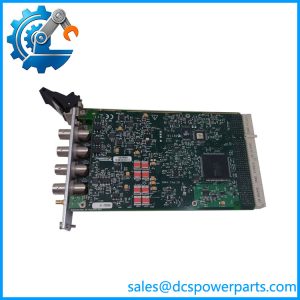
The NI PXI-4462 is a four-channel, 24-bit Dynamic Signal Acquisition module designed for precision sound and vibration measurement. All four analog inputs can be sampled simultaneously, with a maximum sample rate of 204.8 kS/s and six selectable gain settings. AC/DC coupling and integrated IEPE conditioning allow the module to interface directly with many microphones, accelerometers, and other dynamic measurement sensors.
The NI PXI-4462 is particularly useful in PXI-based test platforms where synchronized multi-channel acquisition is required for frequency-domain analysis. Typical applications include audio testing, automotive noise-vibration-harshness (NVH) measurement, machine condition monitoring, and laboratory dynamic testing. NI currently classifies the module as no longer available for purchase, so preserving the existing hardware and software environment can be important for legacy test stations.
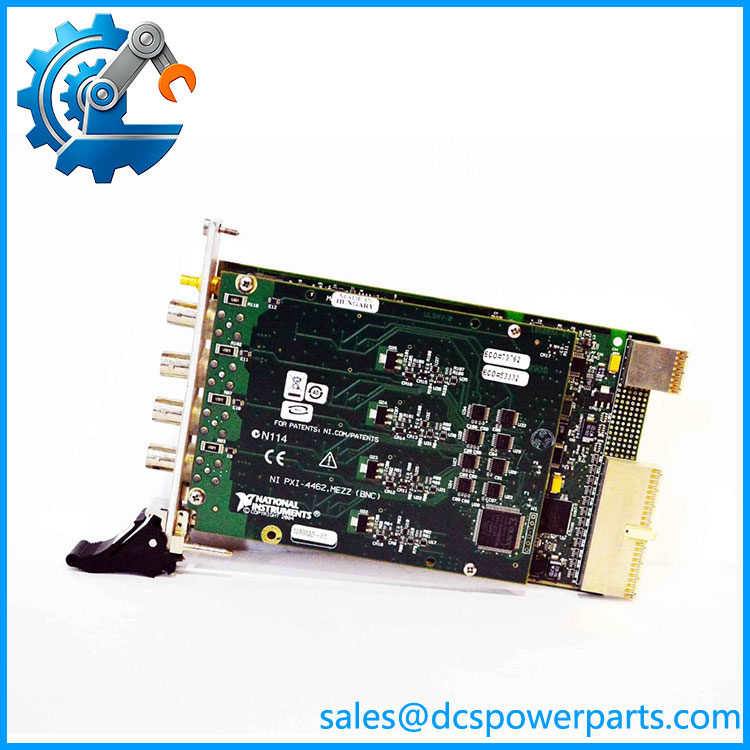
PXI-4462
Application Scenarios & Field Pitfalls — The Engineer’s Perspective
Engineering Pain Point
A failed PXI-4462 in an established test system is not necessarily solved by installing another four-channel DAQ card. The measurement chain depends on simultaneous sampling, dynamic range, gain configuration, IEPE excitation, filtering, synchronization, and application software. A conventional multifunction DAQ module may have four analog inputs but still produce different measurement behavior.
Typical Applications
- Machine vibration measurement — acquisition from IEPE accelerometers for rotating machinery and equipment diagnostics.
- Automotive NVH testing — simultaneous vibration and acoustic measurements during vehicle or component testing.
- Audio and acoustic testing — microphone acquisition for frequency-response and distortion measurements.
- Production and laboratory test systems — synchronized multi-channel dynamic measurements in PXI instrumentation racks.
Technical Pitfalls
1. Do not confuse PXI-4462 with PXI-4461.
Both belong to the NI 446x DSA family, but the PXI-4462 provides four analog inputs, while the PXI-4461 provides two inputs plus two analog outputs. They are not interchangeable simply because their model numbers are closely related.
2. There is no analog output subsystem on the PXI-4462.
The PXI-4462 is an acquisition-focused four-input module. If the original test application generates analog excitation through an NI 4461, a PXI-4462 cannot replace that output function.
3. Verify the hardware variant before procurement.
NI produced standard PXI and PXIe-ready/hybrid-slot versions of the 4461/4462. NI notes that the PXIe-ready version has some synchronization limitations compared with the standard PXI version because connector pins were removed to accommodate the hybrid connector. Check the installed chassis and module part number before replacement.
4. IEPE configuration must match the sensor.
The integrated IEPE conditioning is important when using powered accelerometers or microphones. Confirm the existing sensor’s excitation requirements and channel configuration rather than assuming every dynamic sensor should be connected with the same settings.
5. Four channels do not automatically mean equivalent measurement performance.
The PXI-4462 uses a DSA architecture with selectable gain and AC/DC coupling. Sampling rate, gain, filter configuration, sensor sensitivity, and signal level all influence the actual measurement result. The 24-bit figure alone is not an adequate basis for selecting a substitute.
6. Chassis synchronization should be documented.
For multi-module test systems, determine whether the installed PXI-4462 participates in PXI timing or trigger synchronization. NI specifically documents differences between standard PXI and PXIe-ready versions in this area.
7. EMI and grounding deserve attention.
NI’s specification warns that the sensitive inputs are not protected against electromagnetic interference for functional reasons. Cable routing, grounding, sensor cabling, and nearby power equipment can therefore affect actual measurement accuracy.
8. Calibration status matters.
The published accuracy specifications are associated with the recommended external-calibration interval. For production or laboratory measurement systems, check the module’s calibration history instead of evaluating a used card solely by whether the PXI chassis recognizes it.
9. Legacy software can determine whether a replacement works.
NI lists the PXI-4462 as no longer available for purchase, although support, repair, and calibration services remain listed. NI’s support page identifies PXIe-4464 as a suggested replacement. A migration should still be checked against the existing chassis, DAQ software, LabVIEW/TestStand application, channel configuration, synchronization scheme, and sensor interface.
Related Products
- NI PXI-4461 — 2-input/2-output member of the 446x DSA family; useful when analog output generation is also required.
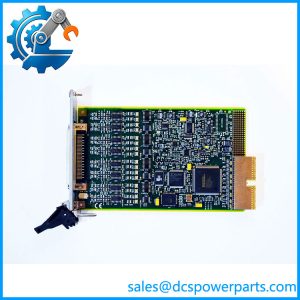
- NI PCI-4462 — PCI version of the four-input 4462 architecture for legacy desktop/industrial measurement systems.
- NI PXIe-4464 — newer four-input PXIe sound and vibration module identified by NI as the suggested replacement for the PXI-4462. Verify software and synchronization compatibility before migration.
- NI PXI-4472 — earlier PXI dynamic signal acquisition family for multi-channel sound and vibration applications.
- NI PXI-449x Series — higher-channel-count sound and vibration acquisition family for larger sensor systems.
- NI PXI-6652 — PXI timing and synchronization hardware serving a different function but potentially relevant in multi-instrument timing architectures.
- NI PXI-6608 — precision counter/timer module with eight counters and an OCXO; useful for timing/encoder work rather than dynamic analog acquisition.
Procurement note: For an existing PXI-4462 installation, record the exact part number (779688-01, 188261-01, or 779131-01), hardware revision, standard-versus-hybrid PXI connector configuration, chassis model, DAQ software version, application version, sensor type, IEPE settings, sampling rate, trigger/synchronization scheme, and calibration status. NI lists all three part numbers as no longer available for purchase, making an exact hardware match particularly important for legacy test equipment.