Description
Product Introduction
The National Instruments sbRIO-9627 is an embedded CompactRIO Single-Board Controller that combines a real-time processor, user-programmable FPGA, and onboard analog/digital I/O on one PCB. It is designed for embedded OEM control, test, measurement, and machine-control applications where the application requires deterministic FPGA processing together with a real-time operating environment. NI identifies the controller as using a 667 MHz dual-core ARM Cortex-A9 processor, a Zynq-7020 FPGA, 512 MB DRAM, and 512 MB nonvolatile storage.
The NI sbRIO-9627 also provides an RMC connector for expansion and direct access to FPGA-connected signals. Its onboard I/O includes 16 channels of 16-bit analog input, configurable as 16 single-ended or 8 differential channels, four 16-bit analog outputs, and 100 digital lines. Communications include Ethernet, CAN, USB, serial interfaces, and SD/SDHC storage. This combination makes the board considerably more than an I/O interface: it is the embedded computing and control core of an sbRIO-based system.
NI currently classifies the sbRIO-9627 as a mature product and lists recommended replacements, so it should be treated as a legacy platform when planning long-term system support. Existing applications should be evaluated for software, FPGA bitfile, operating-system, RMC, and mechanical compatibility before migration.
Key Technical Specifications
| Parameter | Specification |
|---|---|
| Manufacturer | National Instruments |
| Model | sbRIO-9627 |
| Part Numbers | 783817-01 / 783817-02 |
| Product Type | CompactRIO Single-Board Controller |
| Processor | Xilinx Zynq-7000 / Dual-Core ARM Cortex-A9 |
| Processor Speed | 667 MHz |
| FPGA | Zynq-7000 XC7Z020 |
| FPGA Logic Cells | 85,000 |
| DRAM | 512 MB |
| Nonvolatile Storage | 512 MB |
| Operating System | NI Linux Real-Time, 32-bit |
| Analog Inputs | 16 SE / 8 Differential |
| AI Resolution | 16 bit |
| AI Sampling | 200 kS/s aggregate |
| AI Range | ±1, ±2, ±5, ±10 V |
| Analog Outputs | 4 |
| AO Resolution | 16 bit |
| AO Range | ±10 V |
| Digital I/O | 100 bidirectional channels |
| RMC DIO | 96 channels |
| Ethernet | 2 × 10/100/1000Base-T |
| Onboard RS-232 | 2 |
| Onboard RS-485 | 1 |
| CAN | 1 onboard + 1 RMC CAN |
| USB | USB 2.0 Host |
| SD Card | SD/SDHC |
| Supply Voltage | 9–30 VDC |
| Recommended Supply | 55 W, 30 VDC maximum |
| Maximum Power Consumption | 29 W with RMC |
| Operating Temperature | −40 to +85 °C |
| RMC Connector | Yes |
| Mounting | Embedded/OEM PCB installation |
The detailed specifications are based on NI’s published sbRIO-9627 documentation.
Application Scenarios & Engineering Considerations
The NI sbRIO-9627 is particularly useful where conventional PLC scan-based control is not sufficient and the application needs FPGA-level processing.
- OEM machine control: The single-board format allows the controller to be integrated directly into a machine’s electronics rather than requiring a conventional modular chassis.
- High-speed control: FPGA resources can be used for deterministic timing, custom digital protocols, signal processing, and control loops.
- Test and measurement: The combination of 16-bit analog inputs, analog outputs, FPGA processing, and real-time software makes the board suitable for automated test equipment.
- Motion and custom I/O: The RMC connector provides additional FPGA-connected digital resources for custom interface hardware.
- Industrial communications: Ethernet, CAN, RS-232, and RS-485 interfaces allow the controller to communicate with external devices without relying entirely on RMC expansion.
Field note: The 3.3 V FPGA DIO should not be treated as a conventional 24 V PLC input/output. External level conversion, isolation, or interface circuitry may be required when connecting plant-level devices.
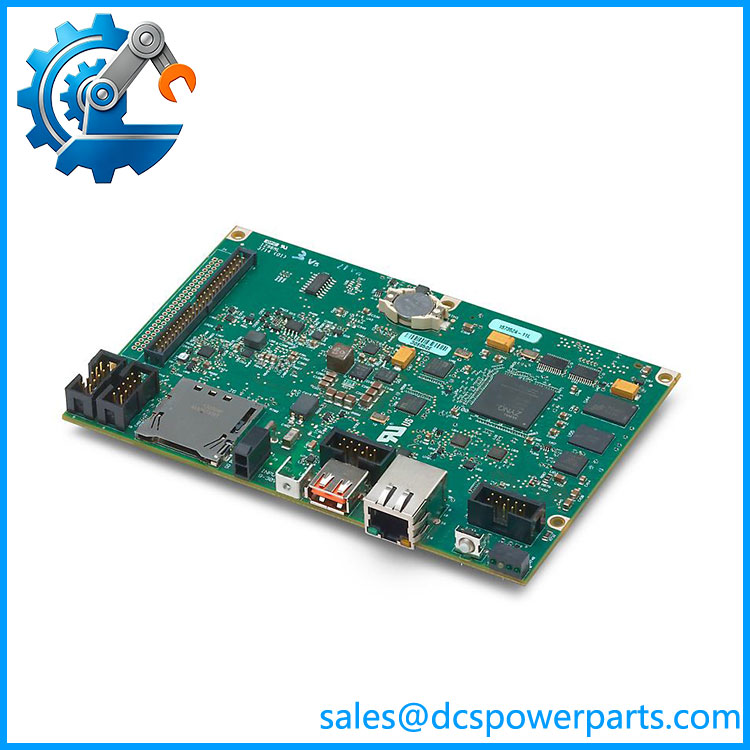
SBRIO-9627
Related Products
- NI sbRIO-9627 783817-01 — Development-kit version of the controller. NI states that this version includes additional development accessories, including the NI-9694 Digital I/O Breakout RMC.
- NI sbRIO-9627 783817-02 — OEM-oriented version of the same controller. It has the same fundamental sbRIO-9627 processor, FPGA, I/O, and RMC architecture.
- NI-9694 — Digital I/O Breakout RMC that provides practical access to sbRIO digital signals. It is included with the 783817-01 development-kit configuration.
- NI sbRIO-9607 — Related sbRIO controller from the same general embedded platform, but it has a different hardware configuration and should not be assumed to be a direct substitute.
- NI CompactRIO platform — Broader NI control platform using real-time processors and FPGA technology. For applications requiring published shock/vibration specifications, NI recommends CompactRIO systems rather than relying on sbRIO’s mechanical performance.
The Engineer’s Guide: Field Pitfalls to Avoid
⚠️ Do not confuse the sbRIO-9627 with a conventional PLC CPU.
The board combines a real-time processor and FPGA, and a substantial portion of the application’s behavior can reside in the FPGA bitfile and LabVIEW Real-Time software.
How to avoid it: When replacing a failed controller, preserve the NI Linux Real-Time configuration, application files, FPGA bitfile, LabVIEW version, and I/O configuration, not just the physical board.
⚠️ Do not connect 24 V field signals directly to FPGA DIO.
The RMC digital I/O operates around 3.3 V logic, with NI specifying ±3 mA maximum tested current per channel.
How to avoid it: Use suitable signal conditioning or isolated interface hardware for industrial field wiring.
⚠️ Check the RMC configuration.
The RMC connector provides high-density FPGA-connected I/O and can also carry communication interfaces and power. A replacement controller must match the RMC hardware used by the application.
⚠️ Do not overlook thermal design.
NI specifies a −40 to +85 °C local ambient operating range, but the final enclosure, mounting, airflow, and RMC hardware affect actual thermal performance. NI also notes that sbRIO shock/vibration performance is application-dependent rather than a published fixed specification.
Frequently Asked Questions
What is NI sbRIO-9627?
The NI sbRIO-9627 is an embedded CompactRIO Single-Board Controller combining a 667 MHz dual-core ARM processor, Zynq-7020 FPGA, onboard analog/digital I/O, communications, and an RMC expansion connector.
How many analog inputs does it have?
It provides 16 single-ended or 8 differential 16-bit analog inputs, with an aggregate sampling rate of up to 200 kS/s.
How many analog outputs are available?
There are four 16-bit analog outputs, with a ±10 V output range.
What FPGA is used?
The controller uses the Xilinx Zynq-7000 XC7Z020, providing approximately 85,000 logic cells, 220 DSP slices, and 560 KB block RAM according to the published specifications.
What supply voltage does sbRIO-9627 require?
The published supply range is 9–30 VDC, with NI recommending a 55 W, 30 VDC maximum supply. Maximum power consumption with an RMC is listed as 29 W.
Is sbRIO-9627 still recommended for new designs?
NI currently marks the sbRIO-9627 as mature and lists recommended replacement products, so it is better regarded as a legacy platform for existing installations rather than a first choice for a new design.
What should I verify before purchasing a replacement?
For a production replacement, verify:
- sbRIO-9627
- 783817-01 or 783817-02
- PCB/hardware revision
- Installed NI Linux Real-Time version
- LabVIEW and FPGA compatibility
- FPGA bitfile
- RMC hardware
- Analog I/O configuration
- Network configuration
- CAN/serial interfaces
- SD/boot configuration
- Power supply and thermal conditions