Description
Technical Specifications
| Parameter | Specification |
|---|---|
| Product Model | MTL831C |
| Manufacturer | Eaton MTL |
| Product Type | Analog multiplexer transmitter |
| Series | MTL830C |
| Number of Inputs | 16 |
| Input Types | Thermocouple, mV, RTD, potentiometer |
| RTD Connections | 2-, 3-, or 4-wire |
| mV Measuring Range | ±100 mV |
| Data Highway | Shielded twisted pair |
| Data Highway Function | Carries signal and power |
| Maximum Highway Distance | Up to 2 km, application and cable dependent |
| Receiver | MTL838C |
| Hazardous-Area Capability | Zone 0, Ex ia IIC T4 Ga, subject to approved installation |
| Power Supply | Loop-powered through the data highway |
| Typical Response Time | 500 ms |
| Operating Temperature | -40°C to +70°C |
| Storage Temperature | -40°C to +85°C |
| Weight | Approximately 0.26 kg |
| Mounting | 35 mm DIN rail |
| Input Termination | Fixed screw terminals |
The MTL831C is the fixed-terminal version. The MTL831C-PS uses pluggable screw-terminal inputs. The maximum highway distance is installation-dependent, not a guaranteed distance for every cable arrangement.
Product Introduction
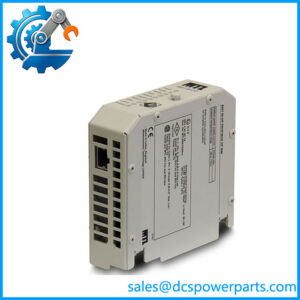
Eaton MTL831C Analog Multiplexer Transmitter
The Eaton MTL831C collects up to 16 analog sensor signals in hazardous-area installations and transmits their measurements to a remote MTL838C receiver. Its configurable input architecture supports thermocouples, millivolt signals, RTDs, and potentiometers, allowing different sensor types to share one field-side transmitter.
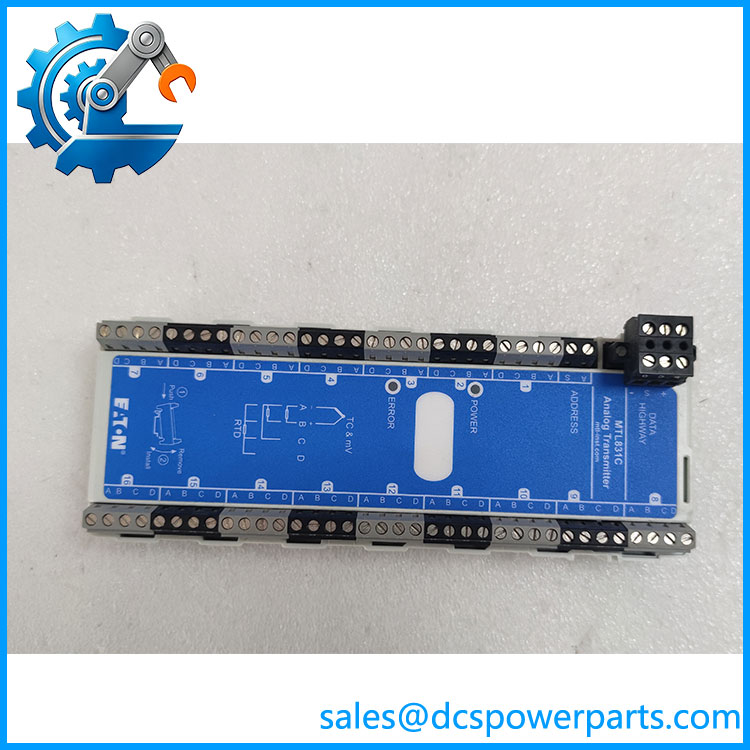
MTL831C
The data highway uses a single shielded twisted-pair cable to carry both communication and power. When paired with the appropriate receiver and MTL5553 isolator/power supply, the system provides a practical way to acquire distributed temperature and process measurements without running a separate signal cable for every sensor.
Application Scenarios & Field Pitfalls
The MTL831C is particularly useful in installations with many temperature measurement points distributed across hazardous process areas. Conventional point-to-point wiring can create substantial cable, tray, and termination requirements. The MTL830C system concentrates those sensor connections at the field transmitter and sends the measurements to the control-room receiver through a shared data highway.
Typical applications
- Oil and gas facilities: Monitoring temperature points across tank farms, process skids, and hazardous production areas.
- Chemical processing: Collecting thermocouple and RTD signals from reactors, vessels, and process pipelines.
- LNG and petrochemical plants: Reducing individual sensor cable runs across large installations.
- Industrial temperature monitoring: Combining different supported sensor types within one multiplexer transmitter.
Engineering checks before installation
- Verify the receiver model. The works with the MTL838C receiver family. Confirm whether the receiving interface is Modbus RS-485 or Modbus TCP before planning the control-system connection.
- Check intrinsic-safety barriers. When the transmitter is installed in a hazardous area, verify the required MTL5553 or approved MTL5053 isolator/power supply and the applicable entity parameters.
- Confirm sensor configuration. Each input must be configured for the actual sensor type and wiring arrangement. A 2-wire RTD configuration is not interchangeable with a 3-wire or 4-wire arrangement.
- Inspect data highway wiring. Use the recommended shielded twisted-pair cable and check cable length, shielding, grounding, and electrical noise conditions. The published maximum distance of 2 km depends on the installation.
- Observe mounting requirements. Mount the transmitter on a vertical plane using the specified DIN-rail arrangement. Temperature gradients caused by nearby heat sources can affect measurement accuracy.
- Check the terminal version. has fixed screw-terminal inputs; -PS has pluggable screw terminals. Confirm the installed version before ordering a replacement.
These installation considerations follow Eaton’s instruction manual and MTL830C system documentation.
Related Products
| Model | Function Difference | Potential Application |
|---|---|---|
| -PS | Analog transmitter with pluggable screw-terminal inputs | Installations requiring removable input terminals |
| MTL838C | Modbus RS-485 receiver for transmitters | Serial communication with a control system |
| MTL838C-MBT | Modbus TCP receiver | Ethernet-based control-system integration |
| MTL5553 | Intrinsic-safety isolator and power supply | Hazardous-area data highway interface |
| MTL5053 | Alternative isolator/power supply identified in earlier documentation | Specific approved intrinsic-safety configurations |
| FCS-9616 | Junction box with 16 sensor outlets and a data highway for one transmitter | Centralized sensor termination |
| FCS-9632 | Junction box with 32 sensor outlets and a data highway for two transmitters | Higher-density field sensor installations |
| ENC8 | Protective enclosure for field transmitter installation | Exposed or environmentally demanding locations |
These components support different parts of the MTL830C system. They are not direct replacements for the transmitter.
Procurement note: When sourcing an , confirm the fixed-terminal version, product label, hardware revision, and hazardous-area certification markings. If replacing an installed unit, also check the MTL838C receiver configuration, data highway wiring, sensor assignments, and intrinsic-safety documentation. A transmitter that physically fits the installation is not necessarily approved for the existing hazardous-area circuit.