Description
Kongsberg MOS-33 Midi Operator Station
Product Overview
The Kongsberg MOS-33 is a compact Midi Operator Station designed for marine automation systems where operators need local access to alarms, process information, and control functions without installing a full-size workstation. Kongsberg describes the MOS as a multipurpose operator station suitable for installation anywhere on a vessel, including exposed deck locations. It provides alarm indication, process control, and power-management functions through a color graphical display and integrated keyboard.
At the equipment level, the Kongsberg MOS-33 combines the display and operator interface into one dedicated marine HMI. The documented display is a 5.7-inch TFT color screen with 320 × 240 pixel resolution. Its keyboard includes menu/navigation keys, F1–F4 function keys, numeric and alphanumeric keys, a sound-off key, and an alarm-acknowledge key. Two relay outputs are also provided.
For maintenance engineers, the important point is that the MOS-33 is an operator terminal rather than the primary distributed I/O controller. Kongsberg documentation describes it as working with distributed processing units and a distributed database. In applicable systems, the station can display standard mimic diagrams, report visual and audible alarms, control process objects through the built-in controls, and allow database-related configuration through its keyboard.
The unit is specified for 18–32 VDC operation with ±5% ripple and approximately 10 W power consumption. Kongsberg specifies -15°C to +70°C operation, -25°C to +70°C storage, and maximum 96% non-condensing humidity. The mechanical envelope is approximately 252 × 144 × 70 mm, with a 242 × 134 mm flush-mount cutout.
Product Introduction
A shipboard HMI has a different job from a standard office touchscreen. It has to remain usable around vibration, temperature changes, machinery noise, alarms, and constrained console space. The Kongsberg MOS-33 was designed around that operating environment, providing physical keys and a dedicated graphical interface rather than depending on a general-purpose PC.
For a Kongsberg marine automation legacy replacement, verify the host system and software configuration before treating the MOS-33 as a simple display replacement. The unit is documented in Kongsberg systems including C20-related applications and Bridge Watch Monitoring System configurations.
Key Technical Specifications
| Parameter | Specification |
|---|---|
| Product Model | |
| Manufacturer | Kongsberg Maritime |
| Product Type | Midi Operator Station / Marine HMI |
| Primary Functions | Alarm indication, process control, power management |
| Display Type | TFT color display |
| Display Size | 5.7 in |
| Display Resolution | 320 × 240 pixels |
| Keyboard | Menu/navigation, F1–F4, numeric/alphanumeric, sound-off, alarm acknowledge |
| Relay Outputs | 2 |
| Supply Voltage | 18–32 VDC |
| Permitted Ripple | ±5% |
| Power Consumption | 10 W |
| Operating Temperature | -15°C to +70°C |
| Storage Temperature | -25°C to +70°C |
| Maximum Humidity | 96%, non-condensing |
| Weight | 1.5 kg |
| Overall Dimensions | 252 × 144 × 70 mm |
| Flush-Mount Cutout | 242 × 134 mm |
| Mounting | Table, ceiling, wall bracket, or flush mount |
| CAN Interface | Used in documented system configurations |
| Shock / Vibration | DNV Class B, IACS E10 |
| EMC | IACS E10, IEC 60945 |
The above values are taken primarily from Kongsberg Maritime’s datasheet.
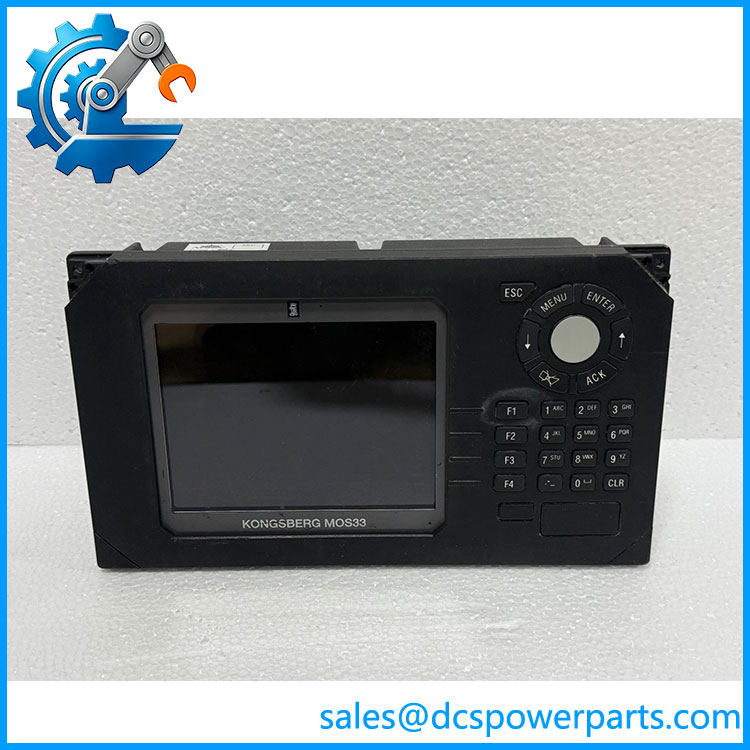
Kongsberg MOS-33
Major Features / Practical Advantages
Dedicated Marine Operator Interface
The was designed specifically as a marine operator station. Kongsberg describes it as suitable for installation throughout a vessel, including locations outside the main control room. That makes the unit useful where a local operator needs alarm visibility and process-control access without a conventional PC-based workstation.
The physical keyboard is also significant. F1–F4 function keys, numeric/alphanumeric entry, navigation controls, sound-off, and alarm acknowledgment are built into the station. This provides a fixed operator interface for shipboard systems rather than relying on a generic USB keyboard and monitor.
Alarm Indication and Acknowledgment
The provides both visual and audible alarm indication. Its documented functions include process and system alarm notification, sound-off operation, and alarm acknowledgment. The graphical display can present standard mimic diagrams using the station’s symbol library.
This architecture is particularly relevant to marine alarm-management systems where operators need to identify an alarm and interact with the corresponding process object from a dedicated panel.
Local Process Control
The is not limited to passive monitoring. Kongsberg specifies process control through the built-in pushbuttons with graphical feedback. The station can monitor an object from its input state through to a controllable object, depending on the host system configuration.
The actual controllable functions depend on the connected Kongsberg automation system and distributed processing units. The itself should not be treated as a replacement for the underlying DPU or controller.
Distributed-System Interface
Kongsberg documentation describes the MOS as working with distributed processing units and a distributed database. The station can provide access to database configuration using numeric and alphanumeric input.
This is an important distinction during troubleshooting: a blank display, communication failure, or incorrect process graphic does not automatically indicate a defective . The associated DPU, CAN network, configuration database, power supply, and system software may also be involved.
Marine Environmental Design
The is rated for -15°C to +70°C operation and 96% maximum non-condensing humidity. Kongsberg also documents DNV Class B and IACS E10 shock/vibration requirements, with EMC performance according to IACS E10 and IEC 60945.
These specifications explain why the unit should not be evaluated like a conventional commercial display. Installation location, mounting method, cable routing, vibration exposure, and vessel classification requirements still matter.
Compact Panel Installation
The unit measures approximately 252 × 144 × 70 mm, with a documented 242 × 134 mm flush-mount cutout. Kongsberg specifies bracket mounting for table, ceiling, or wall installations, while flush mounting is possible using the removable corners.
When replacing an installed unit, physically checking the cutout and rear connector clearance is worthwhile. A panel opening that looks compatible from the front can still create a problem behind the console.
Related Products
- Kongsberg C20 — Marine automation platform associated with Kongsberg operator and alarm-management architectures.
- Kongsberg RDi-32 — Distributed processing unit used for collecting digital input signals in documented Kongsberg systems.
- Kongsberg RDo-16 — Distributed processing unit used for output functions such as external alarm devices and relays.
- Kongsberg PSO — Power Switch Over unit used in applicable Bridge Watch Monitoring System configurations.
- Kongsberg Bridge Watch Monitoring System — System architecture using together with distributed processing and alarm-management hardware.
- Kongsberg K-Chief 500 — Marine automation platform in which MOS33 operator stations appear as replaceable system components in documented service information.
- Kongsberg AutoChief — Marine propulsion-control system associated with operator interfaces in documented applications.
FAQ
What is the Kongsberg used for?
The is a Midi Operator Station used for alarm indication, process monitoring, process control, and power-management functions in Kongsberg marine automation systems.
Is a PLC or DCS I/O module?
No. It is primarily an operator interface/HMI station. The distributed processing and I/O functions are handled by associated system hardware such as Kongsberg DPUs.
What display does the use?
The manufacturer datasheet specifies a 5.7-inch TFT color display with 320 × 240 pixel resolution.
What power supply does the require?
Kongsberg specifies 18–32 VDC with ±5% ripple and 10 W power consumption. An older Kongsberg installation manual also documents a 24 VDC supply as recommended for installations.
Does communicate through CAN?
Yes, CAN is documented in Kongsberg system configurations involving the . The exact CAN network topology and connected DPU arrangement depend on the host system.
Can I hot-swap the ?
Do not assume hot replacement. It is a powered marine operator station connected to the vessel automation network. Follow the applicable Kongsberg maintenance procedure, isolate the relevant power supply, and confirm the system’s backup/recovery procedure before disconnecting it.
Does the contain the complete automation application?
Not in the sense of being a standalone PLC controller. Kongsberg documentation describes distributed processing units and a distributed database associated with the station. The provides the operator-facing display, controls, and configuration interface.
Is the suitable for outdoor shipboard installation?
Kongsberg specifically describes the MOS as suitable for placement anywhere on the ship, including out on deck, while the datasheet specifies -15°C to +70°C operation and marine shock/vibration and EMC requirements. Actual installation still needs to comply with the vessel’s environmental and classification requirements.
What should I verify when purchasing a replacement ?
Check the complete part number, hardware revision, display condition, keyboard condition, rear connectors, power input, mounting dimensions, host Kongsberg system, CAN configuration, and the vessel’s application software/configuration. A physically compatible display does not automatically guarantee compatibility with the installed automation project.
Procurement Note
The Kongsberg should be purchased as a system-specific marine operator station, not as a generic 5.7-inch HMI. The manufacturer specifies the electrical and mechanical characteristics, but the actual graphics, alarms, process objects, and control functions depend on the Kongsberg automation architecture in which the unit is installed.
For a legacy replacement, preserve the existing system configuration before removing the old station. Verify the identification, display and keyboard condition, power supply, CAN connections, DPU arrangement, and host application. If the unit is being sourced as New Surplus, request photographs of the nameplate and rear connectors; condition alone does not establish compatibility.
One useful field check is simple: confirm the 252 × 144 × 70 mm envelope and 242 × 134 mm flush cutout before ordering. Mechanical mismatch is an easy problem to avoid and an annoying one to discover after the replacement reaches the vessel.