Description
Product Introduction (Non-Templated)
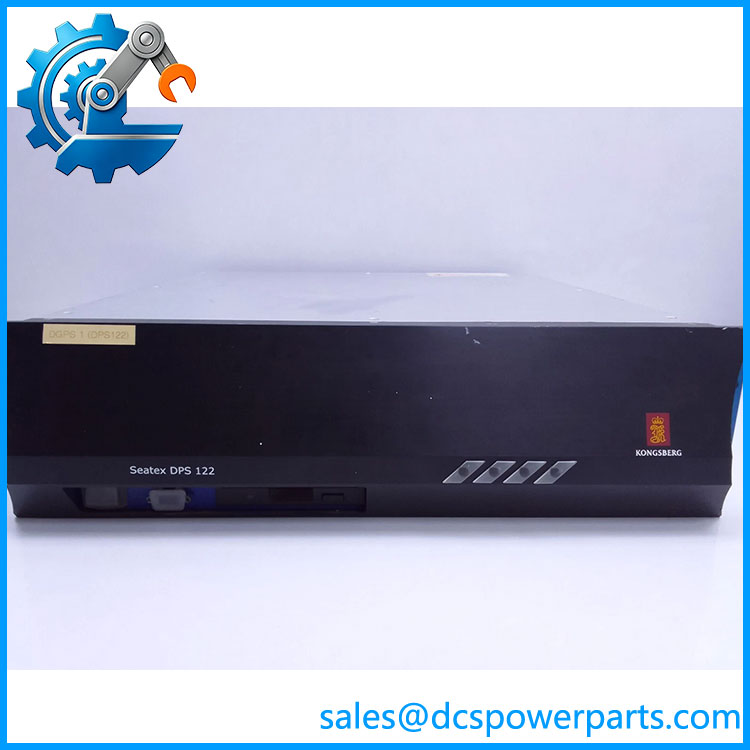
A DP system does not care whether a receiver looks healthy on the rack shelf; it cares whether the position data arriving at the controller is valid, stable, and correctly referenced. The Kongsberg DPS122 belongs to the Seatex DPS family developed for this purpose, providing GNSS-based position information for marine dynamic positioning applications. Older vessel documentation also shows DPS122 installed as a DP reference alongside other navigation sensors.
For legacy vessel maintenance, the DPS122 is primarily a position-reference replacement rather than a generic GPS receiver. The exact interface arrangement, correction source, antenna installation, and software configuration need to match the vessel’s existing system. That matters when maintaining an older DP system where changing one reference sensor can affect the configuration and validation of the complete positioning chain.
Key Technical Specifications
| Parameter | Specification |
|---|---|
| Product Model | DPS122 / DPS 122 |
| Manufacturer / Brand | Kongsberg Seatex |
| Product Type | Differential Positioning System |
| Primary Application | Marine Dynamic Positioning |
| Position Reference | GNSS / GPS-based |
| Differential Positioning | Supported |
| GNSS Technology | GPS; DPS family documentation also supports GPS/GLONASS configurations |
| Correction Sources | Differential correction inputs, depending on system configuration |
| Position Output | External position data for DP/navigation equipment |
| Position Reference Point | GNSS antenna position |
| Software Family | Kongsberg Seatex DPS software |
| Typical Environment | Offshore vessels, marine DP and navigation systems |
Kongsberg’s DPS system documentation states that the system was developed specifically as a position reference for DP applications and that calculated position data are referenced to the GPS antenna position. The same documentation describes use of GPS and/or GLONASS data and differential corrections.
A useful procurement distinction: DPS122 should not be identified solely from the word “DPS.” The DPS family contains several generations, including DPS132, DPS200, DPS232 and DPS700. Kongsberg’s historical release documentation confirms that these models shared software-development branches but were separate products.
Application Scenarios & Pain Points
Position-reference faults are particularly awkward on older DP vessels because the receiver itself may not be the actual source of the problem. A damaged antenna cable, poor connector, incorrect correction input, or mismatched output configuration can all present as position instability.
- Offshore DP vessels: DPS122 can serve as one of the vessel’s independent position references feeding the DP architecture. Kongsberg’s DPS documentation specifically identifies the product family for DP position-reference applications.
- Marine navigation systems: The calculated GNSS position can be passed to external navigation or control equipment. The physical reference point matters because the output is associated with the installed GNSS antenna location.
- Legacy offshore support vessels: Existing vessel specifications show Kongsberg used as a DP reference alongside other sensors, including DGPSS and motion-reference equipment.
- Emergency replacement programs: When an older processor fails, retaining the original antenna arrangement and external interface configuration can reduce commissioning work. That does not mean every DPS-family unit is interchangeable.

kongsberg DPS122
Field note: On a vessel with intermittent position loss, I would inspect the RF connector and antenna cable before condemning the processor. Salt contamination, moisture ingress, or a mechanically stressed coax connection can produce symptoms that look like receiver failure. The front-panel power indication tells you almost nothing about RF integrity.
Related Products
- Kongsberg DPS112 — A later compact DPS position-reference unit supporting GPS L1/L2, GLONASS L1/L2 and SBAS, with documented 100–240 VAC input and serial/Ethernet interfaces. It is related functionally but should not be treated as a direct substitute without an interface review.
- Kongsberg DPS132 — Another member of the legacy DPS family. Its shared family architecture makes it relevant when tracing older vessel configurations, but model-specific hardware and software compatibility must be confirmed.
- Kongsberg DPS200 — Legacy differential positioning equipment in the same product family. It can be encountered in older DP installations and may provide a useful reference when identifying historical system architecture.
- Kongsberg DPS232 — Later DPS-family positioning system supporting GPS/GLONASS dual-frequency operation and SBAS. It represents a later generation and should be assessed at the system-interface level before substitution.
- Kongsberg DPS700 — Another historical DPS model included in the same software release documentation. Its inclusion in the same release family does not establish physical or electrical interchangeability with .
- Kongsberg DPS i1 — Modern DPS-family position sensor using GPS, GLONASS, Galileo and BeiDou with support for differential and SBAS services. Its architecture is substantially newer than the generation.
- Kongsberg DPS i2 — Multi-function position sensor combining GNSS with optional inertial sensors and offering eight isolated serial ports, Ethernet and USB interfaces. It is better viewed as a system migration candidate than a simple legacy spare.
- Kongsberg DPS i4 — Multi-constellation DPS platform using GPS, GLONASS, Galileo and BeiDou together with INS integration. It represents a substantially different architecture from the older .
- Kongsberg DARPS 232 — A separate DP position-reference system designed for offshore loading and relative positioning between vessels such as a shuttle tanker and FPSO/FSU. It should not be confused with the standard position-reference system.
The Engineer’s Guide: Field Pitfalls to Avoid
⚠️ Do not assume a newer DPS model is automatically a plug-in replacement.
, DPS132, DPS200, DPS232 and DPS700 belong to the broader DPS family, but that does not prove identical electrical interfaces, software configuration, connector pinout, or output telegram behavior. Kongsberg’s historical release documentation treats these as distinct DPS models.
How to avoid it: Record the original unit’s model, hardware revision, software version, connected cables, serial-port configuration, correction source, and DP-system interface before approving a substitute.
⚠️ Do not troubleshoot the processor before checking the antenna path.
The position solution depends on the GNSS antenna installation. The DPS documentation identifies the antenna position as the reference point for the calculated position.
How to avoid it: Inspect the antenna connector, coaxial cable, cable routing, grounding, and physical antenna installation. Check for moisture or oxidation—especially around exposed deck-side connectors.
⚠️ Do not ignore software revision history.
The /132/200/232/700 release documentation records specific NAV Engine and HMI revisions, including changes related to UTC leap-second handling. Older software could produce incorrect position/time behavior around a leap-second event.
How to avoid it: Record the installed HMI and NAV Engine versions before replacement. If the replacement carries a different revision, confirm configuration and software compatibility rather than copying settings blindly.
Frequently Asked Questions (FAQ)
What is the Kongsberg used for?
The is part of the Seatex Differential Positioning System family developed for marine position-reference applications, particularly dynamic positioning. It calculates GNSS-derived position information that can be supplied to external DP/navigation equipment.
Is a GPS receiver or a complete DP system?
It is more accurately described as a position-reference system for DP, rather than a generic standalone GPS receiver. The DPS architecture includes GNSS positioning, differential correction processing, navigation functions, configuration software, and interfaces to external systems.
Can I replace with DPS232?
Do not assume a direct replacement. Both are members of the Kongsberg Seatex DPS family, but they are different generations. Before substitution, compare:
- GNSS and correction capabilities
- Antenna configuration
- Serial/Ethernet interfaces
- Output data formats
- HMI/NAV Engine versions
- DP-system compatibility
- Existing vessel configuration
The historical Kongsberg software release documentation lists and DPS232 as separate supported models.
What should I check when buying a used ?
For a vessel-critical positioning component, ask for evidence of actual functional testing rather than only a power-on photograph.
Recommended checks include:
- Exact identification and hardware revision.
- HMI and NAV Engine software versions.
- GNSS satellite acquisition.
- Differential-correction input.
- Position output through the relevant interface.
- Connector and enclosure condition.
- Antenna/cable compatibility.
- Configuration status.
- Repair history, if available.
- Warranty and dispatch lead time.
A unit can boot normally while its RF input or communications interface is defective.
Does the support GLONASS?
The broader Kongsberg DPS documentation describes DPS systems using GPS and/or GLONASS data, including dual-frequency GPS configurations. However, the exact GNSS capability depends on the specific hardware and software configuration.
For procurement, verify the actual receiver configuration from the unit’s identification information rather than assuming every has the same satellite capability.
Is still a current Kongsberg product?
belongs to an older generation of the Seatex DPS family. Kongsberg’s current DPS portfolio has moved toward newer DPS i-series architectures, including systems combining multi-GNSS and inertial technology.
For a legacy vessel, that creates two separate procurement paths: sourcing a compatible spare for the existing installation, or engineering a migration to newer DPS equipment. Those should not be treated as the same project.
What is the difference between and DPS112?
Both are Kongsberg Seatex position-reference products, but the DPS112 documentation specifies a later unit with combined GPS L1/L2, GLONASS L1/L2 and SBAS reception, 100–240 VAC input, three isolated serial ports, Ethernet and USB.
That makes DPS112 a useful reference when evaluating a modernization path, but the documented specifications alone are not sufficient to establish drop-in compatibility with an installed .