Description
Kongsberg Maritime RMP200-8
Product Overview
The Kongsberg Maritime RMP200-8 is an eight-channel Remote Multi Purpose I/O module belonging to the Kongsberg RIO200 family. Unlike a fixed-function digital input or analog output card, the RMP200-8 provides configurable field interfaces that can be assigned to several signal types. Kongsberg documentation specifies six common-ground channels that can individually handle digital input, digital output, analog input, analog output, or potentiometer signals. Two additional channels are individually galvanically isolated and can be configured for analog input, analog output, or digital input.
The module communicates and receives power through the RBUS architecture used by the RIO200 system. Kongsberg describes RBUS as both the communication link and power system for the remote I/O modules. The RMP200-8 provides redundant RBUS Link and RBUS Power interfaces, with the communication link based on multidrop RS-485 technology. Up to 99 RMP200-8 modules can be attached to one RBUS according to the hardware description.
This architecture makes the RMP200-8 particularly useful in marine automation installations where distributed field signals must be brought back to remote controllers without installing a separate fixed-function module for every signal category. The module is documented within Kongsberg DPC-2 and DPC-3 systems, and current Kongsberg certification documents continue to lis as an approved module in dynamic-positioning control-system equipment.
One procurement detail deserves attention: is a configurable I/O platform, not simply an “8-point digital output module.” Some commercial listings describe it that way, but Kongsberg’s own hardware documentation clearly establishes its multipurpose architecture.
Product Introduction
Marine automation systems often have a mixture of discrete contacts, analog measurements, control outputs, and potentiometer signals within the same remote cabinet. The Kong addresses that problem with eight configurable I/O channels rather than forcing the installer into a single signal type.
For a vessel maintenance project, the critical information is the actual channel configuration stored in the control-system engineering, not merel part number. A replacement board should therefore be checked against the installed configuration before commissioning.
Key Technical Specifications
| Parameter | Value |
|---|---|
| Product Model | |
| Manufacturer | Kongsberg Maritime |
| Product Family | RIO200 |
| Module Type | Remote Multi Purpose I/O Module |
| Kongsberg Part Number | 603443 |
| Total Channels / Ports | 8 |
| Common-Ground Channels | 6 |
| Common-Ground Functions | DI / DO / AI / AO / Potentiometer |
| Isolated Channels | 2 |
| Isolated Channel Functions | AI / AO / DI |
| Analog Span | 20 V, ±10 V |
| Analog Resolution | 16-bit ADC |
| Digital Output Supply | Regulated 24 VDC |
| Digital Output Current Limit | 0.1 A per channel |
| Communication Bus | RBUS |
| RBUS Physical Layer | Multidrop RS-485 with Manchester encoding |
| RBUS Architecture | Redundant communication and power connections |
| Ma Modules per RBUS | 99 |
| Status Indication | Run / Error LED |
| Diagnostics | Internal voltage monitoring and BITE |
| Replacement Method | Hot-module replacement supported |
| Marine Standards | IEC 60945, IACS E10 |
Specifications above are based primarily on the Kong hardware-module description.
Major Features / Practical Advantages
Eight configurable field channels
‘s most important feature is its mixed-signal architecture. Six channels can individually be configured for DI, DO, AI, AO, or potentiometer signals. That is considerably different from a conventional fixed-function 8-channel digital card.
For a marine control cabinet, this can reduce the number of specialized I/O module types required across distributed field stations.
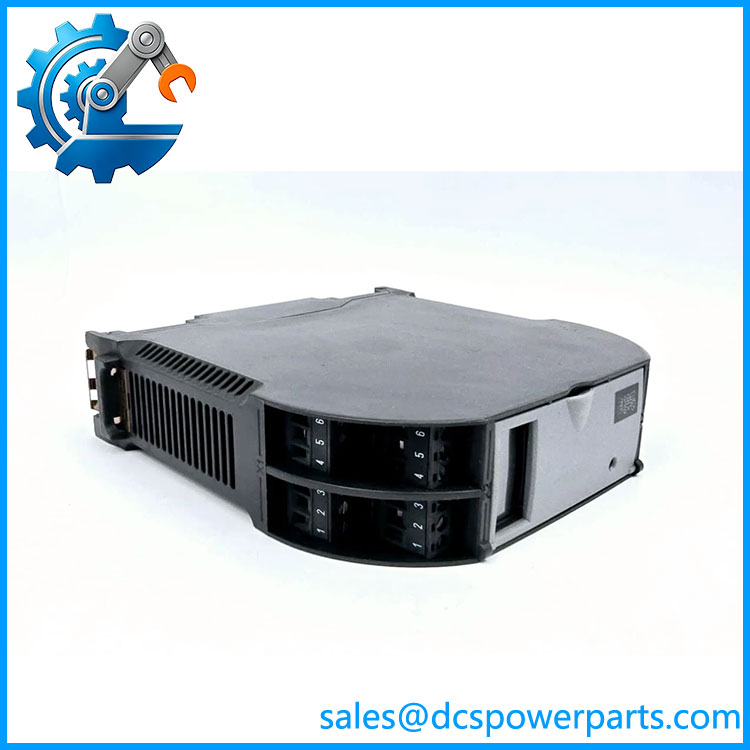
RMP200-8
Two individually isolated channels
Two channels provide individual galvanic isolation and support AI, AO, or DI operation. This is useful where a field signal requires electrical separation from the common-ground I/O portion of the module.
Do not, however, assume that all eight channels are individually isolated. Only the two designated isolated channels have that architecture.
16-bit analog conversion
Kongsberg specifies a 20 V analog span, ±10 V, with 16-bit resolution.
That provides substantially finer numerical representation than a low-resolution legacy analog interface, although actual measurement accuracy still depends on the complete signal path, field transmitter, wiring, configuration, and calibration. Resolution should not be confused with accuracy.
Regulated 24 VDC digital outputs
When configured for digital output uses regulated 24 VDC loop power with a documented 0.1 A current limitation per channel.
This specification matters when determining whether an output can directly drive a solenoid, relay coil, indicator, or other field load. A load exceeding the documented current limit should not be connected directly simply because the nominal voltage is 24 VDC.
Redundant RBUS interfaces
The module has redundant communication-bus and power connections. Kongsberg identifies RBUS as both the communication and power system for the RIO200 modules.
This architecture is important in marine automation because the remote I/O network is not merely carrying data; it also forms part of the module’s power arrangement.
Built-in diagnostics
includes a front Run/Error LED, monitoring of internal voltages, and built-in test equipment operating while the module is running.
For troubleshooting, these features can help distinguish a module-level fault from a field-wiring problem or RBUS communication issue.
Hot-module replacement
Unlike many legacy PLC cards where removal during operation should simply be prohibited, Kongsb documentation explicitly states that hot module replacement is supported.
That does not mean “pull the module whenever convenient.” In a vessel DP or process-control system, the engineering procedure still needs to account for the affected field signals and their fail-safe states. Hot replacement capability is a hardware feature, not a substitute for an approved maintenance procedure.
Marine environmental and certification orientation
hardware description identifies compliance with IEC 60945 and IACS E10. Kongsberg’s current Lloyd’s Register certification documentation also list among equipment evaluated for its dynamic-positioning control-system environment.
That makes the module materially different from an ordinary commercial PLC I/O card that happens to provide similar signal types.
Related Products
- RHUB200-5 — RIO200 RBUS hub/repeater with five downstream channels and controller-side connections; used for RBUS distribution rather than field I/O.
- RSER200-4 — Four-channel galvanically isolated serial interface supporting RS-232, RS-422, RS-485, or NMEA 0183 field interfaces.
- RMP201-8 — Later/related Kongsberg multipurpose I/O module appearing alon in current certification documentation; verify system compatibility before substitution.
- RCU501 — Remote Controller Unit used in the RIO200/DPC architecture; runs the process-control application and interfaces with bus systems.
- — The docum module reference used in Kongsberg spare-parts documentation.
- DPC-2 — Kongsberg process-control architecture documented with modules incl.
- DPC-3 — Kongsberg process-control architecture that also as a replaceable module.
FAQ
What is the Kong?
is an eight-channel Remote Multi Purpose I/O module in the Kongsberg family. It provides configurable digital and analog field interfaces and communicates through the RBUS architecture.
a digital output module?
Not exclusively. Some commercial listings describe it as an 8-point digital output module, but Kongsberg’s hardware documentation is more specific: six channels support DI, DO, AI, AO, and potentiometer functions, while two isolated channels support AI, AO, and DI.
How many channels are galvanically isolated?
Two channels are individually galvanically isolated. The other six are common-ground multipurpose channels.
What analog range support?
Kongsberg’s hardware description specifies a 20 V analog span, ±10 V, with 16-bit ADC resolution. The exact field configuration should still be checked against the vessel’s engineering database.
Can I hot-swa?
Yes, the Kongsberg hardware description explicitly states that the module allows hot-module replacement.
That should not be interpreted as permission to remove it from an operating DP system without following the vessel’s approved maintenance procedure. Before removal, determine what field signals are assigned to that particular module and what their required fail-safe state is.
support firmware v3.1?
Do not infer a firmware version fro model number. This is an remote-I/O module whose compatibility is primarily tied to the Kongsberg system architecture, hardware revision, module configuration, and controller/software environment.
What is the Kongsberg part numbe?
Kongsberg’s DPC-3 spare-parts documentation lists 603443 fo module.
How communicate with the controller?
It uses the RBUS architecture. The documented RBUS Link is a multidrop 2 Mbps RS-485 communication system using Manchester encoding, while RBUS also carries the module power arrangement.
Can I re with RMP201-8?
Do not assume a direct replacement. Kongsberg’s current certification documentation lists and RMP201-8, but that does not establish electrical, configuration, software, or mechanical interchangeability.
Confirm the controller generation, RBUS configuration, field wiring, module revision, and approved replacement procedure first.
What should I verify before purchasi?
For a vessel-critical spare, verify:
- Exact model:
- Kongsberg part number: 603443
- Hardware revision
- system generation
- RCU/controller model
- RBUS A/B connections
- Six common-ground channel assignments
- Two isolated-channel assignments
- Current AI/AO/DI/DO configuration
- Field terminal arrangement
- Existing configuration/database information
- Functional-test evidence
- Front-panel Run/Error indication
Is a refurb acceptable as a vessel spare?
Potentially, but the testing standard matters. Because the module is configurable, simply powering it on does not prove that every analog and digital function operates correctly. For a critical spare, request evidence covering RBUS communication, representative AI/AO operation, DI/DO operation, and the isolated channels where applicable.
Procurement Note
The Kongsberg Mar is a specialized remote multipurpose I/O module, not a generic eight-point digital-output card. Kongsberg’s documentation establishes the six common-ground configurable channels, two isolated channels, 16-bit analog conversion, 24 VDC/0.1 A digital-output limitation, redundant RBUS architecture, built-in diagnostics, and hot-module replacement capability.
For procurement, the most important item is the actual channel configuration modules with identical external part numbers can serve very different field functions depending on the engineering configuration. Before replacing one, obtain the vessel’s I/O list or configuration database and document which channels are assigned to DI, DO, AI, AO, and potentiometer functions.
The documented Kongsberg part number is 603443, and DPC-3 spare-parts documentation as a replaceable module.
Do not rely on generic supplier descriptions that simply an “8-point digital output module.” That description omits the most important feature of the hardware: its configurable mixed-signal architecture.
For a shutdown-critical or vessel-critical spare, request photographs of the actual module, revision marking, part number, and terminal/interface condition, together with functional-test evidence. If the module is intended for hot replacement, confirm the vessel’s approved maintenance procedure before removing the installed unit.