Description
Kongsberg Maritime RCU502
Product Overview
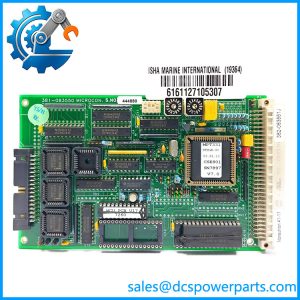
The Kongsberg Maritime RCU502 is a real-time Remote Controller Unit designed to function as the processing and remote-I/O communication node within Kongsberg marine automation systems. Kongsberg’s hardware documentation describes the RCU as a real-time single-board computer and remote I/O bus driver. The RCU502 hardware is based on a PowerPC MPC8245 processor operating at 400 MHz, with 64 MB RAM and 32 MB flash memory.
Rather than being an ordinary PLC CPU with a generic backplane, the RCU502 sits inside Kongsberg’s marine control architecture and provides several system-specific communication paths. The hardware includes dual Ethernet connections for Net A and Net B, RBUS A/B connections for remote I/O, PROFIBUS interfaces, CAN bus connections, serial links, RedNet, and FieldNet interfaces. The unit also contains local isolated digital I/O: four optically isolated digital inputs, four optically isolated digital outputs, and a watchdog function.
The RCU502 has been used in Kongsberg K-Chief 700 process-control installations and K-Thrust controller architectures. Kongsberg documentation for K-Thrust shows RCU502 units serving dedicated thruster controllers, with one or two RCUs used where redundancy is required.
A separate Kongsberg type-approval report is particularly important for maintenance engineers: the was introduced into the AIM Safe system specifically as a new controller intended to replace the RCU501. That approval evaluated the modified system against IEC 61508 requirements for safety-related applications.
Product Introduction
When an fails, replacing the physical controller is only part of the job. The controller also carries application software and system configuration, so procurement teams should treat it as a system-specific computing node, not a generic 24 VDC CPU card.
The architecture is built around redundant communication and control paths. Dual Ethernet, RedNet, and RBUS connections allow the to participate in Kongsberg controller redundancy and distributed I/O architectures. The correct application software must be loaded after replacement when the replacement unit does not already contain the required vessel-specific image.
Key Technical Specifications
| Parameter | Value |
|---|---|
| Model | |
| Manufacturer | Kongsberg Maritime |
| Product Type | Remote Controller Unit |
| System Role | Real-time controller and remote I/O bus driver |
| Processor | PowerPC MPC8245 |
| Processor Frequency | 400 MHz |
| RAM | 64 MB |
| Flash Memory | 32 MB |
| Supply | 24 VDC |
| Power Architecture | Redundant power connection |
| Ethernet | 2 × 10Base-T / 100Base-TX |
| Ethernet Ports | Net A / Net B |
| RBUS | RBUS A / RBUS B |
| RBUS Function | Remote I/O communication |
| Onboard Digital Inputs | 4, opto-isolated |
| Onboard Digital Outputs | 4, opto-isolated |
| Watchdog | Yes |
| CAN Bus | 2 interfaces documented |
| PROFIBUS | 2 interfaces documented |
| Serial Links | Multiple serial-line connections |
| Console Interface | RS-232 |
| RedNet | Redundant controller-network interface |
| FieldNet | Ethernet communication interface |
| Processor Architecture | Embedded real-time PowerPC |
| Typical System | K-Chief 700 / K-Thrust / Kongsberg marine control systems |
The core hardware figures above come from the Kongsberg hardware-module description.
Major Features / Practical Advantages
Real-time controller architecture
The is fundamentally a controller, not a remote I/O module. Its job is to execute the application and manage communication with distributed I/O and other system nodes. Kongsberg explicitly describes the RCU as a real-time single-board computer combined with an I/O bus driver.
That distinction matters when sourcing a spare. An RMP200-8, for example, handles field I/O; the provides the processing and system-level control function. Substituting one for the other is not technically meaningful.
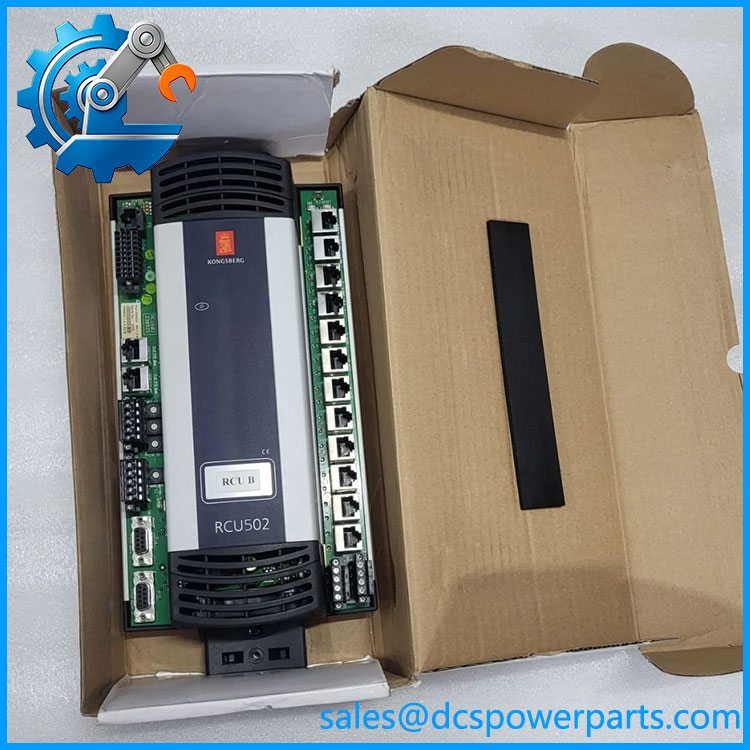
RCU502
PowerPC-based embedded computer
The documented hardware uses a 400 MHz PowerPC MPC8245, supported by 64 MB of RAM and 32 MB of flash.
The flash memory is particularly important during replacement. Kongsberg’s K-Thrust documentation explains that controller software is loaded into the RCU and stored in its flash memory so that normal restarts do not depend on another station to provide the software. When a replacement RCU is installed, the controller may need to obtain the required software from a configured operator or maintenance station and write it into flash.
Dual Ethernet networking
The hardware provides separate Net A and Net B Ethernet connections. The documentation identifies these as dual RJ45 interfaces supporting 10Base-T / 100Base-TX.
For redundant controller architectures, this separation is significant. Do not assume that two Ethernet connectors automatically mean two independent generic LAN ports; their actual function is determined by the Kongsberg system configuration.
RBUS remote-I/O connectivity
Two dedicated RBUS connections, identified as RBUS A and RBUS B, connect the with the RIO architecture. The hardware documentation specifically shows the RBUS connections leading toward the RIO/RHUB portion of the system.
This is one of the main reasons the should not be treated as a conventional industrial PC. Its hardware interfaces are closely tied to Kongsberg’s control-system architecture.
Onboard isolated digital I/O
The includes four opto-isolated digital inputs and four opto-isolated digital outputs, together with a watchdog function. Kongsberg’s training material illustrates the onboard I/O being used for functions such as power alarms.
These local I/O points should not be confused with the distributed RIO modules attached through RBUS.
Multiple industrial communication interfaces
In addition to Ethernet and RBUS, the hardware provides CAN bus, PROFIBUS, serial links, RedNet, and FieldNet interfaces. The exact application of each interface depends on the Kongsberg system and installed configuration.
For maintenance work, this creates an important diagnostic advantage: a communication fault should be investigated at the appropriate interface rather than automatically attributed to the controller CPU.
Redundant controller configurations
Kongsberg’s documentation shows both dual-RCU and triple-RCU redundancy configurations. The hardware training material also identifies the RedNet connections used for the controller network.
K-Thrust documentation gives practical examples of controllers dedicated to individual thrusters, with one or two RCUs used depending on the required redundancy arrangement.
Application software is part of the replacement equation
This is the procurement point that is often missed. The is not simply a board that can be installed and expected to operate because its hardware matches.
Kongsberg’s K-Thrust documentation states that when an RCU is replaced, the new controller can require a software download from an operator or maintenance station, after which the software is stored in flash for subsequent operation.
Therefore, a physically correct with an incorrect or empty application image may still be unusable until the system-specific software is restored.
Related Products
- RCU501 — Earlier Kongsberg Remote Controller Unit. Kongsberg’s AIM Safe approval specifically identifies as the controller introduced to replace RCU501.
- RMP200-8 — RIO200 remote multipurpose I/O module used for configurable field I/O; it does not perform the same controller function as .
- RHUB200 — RIO200 bus hub used to distribute the RBUS architecture to remote I/O modules.
- RSER200-4 — Serial interface module associated with Kongsberg’s remote I/O architecture and connected through RCU serial-link interfaces.
- RCU502i — Related variant identified in Kongsberg regulatory/certification records; exact interchangeability should be verified by hardware revision and system documentation.
- K-Chief 700 — Kongsberg integrated automation platform in which hardware is documented as a process-station controller.
- K-Thrust RCS Controller — Thruster-control architecture using one or two units together with remote I/O.
- AIM Safe — Kongsberg safety-control architecture in which was introduced as the successor to RCU501.
FAQ
What is the Kongsberg ?
The is a Kongsberg Maritime Remote Controller Unit. It functions as a real-time single-board computer and remote I/O bus driver within Kongsberg marine control systems. The documented hardware uses a 400 MHz PowerPC MPC8245 with 64 MB RAM and 32 MB flash.
Is a PLC CPU?
Functionally, it performs many duties associated with a PLC or process controller, but it is better described as a Kongsberg-specific real-time Remote Controller Unit. Its interfaces and software environment are designed around Kongsberg architectures such as K-Chief and K-Thrust rather than a generic PLC programming ecosystem.
Can I hot-swap the ?
Do not assume unrestricted hot swapping.
The participates in the controller, communication, and I/O architecture, and Kongsberg documentation describes redundant controller configurations. A controller replacement should therefore follow the applicable Kongsberg maintenance procedure and vessel operating requirements. The available documentation reviewed here does not establish a blanket “hot-swap under all operating conditions” rule.
Does support firmware v3.1?
The model number alone does not establish firmware v3.1. The stores system software in flash, and Kongsberg documentation describes loading application software into the controller during initial replacement/startup.
For procurement, request the actual hardware revision, installed software/application version, and vessel-specific software image rather than assuming a firmware number from the part number.
What happens when an is replaced?
A replacement RCU may need to obtain its application software from an operator or maintenance station. Kongsberg’s K-Thrust documentation states that the first startup can involve downloading software and subsequently storing it in the controller’s flash memory.
This means a replacement should be planned as a hardware plus software/configuration recovery task.
Is compatible with RCU501?
Kongsberg documentation confirms that was introduced as a replacement for RCU501 in the AIM Safe system.
That does not mean every installation can be converted by simply plugging in an . System release, application software, interface configuration, hardware revision, and safety-system approval must be checked.
Does have onboard I/O?
Yes. The documented hardware provides four opto-isolated digital inputs and four opto-isolated digital outputs, plus a watchdog function.
These local points are separate from the distributed I/O connected through RBUS.
What networks are available on ?
The documented interfaces include dual Ethernet Net A/Net B, RBUS A/B, PROFIBUS, CAN bus, serial links, RedNet, and FieldNet. The exact use of each interface depends on the installed Kongsberg application and system architecture.
Is used for thruster control?
Yes. Kongsberg K-Thrust documentation identifies as the controller used in dedicated RCS controller cabinets for individual thrusters. One or two units can form the controller portion of the architecture depending on redundancy requirements.
What should I verify before purchasing an ?
For a vessel-critical spare, verify:
- Exact model:
- Hardware revision
- Kongsberg system: K-Chief, K-Thrust, AIM Safe, or other application
- Existing RCU software/application version
- Required software image and recovery method
- Redundancy configuration
- Net A/Net B configuration
- RBUS A/B connections
- PROFIBUS/CAN/serial interface requirements
- Onboard I/O assignment
- Existing controller address settings
- Flash-memory/application status
- Physical connector condition
- Functional-test evidence
Procurement Note
The Kongsberg Maritime should be purchased as a system-specific marine controller, not as a generic embedded computer. Its documented 400 MHz MPC8245 PowerPC processor, 64 MB RAM, 32 MB flash, redundant Ethernet, RBUS, PROFIBUS, CAN, serial, RedNet, FieldNet, and onboard isolated I/O make it a central component in the Kongsberg control architecture.
The biggest procurement risk is not simply getting the wrong CPU board. It is receiving a physically correct without the correct application software and system configuration. Kongsberg documentation explicitly describes software loading and flash-memory initialization when an RCU is replaced.
For an operational vessel, request the actual unit’s hardware revision, serial number, software/application version, flash contents where available, and test evidence. If the unit is being used in a redundant controller architecture, verify whether the installation uses dual or triple RCU arrangements before removing or replacing one controller.
was also introduced as the replacement controller for in Kongsberg’s AIM Safe architecture, including safety-related applications evaluated against IEC 61508 requirements.
That makes revision and application compatibility more important than a simple model-number match. For a critical spare, the correct question is not merely “Does the label say ?” It is “Can this exact hardware be loaded and commissioned into this specific Kongsberg system without changing the validated control architecture?”