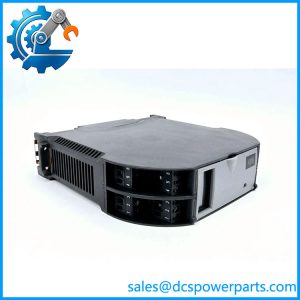
Description
Product Introduction (Non-Templated)
When a DP vessel loses a position-reference source, the problem reaches far beyond a single navigation instrument. Reference quality affects the information available to the DP system for maintaining vessel position. The Kongsberg DPS232 was designed for this exact environment, combining GPS and GLONASS reception in a dedicated differential positioning system for marine DP applications.
The unit accepts 100–240 VAC shipboard power and uses a combined GNSS receiver architecture covering GPS L1/L2, GLONASS L1/L2, and SBAS. For older vessel systems, that makes the DPS232 relevant to DP system maintenance, position-reference replacement, and marine navigation system migration work—though interface configuration and external equipment must be checked before assuming a direct replacement.
Key Technical Specifications
| Parameter | Specification |
|---|---|
| Product Model | DPS232 / DPS 232 |
| Manufacturer / Brand | Kongsberg Seatex |
| Product Type | GNSS-based differential positioning reference system |
| Primary Application | Dynamic positioning / marine position reference |
| GNSS | GPS + GLONASS |
| GPS Reception | L1/L2 |
| GLONASS Reception | L1/L2 |
| SBAS | Supported |
| Processing Unit Supply | 100–240 VAC |
| Frequency | 50/60 Hz |
| Maximum Power Consumption | 60 W |
| Standard Mounting | 19-inch rack, 2U processing unit |
| GNSS Antenna | NovAtel GPS-702-GG-N specified in installation documentation |
| External Interfaces | Serial communications, analog outputs, Ethernet and external correction/sensor connections |
| Standard Module Part Number | G205-39 |
| Cabinet Version | G205-40 |
The installation documentation specifies a 19-inch, 2U processing unit and identifies G205-39 as the DPS 232 module and G205-40 as the DPS 232 version with cabinet. The same documentation lists 100–240 VAC, 50/60 Hz and maximum 60 W consumption.
The receiver architecture is not simply a single-frequency GPS instrument. Documentation describes 14 GPS L1 channels, 14 GPS L2 channels, 12 GLONASS L1 channels, 12 GLONASS L2 channels, plus two SBAS channels.
Application Scenarios & Pain Points
On a DP vessel, the first question after a positioning alarm should not be “Is the processor powered?” Power is only the starting point. Antenna condition, satellite visibility, correction data, serial/Ethernet outputs, and the DP interface all have to agree before the reference can be trusted.
- Offshore dynamic positioning: The DPS232 supplies position-reference information to DP equipment on offshore vessels where position data forms part of the vessel control architecture. Vessel documentation has listed DPS232 alongside Kongsberg DP systems as a differential-positioning reference.
- Offshore loading operations: The broader Kongsberg DPS family is used for vessel positioning applications, while DARPS 232 is specifically designed for relative and absolute positioning during offshore loading. DPS232 should not be confused with DARPS 232; they are different systems.
- Marine GNSS reference: GPS and GLONASS dual-frequency reception gives the processor access to more satellite observations than a basic single-frequency receiver. SBAS is also supported.
- Legacy vessel maintenance: Older vessels can retain equipment long after the original system integrator’s commissioning work. In that situation, preserving the exact processing-unit revision and interface configuration can matter more than simply finding another box carrying the same family name.
Field case: A vessel experiencing intermittent DP reference dropouts may show a perfectly normal processing-unit power state. The fault can instead sit in an antenna cable, connector, correction-data path, or serial interface. Before condemning the , check the complete signal path—especially coax condition and connector integrity.

kongsberg DPS232
Related Products
- G205-39 — The documented DPS 232 module part number. This is the reference to verify when sourcing the processing unit itself rather than a complete cabinet assembly.
- G205-40 — DPS 232 supplied with its cabinet. The functional system is related to the G205-39 module, but the mechanical package differs; useful when the vessel installation requires the complete cabinet arrangement.
- DPS 200 — Earlier Kongsberg Seatex differential-positioning processing unit. Kongsberg’s equipment documentation identifies it as a GPS/GLONASS/SBAS position-reference processor, but its receiver configuration differs from .
- DPS 132 — Another member of the earlier DPS family. It can appear in legacy vessel DP documentation, but it should not be treated as a drop-in replacement without checking interfaces and configuration.
- DPS 122 — Older DPS-family position-reference equipment. It is relevant when tracing legacy vessel configurations, particularly where multiple generations of Kongsberg position sensors remain in service.
- DPS i1 — A later Kongsberg DPS-family position-reference platform. Its architecture and interfaces differ from the older , so replacement requires a system-level compatibility review rather than a model-number comparison alone.
- NovAtel GPS-702-GG-N — The GNSS antenna specified in the installation documentation. Antenna replacement therefore needs attention to frequency coverage, connector type, cable losses, and supply requirements—not just physical mounting.
- DPS Display Unit — A modern Kongsberg display component intended for DPS i1, communicating with its processing unit through Ethernet. It should not be assumed compatible with the older simply because both carry the DPS name.
The Engineer’s Guide: Field Pitfalls to Avoid
⚠️ Do not confuse with DARPS 232.
The names are close, but the applications are different. is a GNSS differential positioning reference system, while Kongsberg describes DARPS 232 as a DP position-reference system for offshore loading and relative vessel positioning.
How to avoid it: Match the complete equipment designation, hardware identification, antenna arrangement, and vessel system documentation before approving a replacement.
⚠️ Do not replace the antenna without checking the RF path.
The installation documentation specifies a GPS/GLONASS L1/L2 antenna and gives a particular antenna type. A physically fitting antenna can still produce poor or unusable GNSS performance if its frequency coverage, gain, supply, or cable arrangement is wrong.
How to avoid it: Inspect the antenna, coaxial cable, connectors, and antenna power before declaring the processing unit defective.
⚠️ Do not assume every communication port has the same purpose.
The installation documentation identifies multiple serial communication ports, terminal interfaces, analog outputs, and Ethernet connections. The external DP system therefore depends on the actual configured interface—not merely on the processor being online.
How to avoid it: Photograph the original rear-panel connections before removal. Record port numbers, cable labels, baud-rate settings, output formats, and connected DP equipment.
Frequently Asked Questions (FAQ)
What is the Kongsberg used for?
The is a GNSS-based differential positioning reference system intended primarily for marine dynamic positioning applications. It receives GPS and GLONASS signals and can use SBAS information to calculate and provide vessel position-reference data to external systems.
Does support both GPS and GLONASS?
Yes. The receiver uses GPS L1/L2 and GLONASS L1/L2 reception, with SBAS channels also included in the documented receiver architecture. This is an important distinction when comparing it with older single-frequency positioning equipment.
What power supply does the require?
The processing unit is specified for 100–240 VAC, 50/60 Hz, with maximum power consumption of approximately 60 W. The installation manual specifically instructs connection to the vessel’s 100–240 VAC supply.
Can I replace a with a DPS200?
Not automatically. Both belong to the Kongsberg Seatex DPS family, but the documented receiver configurations differ. A replacement assessment should compare the exact processing unit, external interfaces, output telegrams, antenna arrangement, software/configuration, and the DP system receiving the position data.
What should I check when buying a used or refurbished ?
For a vessel-critical position-reference unit, request evidence covering:
- Exact model and hardware identification
- Processing-unit part number, particularly G205-39 where applicable
- Power-up test
- GNSS satellite acquisition test
- GPS/GLONASS reception verification
- Output-data/interface test
- Connector and rear-panel condition
- Software/configuration information
- Repair history, if available
- Warranty period and actual dispatch lead time
A simple power-on photograph is not enough. The unit can boot normally while an RF input, communications interface, or configuration parameter remains defective.
Does the include the GNSS antenna?
A complete standard system delivery was documented as including the unit, cabinet, GNSS antenna, DGPS/IALA antenna, cables, and associated installation hardware. However, individual replacement units are often supplied separately, so procurement should specify whether the quoted item is G205-39 alone, G205-40 with cabinet, or a complete system package.
What is the documented position accuracy of ?
The installation documentation gives a DGPS position accuracy of less than 1 m at 95% CEP under the specified conditions, with SBAS performance also documented separately. Actual vessel performance depends on satellite visibility, correction source, antenna installation, interference, and environmental conditions.