Description
Key Technical Specifications
| Parameter | Specification |
|---|---|
| Product Model | 8273-140 |
| Manufacturer | Woodward |
| Controller Series | 2301D |
| Product Type | Digital load-sharing and speed controller |
| Input Supply | 18–40 VDC |
| Nominal Voltage | 24 VDC |
| Power Consumption | ≤20 W nominal |
| Current at 24 VDC | 431 mA |
| Speed Sensor | Magnetic pickup |
| Magnetic Pickup Frequency | 100–25,000 Hz |
| Supported Engine Speed | 300–3,600 rpm |
| Steady-State Speed Band | ±0.25% of rated speed |
| Discrete Inputs | 8 |
| Analog Inputs | 2 configurable |
| Analog Output | Configurable actuator output, including 0–200 mA range |
| Discrete Outputs | 4, maximum 200 mA each |
| Communication Interface | RS-232 / RS-422 |
| Communication Baud Rate | 1,200–38,400 baud |
| Operating Temperature | -40 to +70°C |
| Storage Temperature | -40 to +105°C |
| Installation Classification | Ordinary locations |
| Configuration Software | Woodward Watch Window |
Specifications are based on Woodward Product Manual 26247. The magnetic pickup frequency range and engine speed range are separate operating parameters; the actual relationship depends on engine configuration and gear-tooth count.
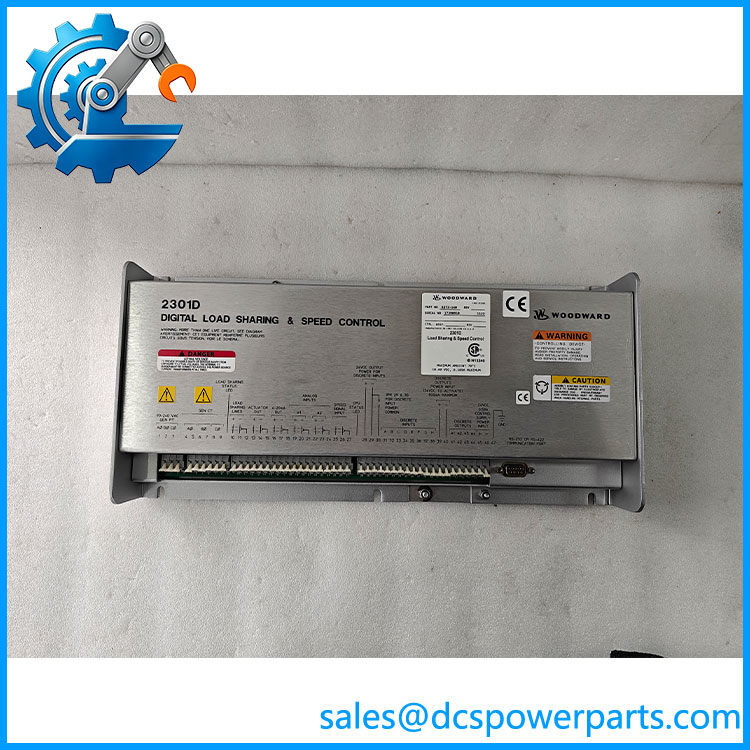
8273-140
Product Introduction
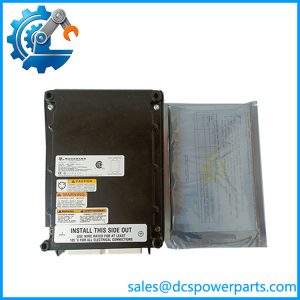
The Woodward 8273-140 is a microprocessor-based 2301D controller designed to regulate engine speed and manage generator loading. It supports isochronous load sharing, droop control, and baseload operation. In parallel generator installations, it coordinates the prime mover’s fuel demand with generator load measurements to help maintain stable frequency and proportional load distribution.
The controller provides magnetic pickup speed sensing, actuator drive output, configurable analog inputs and outputs, discrete control inputs, and relay-driver outputs. Configuration and commissioning are performed through an external computer connected to the controller’s communication port using Woodward configuration software.
Application Scenarios & Field Pitfalls
Typical applications
- Diesel generator control: Regulates engine speed and generator load during standalone or parallel operation.
- Gas engine generator systems: Controls prime-mover speed and fuel demand based on configured engine dynamics.
- Parallel generator installations: Supports isochronous load sharing between generators operating on an isolated bus.
- Utility-paralleled generation: Provides droop and baseload control when operating against an infinite bus.
- Generator synchronization systems: Accepts external speed-reference signals and load-control commands.
Field checks before replacement
- Confirm the installation classification. The 8273-140 is intended for ordinary locations. The hazardous-location version is 8273-141. Do not substitute between them without checking the applicable certification and installation requirements.
- Verify the supply voltage. The controller requires 18–40 VDC, with 24 VDC nominal. Check supply polarity, grounding, and startup voltage.
- Match the magnetic pickup configuration. Verify sensor frequency, gear-tooth count, rated engine speed, and speed-range settings. An incorrect speed configuration can create a serious overspeed risk.
- Record actuator characteristics. Confirm actuator current range, direct- or reverse-acting configuration, and fuel-system response before commissioning.
- Check generator CT/PT wiring. Incorrect current-transformer phasing or potential-transformer connections can produce inaccurate load measurement and poor load sharing.
- Preserve control parameters carefully. Record gain, reset, actuator compensation, speed reference, load calibration, and droop settings before removing the original controller.
- Verify communication settings. Check RS-232/RS-422 wiring and baud rate when using Watch Window for configuration and diagnostics.
Critical safety point: Woodward requires an independent overspeed shutdown device. The 2301D speed controller must not be treated as the sole protection against engine overspeed.
Related Products
- 8273-501 – Updated 2301D replacement for the ordinary-location 8273-140.
- 8273-503 – Updated 2301D replacement for hazardous-location part 8273-141.
- 8273-138 – 2301D-EC version with Modbus communication, ordinary locations.
- 8273-139 – 2301D-EC version with Modbus communication, hazardous locations.
- 8273-505 – Updated 2301D-EC replacement for 8273-138.
- 8273-507 – Updated 2301D-EC replacement for 8273-139.
- 5418-1989 – Software part number associated with the original 8273-140/8273-141 generation.
- 5418-159 – Software part number associated with the updated 8273-501/8273-503 generation.
Woodward’s Application Note 51263 documents the old-to-new part-number mapping.
Procurement and Replacement Notes
Manufacturer replacement identified
Woodward identifies 8273-501 as the replacement for 8273-140. The updated controller includes changes to its PID algorithm, speed-sensing filter, and other control functions.
Do not copy the old controller’s gain, reset, and actuator-compensation values directly into the replacement. Woodward specifically advises starting with the new controller’s default values and tuning the system during commissioning.
For procurement, confirm:
- Complete part number: 8273-140
- Revision marking on the original unit
- Ordinary-location installation requirement
- 24 VDC supply configuration
- Actuator output range and operating direction
- Engine speed and magnetic pickup configuration
- Generator CT/PT arrangement and load-sharing topology