Description
Key Technical Specifications
| Parameter | Value |
|---|---|
| Manufacturer | Woodward |
| Part Number | 8440-1666 B |
| Product Family | SPM-D11 |
| Product Type | Synchronizer / Synchronizing Relay |
| Primary Function | Generator synchronization |
| Secondary Function | Load-sharing application |
| Outputs | Two-output synchronizing relay configuration |
| Supply | 12/24 VDC |
| Application | Generator control and paralleling |
| Typical Equipment | Diesel/gas generator sets, power-generation systems |
| Synchronizing Variables | Voltage, frequency, and phase relationship |
| Control Architecture | Microprocessor-based synchronization |
| Communication | Application-dependent; verify exact installation |
| Mounting | System/application dependent |
| Operating Temperature | Verify OEM documentation for exact revision |
| Dimensions | Verify exact Woodward documentation |
| Certifications | Verify exact nameplate and application |
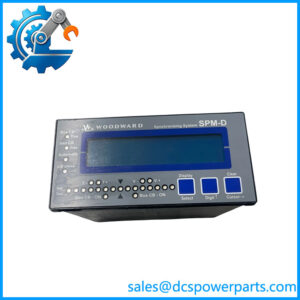
Important: Public listings contain contradictory information about this part. The most consistent identification is Woodward 8440-1666 B as an SPM-D11 synchronizing/load-sharing module, while some listings call it simply a two-output synchronizing relay.
I would not publish specific communication protocols, contact ratings, dimensions, or environmental limits as confirmed specifications without the original Woodward documentation for the exact revision.
Product Introduction
Woodward 8440-1666 B
The Woodward 8440-1666 B is associated with the SPM-D11 generator synchronization system. Its primary role is to supervise generator and bus electrical conditions and support synchronization before generator breaker closure. It is intended for generator control and power-generation applications.
This is synchronization hardware, not a general-purpose PLC I/O module. In a generator paralleling system, the critical job is timing the breaker-closing command so the generator reaches the required voltage, frequency, and phase relationship with the bus.
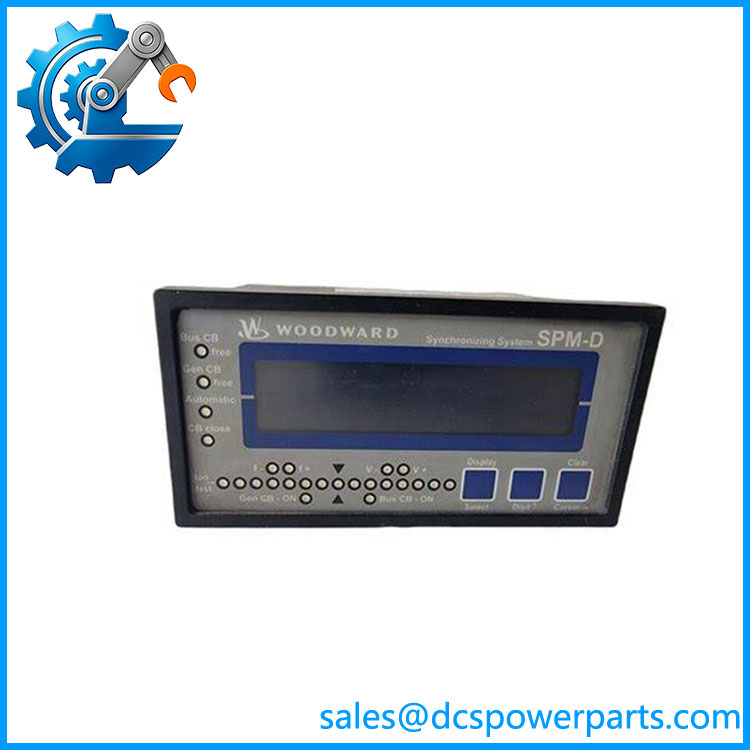
8440-1666
Application Scenarios & Field Pitfalls
Engineering Pain Point
A generator that is electrically healthy can still refuse to synchronize. The problem may be frequency mismatch, incorrect voltage sensing, phase-reference wiring, breaker feedback, or an incorrect synchronizer setting. Replacing the 8440-1666 B without checking those signals can turn a simple commissioning problem into an unnecessary hardware replacement.
Typical Applications
- Diesel Generator Plants — Automatic synchronization of standby generators to a common bus.
- Gas Engine Power Plants — Generator paralleling and load-sharing applications.
- Industrial Power Systems — Synchronization of captive generators with plant distribution buses.
- Marine Power Generation — Generator paralleling where multiple generator sets operate on a common electrical bus.
Technical Pitfalls to Avoid
- Do not confuse synchronization with load sharing.
Synchronization gets the generator electrically aligned before breaker closure. Load sharing is a separate control objective after generators are paralleled. - Verify the exact revision.
The “B” suffix matters. Do not assume that another 8440-1666 variant has identical hardware or configuration. - Check voltage sensing first.
Incorrect generator or bus voltage feedback can produce apparent synchronizer faults even when the synchronizer hardware is healthy. - Check phase reference wiring.
A phase-sequence or phase-reference error can prevent synchronization entirely. This is especially easy to introduce during panel modification. - Verify breaker feedback.
The synchronizer needs the correct breaker status information. Incorrect auxiliary-contact wiring can produce confusing synchronization behavior. - Do not assume 12/24 VDC means universal power compatibility.
Confirm the actual supply arrangement, polarity, protection, and voltage at the installed module before energizing it. - Check generator frequency stability.
A governor problem can look like a synchronizer problem. If frequency is hunting excessively, fix the speed-control loop before condemning the synchronization hardware. - Verify CT/PT or voltage-transformer wiring.
Incorrect sensing ratios can produce valid-looking but incorrect measurements and prevent proper synchronization. - Do not close the breaker simply because the synchronizer indicates permissive.
The complete breaker-control and protection scheme must be verified before commissioning. - Check the complete paralleling system.
Synchronizer, governor, AVR, breaker, sensing transformers, protection relay, and load-sharing controls must be evaluated as one system.
Related Products
- Woodward SPM-D11 8440-1706 — Related SPM-D11 synchronizing/load-sharing controller. It belongs to the same general Woodward generator synchronization family and is useful when evaluating replacement or system upgrades.
- Woodward 8440-1703 — SPM-D11 synchronizer variant. It provides a related generator synchronization function but should not be substituted for 8440-1666 B without confirming the complete application configuration.
- Woodward 8440-2165 — Microprocessor-based synchronizer. It performs generator synchronization but represents a different Woodward hardware implementation.
- Woodward 5448-890 — SPM-D10-series synchronizer. This is an earlier/different Woodward synchronizing platform and is useful when maintaining legacy generator-control systems.
- Woodward 5466-425 — Analog I/O module used in Woodward control systems. It handles analog signal acquisition rather than generator synchronization and is therefore complementary hardware rather than a direct replacement.
- Woodward 5466-258 — Discrete input/output module. It handles discrete field signals and is functionally different from the 8440-1666 B synchronizer.
- Woodward 9907-1106 — Pressure regulating valve controller. It is used for actuator/process control rather than electrical generator synchronization.
- Woodward 5501-471 — Actuator driver module. It belongs to Woodward’s control-system hardware family and can be involved in actuator control, but it does not replace synchronizer hardware.
- Woodward 5453-203 — Operator interface panel. It provides operator interaction rather than the synchronization control function.
- Woodward 5466-318 — MicroNet digital controller/power-related hardware in Woodward control systems. It is a different control-system component and should not be treated as an equivalent to the synchronizer.