Description
Product Introduction (Non-Templated)
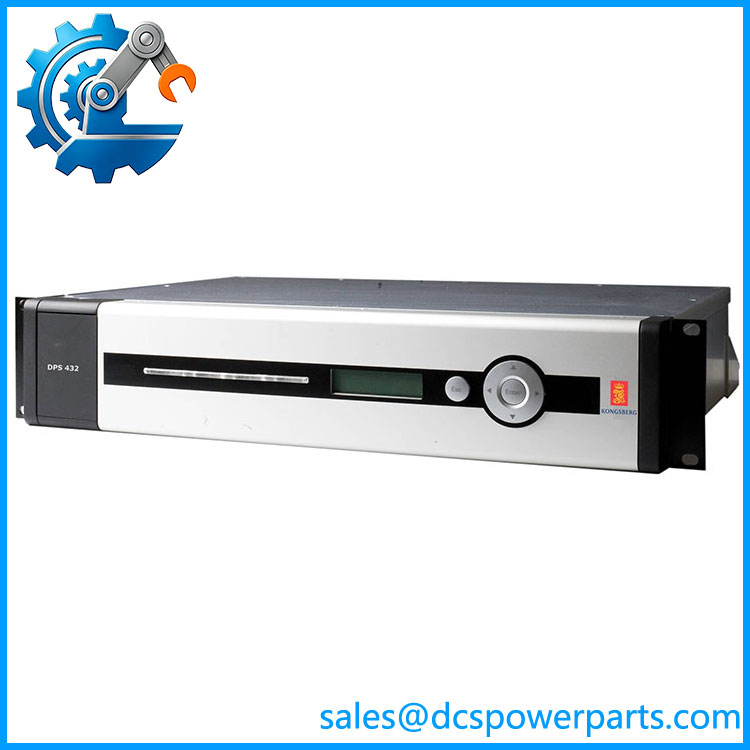
A DP vessel can have plenty of satellite signals available and still suffer from a poor position reference if the receiver cannot make effective use of them. The Kongsberg DPS432 was developed around that problem, combining multiple GNSS constellations and correction sources for marine dynamic positioning applications. Its processing architecture is built around Kongsberg’s DPS NAV Engine, separate from the operator HMI.
The hardware accepts 100–240 VAC shipboard power and occupies a 19-inch, 2U rack position. It supports GPS, GLONASS, Galileo, BeiDou, QZSS and SBAS reception, making the unit relevant to DP system maintenance, offshore vessel upgrades, and marine navigation system migration projects where the existing interface and configuration must be preserved.
Key Technical Specifications
| Parameter | Specification |
|---|---|
| Product Model | DPS432 / DPS 432 |
| Manufacturer / Brand | Kongsberg Seatex / Kongsberg Maritime |
| Product Type | GNSS-based position reference system |
| Primary Application | Dynamic Positioning (DP) |
| GPS | L1 / L2 / L5 |
| GLONASS | L1 / L2 |
| Galileo | E1 / E5 |
| BeiDou | B1 / B2 |
| QZSS | Supported |
| SBAS | Supported |
| Correction Services | Supports regional SBAS and commercial correction services |
| Processing Unit Power | 100–240 VAC, 50/60 Hz |
| Maximum Power Consumption | 60 W |
| Rack Format | 19-inch, 2U |
| Navigation Engine | DPS NAV Engine |
| HMI Architecture | Networked HMI architecture supported |
| Positioning Technology | Multi-constellation GNSS / differential positioning |
Kongsberg’s rental catalog specifically identifies the DPS 432 processing unit as a 19-inch, 2U GNSS position-reference sensor with GPS L1/L2/L5, GLONASS L1/L2, Galileo E1/E5, BeiDou B1/B2, QZSS and SBAS reception. It lists 100–240 VAC, 50/60 Hz and maximum 60 W consumption.
The 2016 Kongsberg announcement also states that DPS 432 can integrate Fugro G4 correction services in addition to regional SBAS services such as WAAS, EGNOS, MSAS and GAGAN.
Application Scenarios & Pain Points
On an offshore vessel, position-reference problems often appear first as a DP alarm rather than as an obvious receiver failure. Satellite availability, correction data, antenna installation, interface configuration and the downstream DP system all contribute to the final position solution. A green power LED proves very little.
- Offshore DP operations: DPS432 provides GNSS-derived position information for dynamic positioning systems. Its multi-constellation architecture can use signals from several GNSS systems rather than depending on GPS alone.
- Offshore construction and support vessels: The system is suited to operations where position-reference integrity is important and satellite visibility may vary with vessel orientation, structures, cranes, or other obstructions.
- Global marine operations: Support for GPS, GLONASS, Galileo, BeiDou and regional SBAS gives the receiver access to a broader signal environment. Kongsberg specifically positioned DPS432 for DP operations in different geographical regions.
- Legacy DPS maintenance: Existing vessels may require a replacement processor without redesigning the entire DP position-reference architecture. In that situation, matching software, I/O configuration and external interfaces is just as important as matching the DPS432 nameplate.
Field note: A common troubleshooting mistake is replacing the processor after observing intermittent position dropouts. Before doing that, inspect the GNSS antenna connector, coaxial cable, antenna supply and correction-data path. A receiver can be functioning normally while the RF path is degraded—salt residue around a connector is sometimes a more useful clue than the alarm history.
kongsberg DPS232
Related Products
- Kongsberg DPS232 — Earlier-generation GNSS position-reference processor using GPS L1/L2, GLONASS L1/L2 and SBAS. It belongs to the same DPS family, but its constellation and frequency coverage are narrower than DPS432.
- Kongsberg DPS i1 — Later-generation DPS platform using multi-frequency GNSS with integrated inertial technology. It adds capabilities such as INS/GNSS integration and is not automatically a drop-in hardware replacement for .
- Kongsberg DPS i4 — Multi-constellation DPS i-series system supporting GPS, GLONASS, Galileo, BeiDou and SBAS. Its integrated GNSS/INS architecture represents a different generation of position-reference equipment.
- Kongsberg DPS i3 — DPS i-series position sensor using GPS and Galileo with integrated inertial technology. Useful when evaluating a system migration rather than performing a like-for-like replacement.
- Kongsberg 3710 DGNSS Receiver — Separate DGNSS correction-service receiver supporting external correction services and Ethernet/serial interfaces. It complements a position-reference architecture rather than replacing the processor.
- Kongsberg MGC Series — Motion Gyro Compass equipment used with newer DPS i-series architectures for inertial and heading information. It serves a different sensing role from the GNSS processor.
- Kongsberg DARPS 232 — DP position-reference equipment intended specifically for offshore loading, where absolute and relative positioning between vessels such as shuttle tankers and FPSOs is required. It should not be confused with .
- Kongsberg DPS 5D — A later/discontinued DPS-family hybrid GNSS position, attitude and heading system. Its sensor architecture differs substantially from the processing unit.
The Engineer’s Guide: Field Pitfalls to Avoid
⚠️ Do not treat as a generic GPS receiver.
The system is designed as a DP position-reference system. Its value comes from the complete combination of GNSS processing, correction services, navigation computation and DP interfaces.
How to avoid it: Before approving a replacement, record the existing unit’s hardware revision, software version, connected interfaces, correction source and DP system configuration.
⚠️ Do not assume DPS232 and are interchangeable.
Both belong to the Kongsberg DPS family, but supports a substantially broader GNSS signal set. The documented DPS232 supports GPS L1/L2, GLONASS L1/L2 and SBAS, whereas adds GPS L5, Galileo, BeiDou and QZSS capabilities.
How to avoid it: Compare the vessel’s actual configuration and required correction services before substituting one generation for another.
⚠️ Do not overlook the HMI/NAV Engine architecture.
separates the critical DPS NAV Engine from the operator HMI and permits several HMIs to connect through a networked architecture. Changing a processor or HMI without understanding this relationship can produce an apparently healthy display with an incorrectly configured navigation service.
How to avoid it: Document the network topology and configuration before removing the original processor. Preserve configuration backups whenever available.
Frequently Asked Questions (FAQ)
What is the Kongsberg used for?
The is a GNSS position-reference system designed primarily for marine dynamic positioning. It calculates vessel position using multiple GNSS constellations and available correction services, then provides position information to the vessel’s DP/navigation architecture.
Which satellite systems does support?
The documented processing unit supports:
- GPS L1/L2/L5
- GLONASS L1/L2
- Galileo E1/E5
- BeiDou B1/B2
- QZSS
- SBAS
This broader reception capability is one of the major technical differences between and older DPS-family equipment.
What power supply does require?
The processing unit is specified for 100–240 VAC, 50/60 Hz, with maximum power consumption of 60 W. The unit is designed as a 19-inch, 2U rack-mounted processor.
Can DPS232 be used instead of ?
Not as an automatic drop-in substitution. DPS232 and differ in GNSS capabilities and generation. DPS232 is documented with GPS L1/L2, GLONASS L1/L2 and SBAS, while supports additional constellations and frequencies.
For a vessel replacement, verify the antenna system, correction source, output interfaces, software configuration and DP system compatibility before accepting the substitution.
Does use Fugro correction services?
Kongsberg stated that supports the G4 services from Fugro in addition to regional SBAS correction systems. The actual correction-service availability depends on the vessel’s equipment configuration and service subscription.
What should I check when buying a used ?
For a used or refurbished unit, request more than a basic power-up test. At minimum, verify:
- Exact model and hardware identification.
- Software/firmware revision.
- GNSS satellite acquisition.
- GPS, GLONASS and other supported constellation reception.
- Correction-data reception where applicable.
- Network and serial communications.
- Output data received correctly by the connected DP equipment.
- Rack connectors and rear-panel condition.
- Configuration backup or documented configuration status.
- Test report, warranty period and actual shipping lead time.
A processor that boots normally can still have a communications or RF-input fault. For a DP position-reference system, functional interface testing is much more useful than a photograph showing the front panel powered on.
Is still part of Kongsberg’s current DPS product range?
Kongsberg’s current navigation and positioning portfolio emphasizes the newer DPS i-series, including DPS i1, i3, i4 and i6, while the appears in Kongsberg’s equipment documentation and rental catalog as an established processing unit.
For procurement, this means the exact status of the installed hardware should be established before planning a long-term vessel support strategy. A like-for-like spare and a system migration are two different engineering projects.