Description
Product Overview
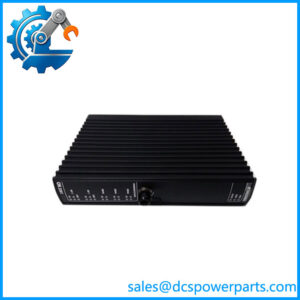
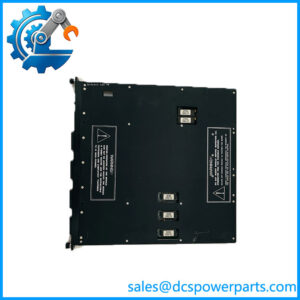
CM3201 is the Communication Module of the Trident v2 safety controller — the optional assembly that connects a triplicated controller to everything outside it: DCS, host computers, historians, printers and other Trident or Tricon v9–10 systems. It is not an I/O module. The official Trident module table lists its points as “not applicable”, because the CM carries data about the process, not process signals. It sits on its own baseplate, not on an I/O baseplate, and a single controller accepts up to two CMs on one CM Baseplate — either for redundant communication paths or simply for more independent ports.
The interface description needs one clarification, because two official documents word it differently. The Trident product specification calls the CM a “three-to-one interface to the MPs”; the earlier module datasheet calls it a “one-to-one interface to the MPs”. Both describe the same hardware from different angles: one network path, three processors behind it, each MP talking to the CM over its own channel. What matters for a buyer is the consequence — communication work happens in the CM, and the module operates independently of the MP scan.
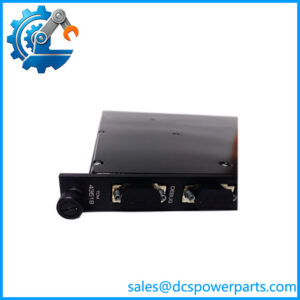
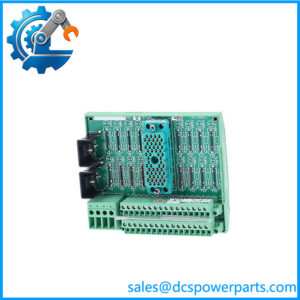
The ports are the part that trips people up in a spares store, because they are not on the module. Every connector lives on the CM baseplate: three DB-9 serial connectors, 10BaseT RJ-45 for Net1, an AUI connector for a 10 Mbit MAU, 100BaseTX RJ-45 for Net2, an MII connector for a 100 Mbit MAU, and a debug port. The module itself carries the front panel — PASS, FAULT and ACTIVE indications, per-port TX/RX and LINK LEDs, a lock lever — and plugs onto that baseplate. A CM3201 bought without the baseplate is a module with nowhere to connect.
That two-tier network design is deliberate, and it dates the product honestly. Net1 is a 10 Mbit channel with both twisted pair and AUI, which is exactly what an installed base of 1990s DCS and network printers needs; Net2 is 100 Mbit with 100BaseTX and MII for the modern side of the plant. Media adapter units can replace the RJ-45 connections to move to other Ethernet media or extend distance, which is how these systems reach across a switchyard or a long cable run without a media converter.
What the CM is not, despite what much of the aftermarket claims: it is not a controller, it has no analog or digital channels, no flash memory holding a user program, no web server, and no SIL rating of its own. Those descriptions belong to other products. CM3201 is a communication gateway on a dedicated baseplate, and the numbers on a page that describes it otherwise were not taken from a Triconex document.
Technical Specifications
| Parameter | Value |
|---|---|
| Model | CM3201 (Model 3201; front panel marked “CM 3201”) |
| Manufacturer / platform | Triconex, Invensys; now Schneider Electric — Trident v2 safety controller |
| Module type and role | Communication Module: three-to-one interface between the three MPs and external networks; I/O points not applicable |
| Serial ports | 3 × optically isolated RS-232 or RS-485, DB-9 DTE connectors on the CM baseplate, mode set from TriStation; rates 1200 to 115.2 kbps |
| Serial protocols | Modbus master (RTU); Modbus slave (ASCII or RTU); point-to-point or multi-point RS-485 networks |
| Net1 (10 Mbit) | 10BaseT RJ-45 plus AUI connector for a 10 Mbit media adapter unit |
| Net2 (100 Mbit) | 100BaseTX RJ-45 plus MII connector for a 100 Mbit media adapter unit |
| Network protocols | TSAA (UDP/IP) and TSAA with IP multicast, TriStation, Peer-to-Peer (UDP/IP and DLC), Modbus master or slave (TCP), time synchronisation (UDP/IP and SNTP), JetDirect DLC/LLC; maximum 4 Modbus TCP ports per CM |
| Logic power and isolation | Supplied from the MP baseplate: 24 VDC nominal, 19.2–30 VDC, 8 W maximum without MAUs, plus up to 6 W per 10 Mbit AUI MAU and 3.75 W per 100 Mbit MII MAU; 1 ms ride-through, 33 VDC absolute maximum; 500 VDC galvanic isolation |
| Mechanical | Module 44 × 220 × 169 mm (W × H × D); CM baseplate 229 × 249 mm; up to two CMs per baseplate; PASS / FAULT / ACTIVE plus per-port TX, RX and LINK indications; lock lever |
| Environment and cabling | Storage −40 to +85 °C, modules rated for 70 °C ambient maximum; RS-232 cable to 15 m, RS-485 to 1.2 km; network address derived from the MP baseplate address plug |
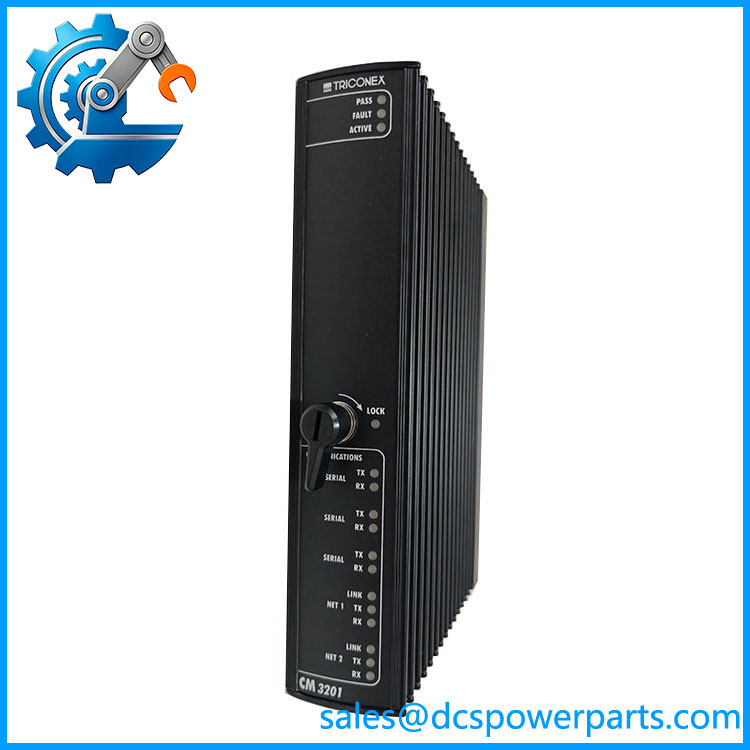
TRICONEX 3201
Key Features and Advantages
Communication off the scan: the CM runs its own protocol stack on its own processor, so polling a DCS over Modbus or pushing data to a historian does not consume MP bandwidth. On a controller whose scan is the safety loop, that separation is the whole point of buying the module rather than using the MP’s built-in port.
Redundancy as a hardware decision, not a software setting: two CMs on one baseplate operate independently; wire both to the same network and one failing module leaves the other carrying traffic. Wire them to different networks and the pair becomes two genuinely separate communication paths — the same part number serving two different architectures.
A network interface that matches an installed base: Net1 is 10 Mbit with 10BaseT and AUI, which is what legacy DCS nodes and JetDirect print servers expect; Net2 is 100 Mbit 100BaseTX or MII. Converting either to fiber or to a different media type is a media adapter unit at the connector, not a new module — the practical way to bridge an old control room to a modern plant LAN.
Isolation where the plant touches the electronics: three optically isolated serial ports and 500 VDC galvanic isolation mean a ground fault or a surge on a field RS-485 run stops at the port. On multi-drop RS-485 networks stretched to 1.2 km across a process area, that is not a specification footnote, it is why the port survives.
Serviceable without opening the cabinet’s wiring: every connector is on the baseplate, so the module can be lifted off and replaced without disturbing a single field termination. On a system where a comms module swap can otherwise mean re-terminating nine connectors and re-verifying a network, that design is worth more than any feature list.
Protocol breadth without a gateway box: TSAA, Modbus TCP as master or slave, Peer-to-Peer over UDP and DLC, SNTP and time synchronisation over UDP/IP, and JetDirect printing all come from the one module — up to four Modbus TCP ports per CM. A plant integrating a Trident node into an existing DCS, a historian and a sequence-of-events printer can do it with two of these and no third-party protocol converter.
The honest limit: it is a communication module. It holds no I/O points, no user program and no independent safety rating; the SIL 3 certification belongs to the Trident controller, and the CM is the path the data takes out of it. Any listing that describes this part number as a controller with analog inputs and a web server is describing a different product entirely.
Applications
Safety-to-DCS integration: an ESD or fire-and-gas Trident controller reporting to a plant DCS over Modbus TCP, with a second CM providing the redundant path or a separate link to the historian. This is the archetypal use — the CM exists so that the safety controller can be seen by the plant without its scan being loaded by the conversation.
Legacy networks that will not be replaced this decade: 10BaseT and AUI segments still serving DCS operator stations, JetDirect printers producing sequence-of-events logs, and older host computers polling over serial. Net1 keeps those alive while Net2 carries the newer traffic — the reason both ports exist on one module.
Multi-drop serial instrumentation: RS-485 runs to analyzers, motor protection relays, tank gauging or a substation RTU, up to 1.2 km per port, with the CM acting as Modbus master and the safety controller as the data source for the DCS. Three isolated ports mean three such networks per module without external converters.
Peer-to-peer interlocks between safety nodes: two Trident systems, or a Trident and a Tricon v9/v10 system, exchanging data over Peer-to-Peer rather than through a DCS. Useful where two units share an interlock that must not depend on a third system being healthy.
Time synchronisation across a site: SNTP and Triconex time synchronisation over the network ports, so that sequence-of-events records from several controllers line up to the same millisecond when an incident is reconstructed.
Online capacity expansion: a controller commissioned with one CM and later asked to feed a second DCS, an OPC gateway and a printer. The second slot on the CM baseplate takes the extra module with no change to the I/O architecture.
Related Products
2201 CM Baseplate Kit (Model 2201) — the baseplate that carries every connector this module uses; a CM3201 without it has no ports. 5201 Communication Module TriPak — the packaged combination of one 3201 module and one 2201 baseplate kit; the part to order when a complete assembly is needed. MP 3101 Main Processor Module — the three processors the CM serves; logic power for the CM is supplied from the MP baseplate. 5101 Main Processor TriPak — the three-MP assembly that forms the core of a Trident controller. 3301 Digital Input Module — same-generation I/O, mounted on its own I/O baseplate; the contrast that shows why the CM has no field terminations. 3351 Analog Input Module — the 4–20 mA input module of the same platform, and the module whose data the CM typically forwards. 3481 Analog Output Module — same-generation output module, another data source for the CM’s network links. 2281 / 2291 / 2292 I/O Extender Module Kits — extend the I/O bus to further columns; relevant when a controller’s CM traffic grows with its I/O count. CM3201S2 — a later hardware revision of the same module listed by parts suppliers; check the front-panel marking before substituting, since the baseplate and firmware expectations differ by revision. Tricon v9/v10 controllers — not a part number but the peer systems this CM can talk to over Peer-to-Peer, which is why the module is often bought for mixed Tricon/Trident sites.
Installation and Maintenance
Before installation: confirm what is being installed. CM3201 is a Trident CM and fits a CM baseplate, not a Tricon v9/v10 chassis slot and not an I/O baseplate — mismatches here are the most common mistake on this part number. Check that the 2201 baseplate is present and that its connectors match the network plan: which port is Net1, which is Net2, and whether a media adapter unit will be used instead of the RJ-45. Verify the logic power path, since the CM draws from the MP baseplate at 24 VDC nominal within 19.2–30 VDC, and confirm the baseplate address plug setting, because the CM derives its network address from it.
Installation: fit the module onto the baseplate and confirm the lock lever is engaged before power is applied. Terminate serial runs according to the mode selected in TriStation — RS-232 within 15 m, RS-485 terminated at the ends of the segment and within 1.2 km — and keep the serial shields bonded at the cabinet entry. On the network side, connect Net1 and Net2 to their intended segments rather than to the same switch by default, and if MAUs are used, respect the output power budget of the +12 V AUI and +5 V MII supplies.
Maintenance: the module is designed to be replaced at the baseplate without touching field wiring, which is precisely why the connectors live there — record the baseplate and port assignment before a swap so the replacement lands on the same network plan. Watch the front panel rather than a laptop: PASS, FAULT and ACTIVE at module level, TX/RX per serial port, LINK per network port; a port with no LINK and a live cable is a cabling or MAU problem, not a module fault. Keep a written record of the TriStation port configuration, because a replacement module inherits the baseplate’s connections but not the settings, and re-verify time synchronisation after any comms work, since a silent clock offset corrupts sequence-of-events data long before anyone notices.
Warranty and Quality
Every is supplied as a Trident Communication Module — model 3201, on the 2201 baseplate family, with three isolated serial ports and two network ports — and is identified as such before dispatch, because this is a part number that attracts confident but wrong descriptions: controllers with analog channels, flash memory and web servers, none of which exist here. Each unit is inspected for front-panel and housing condition, baseplate connector and lock-lever integrity, LED operation, and evidence of prior repair, heat damage or moisture ingress. Where a Trident bench is available the module is powered from a 24 VDC source at the specified range, checked for PASS indication, exercised on a serial port in Modbus mode and on both network ports with link and traffic observed, and verified for configuration retention and time-sync behaviour. A 12-month repair, replacement or refund commitment applies. Technical support covers what this platform actually raises: telling a Trident CM from a Tricon chassis module, pairing the right baseplate, budgeting logic power with media adapter units, and planning a redundant two-CM configuration that does what the plant expects when one path fails.
免费
今天 10:38