Description
Product Overview
Product Overview
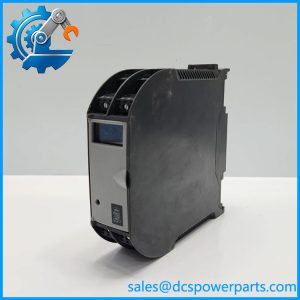
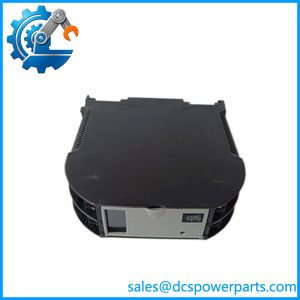
The KONGSBERG MRU 5 is a fifth-generation Motion Reference Unit designed to measure marine platform motion for applications where vessel movement directly affects positioning, surveying, stabilization, or measurement accuracy. Kongsberg identifies the MRU 5 as a high-precision marine motion sensor providing roll, pitch, and heave measurements. The unit uses inertial sensing to determine vessel attitude and dynamic motion, producing data that can be consumed by navigation, hydroacoustic, survey, and motion-compensation systems. Kongsberg specifically lists multibeam echo sounders, offshore cranes, hydroacoustic positioning systems, and dynamic motion monitoring among its intended applications.
For demanding marine measurement work, the KONGSBERG MRU 5 provides documented roll and pitch accuracy of 0.02° RMS within a ±5° amplitude. Its heave processing offers a 25-second real-time period with a specified 5 cm/5% performance figure, while delayed heave processing extends to a 50-second period with 1 cm/1% performance. These characteristics make the unit useful where vessel motion must be removed from measured data rather than simply observed.
The KONGSBERG MRU 5 belongs to Kongsberg’s Seatex MRU family and should not be confused with the newer MRU 5+ generation. Kongsberg’s current product information presents MRU 5 and MRU 5+ as separate products, while its upgrade documentation identifies newer fifth-generation variants for lifecycle replacement of older equipment. For procurement, serial number, hardware revision, software version, calibration certificate, mounting arrangement, and interface configuration should be checked before treating a surplus unit as a direct substitute. That is especially important for survey systems, where a sensor can power up normally yet still require recalibration or configuration before its measurement data can be trusted.
Product Introduction
Product Introduction
When a vessel moves beneath a survey sensor, even small attitude changes can distort the resulting measurement. The KONGSBERG MRU 5 provides real-time motion data for compensating roll, pitch, heave, and related dynamic effects, with documented 0.02° RMS roll and pitch accuracy under the specified ±5° test condition.
Built for marine survey and motion-compensation applications, it can interface with systems such as multibeam echo sounders, offshore cranes, hydroacoustic positioning equipment, and dynamic positioning systems. For a legacy replacement, calibration records and software revision matter as much as the physical part number.
Key Technical Specifications
Key Technical Specifications
| Parameter | Value |
|---|---|
| Product Model | MRU 5 |
| Manufacturer / Brand | KONGSBERG / Kongsberg Seatex |
| Product Type | Motion Reference Unit |
| Generation | 5th Generation |
| Primary Measurements | Roll, pitch, yaw, angular rate, acceleration, heave |
| Roll Accuracy | 0.02° RMS within ±5° amplitude |
| Pitch Accuracy | 0.02° RMS within ±5° amplitude |
| Real-Time Heave Period | 25 s |
| Delayed Heave Period | 50 s |
| Real-Time Heave Performance | 5 cm / 5% |
| Delayed Heave Performance | 1 cm / 1% |
| Data Output Rate | Up to 200 Hz, configuration dependent |
| Internal Angular Update Rate | Up to 400 Hz in documented MRU 5 configuration |
| Power Supply | 10–36 VDC, max. 12 W in documented 5th-generation configuration |
| Digital Interfaces | RS-422/232 and Ethernet, configuration dependent |
| Analog Interfaces | 4 × ±10 V channels in documented configuration |
| Operating Application | Marine survey, motion compensation, positioning, DP, crane applications |
| Condition | New Surplus — verify calibration and configuration |
Specification note: Kongsberg’s current MRU 5 product page confirms the 0.02° RMS roll/pitch performance and heave specifications. A Kongsberg technical reference document gives 10–36 VDC, maximum 12 W, two RS-422/232 outputs, two RS-422/232 inputs, four ±10 V analog channels, and Ethernet interfaces for an MRU 5th-generation configuration. Older MRU 5 documentation shows different electrical and mechanical figures, so the exact serial-number generation and configuration should be checked before publishing those values as universal specifications.
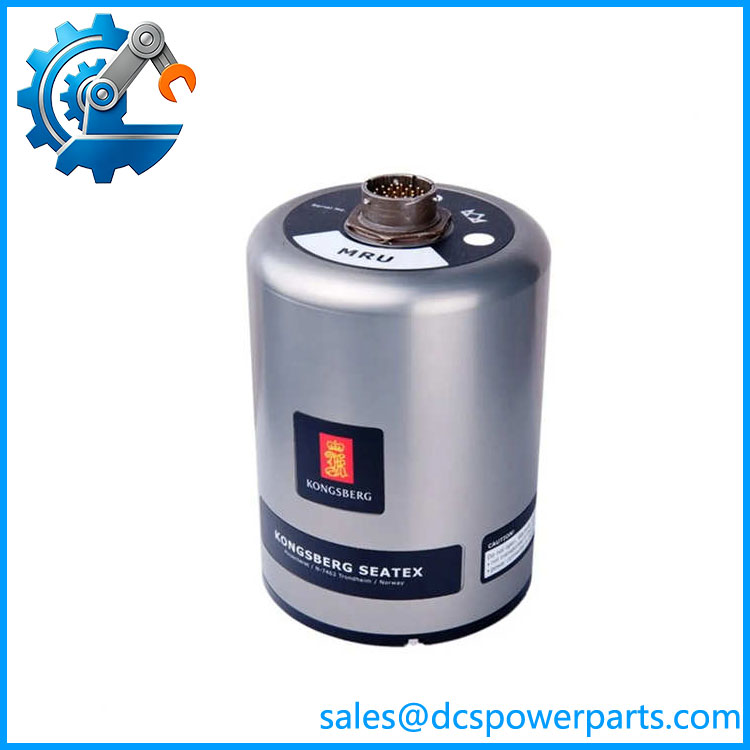
KONGSBERG MRU 5
Related Products
Related Products
- KONGSBERG MRU 5+ — A newer, higher-performance member of the MRU family. Kongsberg specifies 0.008° static roll/pitch accuracy and dynamic angle noise below 0.002° for MRU 5+. It is relevant to higher-precision survey and integrated INS/GNSS applications, but should not be treated as a drop-in replacement without system-level verification.
- KONGSBERG MRU D — A fifth-generation roll and pitch sensor designed for applications with restricted orientation requirements. Unlike MRU 5, its application is focused on roll and pitch measurement rather than the broader three-axis motion-sensing role.
- KONGSBERG MRU E — Another fifth-generation MRU family member intended for marine attitude and motion measurement. Its interface and performance configuration should be checked against the vessel system before substitution.
- KONGSBERG MRU H — A fifth-generation MRU option within the current Kongsberg product family. It may address different installation or application requirements from the MRU 5.
- KONGSBERG MRU S — An MRU designed specifically for fish-finding sonars and echo sounders. It is therefore more application-specific than the general-purpose MRU 5.
- KONGSBERG MRU 3 — A smaller member of the current MRU range intended for marine motion-sensing applications where the MRU 5 performance level is not necessarily required.
- KONGSBERG MGC R5 — A related motion and gyrocompass product in Kongsberg’s inertial-solutions portfolio. It serves a broader navigation/inertial role rather than functioning as a direct MRU 5 replacement.
- KONGSBERG Seapath 380 — A navigation solution that can work with motion and positioning sensors in integrated marine navigation applications. It complements an MRU rather than replacing the sensor itself.
Frequently Asked Questions
Frequently Asked Questions
1. What is KONGSBERG MRU 5 used for?
The MRU 5 measures marine platform motion and provides motion-reference data to equipment that needs to compensate for vessel movement.
Typical applications include:
- Multibeam and single-beam echo sounding
- Hydroacoustic positioning
- Offshore crane heave compensation
- Dynamic positioning
- Vessel motion monitoring
- AUV and ROV attitude measurement
- Antenna and sensor stabilization
Kongsberg specifically identifies several of these applications in its product documentation.
2. What accuracy does MRU 5 provide?
Kongsberg specifies 0.02° RMS roll and pitch accuracy within a ±5° amplitude for the MRU 5. The published heave figures are 5 cm/5% for real-time heave with a 25-second period and 1 cm/1% for delayed heave with a 50-second period.
These figures describe defined test and operating conditions. They should not be interpreted as a universal accuracy value under every vessel-motion profile.
3. Can I replace an older MRU with MRU 5?
That depends on the existing system architecture.
A replacement assessment should compare:
- Physical mounting and orientation.
- Power supply.
- Communication interfaces.
- Data telegram format.
- Output rate.
- Software and configuration revision.
- Calibration status.
- Connected survey, navigation, or DP equipment.
Kongsberg’s lifecycle documentation also distinguishes older MRU generations from later fifth-generation products, so the serial number and exact product variant are important when planning an upgrade.
4. Can I hot-swap the KONGSBERG MRU 5?
Do not assume hot replacement.
The MRU is an active measurement sensor feeding potentially critical navigation, survey, positioning, or motion-compensation systems. Removing it can immediately invalidate motion data or cause downstream equipment to enter an alarm or degraded operating state.
For replacement, place the dependent system into its approved maintenance state, isolate the relevant power where required, replace the sensor, and complete alignment/configuration and functional testing before returning the system to operation.
5. Does MRU 5 require calibration after replacement?
Calibration status should be checked before commissioning any replacement MRU.
For a survey-grade application, inspect the unit’s calibration documentation and determine:
- Calibration date
- Calibration validity requirements
- Serial number correspondence
- Sensor configuration
- Installation alignment
- Required vessel reference offsets
A physically identical spare can produce unusable survey results if the installation alignment or reference-point configuration is wrong. Kongsberg provides dedicated MRU recalibration documentation as part of its product support material.
6. Is MRU 5 the same as MRU 5+?
No. They are separate Kongsberg products.
The MRU 5+ is a later, higher-performance version using upgraded MEMS gyro technology. Kongsberg specifies 0.008° static roll/pitch accuracy for MRU 5+ and dynamic angle noise below 0.002°.
Therefore, an MRU 5+ should not be purchased solely because the name looks similar. Interface compatibility, software, mechanical installation, and system acceptance requirements need to be checked.
7. How should I verify a New Surplus MRU 5 before installation?
For a marine survey or navigation spare, condition inspection should go beyond checking whether the housing looks unused.
Recommended checks:
- Verify the exact MRU 5 identification and serial number.
- Check the calibration certificate and calibration date.
- Confirm software revision.
- Inspect connectors and housing for corrosion or impact damage.
- Confirm the supplied junction box, cable, or mounting bracket if the original installation requires them.
- Verify supply voltage and interface configuration.
- Compare output telegram configuration with the vessel system.
- Confirm installation reference point and orientation.
- Perform controlled functional testing before connecting it to a live survey or navigation workflow.
Kongsberg documentation identifies a complete MRU 5 with bracket and junction box under part number 374197; this is useful when checking whether a procurement listing represents the sensor alone or a complete assembly.
Procurement note: The most important distinction for this product is MRU 5 vs. MRU 5+. Kongsberg currently lists both as separate products, and their performance and sensor technology differ. For a replacement order, use the exact installed unit’s serial number, hardware/software revision, calibration documentation, and interface configuration rather than relying on the generic “MRU 5” name alone.