Description
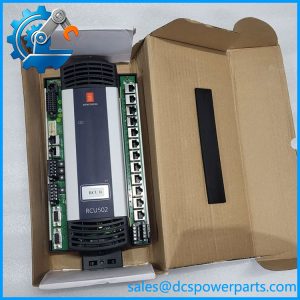
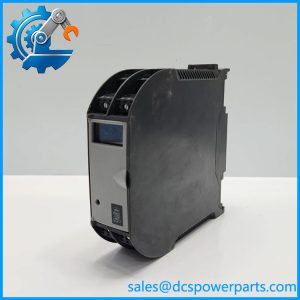
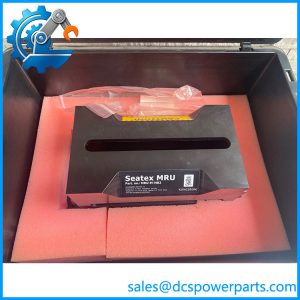
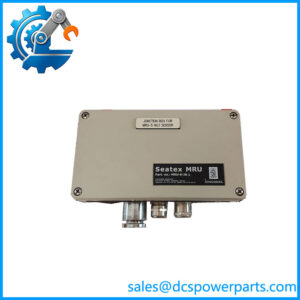
Kongsberg Maritime RCU501
Product Overview
The Kongsberg Maritime RCU501 is a real-time Remote Controller Unit designed to execute process-control applications and manage communication with distributed field equipment. Kongsberg describes the RCU501 as a general-purpose real-time process-control computer based on an embedded PowerPC architecture. The documented processor is a PowerPC MPC8245 operating at 400 MHz, supported by 64 MB of RAM and 16 MB of application flash memory.
In the Kongsberg architecture, the Kongsberg RCU501 sits between higher-level operator/process networks and distributed I/O. It provides dual Ethernet process-network connections, dual RedundancyNet interfaces, dual RBUS connections for RIO200/RIO420 modules, two CAN interfaces, two PROFIBUS DP interfaces, and serial-link connections through RSER200 modules. Local field connectivity includes four opto-isolated digital inputs and four opto-isolated digital outputs, plus an opto-isolated watchdog output.
The controller was designed for a broad range of marine and offshore applications, including dynamic positioning, thruster and steering control, navigation-sensor integration, integrated process control, alarm and monitoring systems, and safety systems. Kongsberg’s published datasheet also documents single-, dual-, and triple-unit architectures, with dual-unit configurations supporting SIL 2/SIL 3 claims within the specified system architecture. Those safety classifications should not be interpreted as properties of the hardware alone; the complete validated system configuration matters.
Product Introduction
Marine control systems rarely fail at the level of “just another computer.” A controller replacement can affect the application image, network identity, redundancy arrangement, RBUS topology, and field I/O communications at the same time. The RCU501 was designed specifically around these requirements, combining embedded real-time processing with Kongsberg’s marine control interfaces.
For legacy Kongsberg installations, the RCU501 is therefore best treated as a system-specific controller spare. Matching the label is necessary, but not sufficient. Hardware revision, application software, address settings, connected RIO modules, and the vessel’s controller topology all deserve verification before commissioning.
Key Technical Specifications
| Parameter | Specification |
|---|---|
| Model | |
| Manufacturer | Kongsberg Maritime |
| Kongsberg Article Number | 603439 |
| Product Type | Remote Controller Unit |
| Processor | PowerPC MPC8245 |
| CPU Frequency | 400 MHz |
| Operating System | VxWorks real-time operating system |
| RAM | 64 MB @ 133 MHz |
| Application Flash | 16 MB |
| Supply Voltage | 24 VDC, +30% / -25% |
| Nominal Current | Approx. 0.8 A |
| Startup Current | Max. 2.7 A |
| Maximum Power | 20 W |
| Heat Dissipation | Max. 20 W |
| Local Digital Inputs | 4 × opto-isolated DI |
| Local Digital Outputs | 4 × opto-isolated DO |
| Watchdog | 1 × opto-isolated watchdog output |
| Serial Interfaces | 32 insulated serial lines through RSER200 |
| Serial Physical Layers | RS-232 / RS-422 / RS-485 multidrop via RSER200 |
| Serial Maximum Bit Rate | 115 kb/s |
| Process Network | 2 × Ethernet 10BASE-T/100BASE-TX |
| Redundancy Network | Dual RedNet Ethernet |
| RBUS | 2 × RJ45, 2 Mb/s |
| RBUS Physical Layer | RS-485 multidrop |
| CAN | 2 × CANopen / DeviceNet |
| CAN Maximum Rate | 1 Mb/s; DeviceNet not defined above 500 kb/s |
| PROFIBUS | 2 × opto-isolated PROFIBUS DP |
| PROFIBUS Maximum Rate | 12 Mb/s |
| Operating Temperature | -15°C to +70°C |
| Storage Temperature | -25°C to +70°C |
| Operating Humidity | Up to 98% RH |
| Protection Rating | IP20 |
| Dimensions | 355 × 158 × 87 mm |
| Weight | 1.35 kg |
| Mounting | DIN rail T35 7.5/15 |
| RBUS Copper Cable Distance | Up to 200 m between repeaters |
| Standards | IACS E10, IEC 60533, IEC 60945, IEC 61508, IEC 62061 |
| Hazardous Area Approval | Ex nA II T4, Zone 2 |
Specifications are taken from Kongsberg’s datasheet and hardware-module description.
Major Features / Practical Advantages
Real-time process-control computer
The is fundamentally a controller rather than an I/O expansion card. Its PowerPC processor executes the Kongsberg process-control application while the integrated communication interfaces connect the controller to field I/O and third-party equipment. Kongsberg’s hardware description identifies it as a controller module for process-control purposes.
That distinction is important during procurement. An RMP200-8, for example, provides configurable remote field I/O, whereas the provides the processing function and manages the remote-I/O bus architecture.
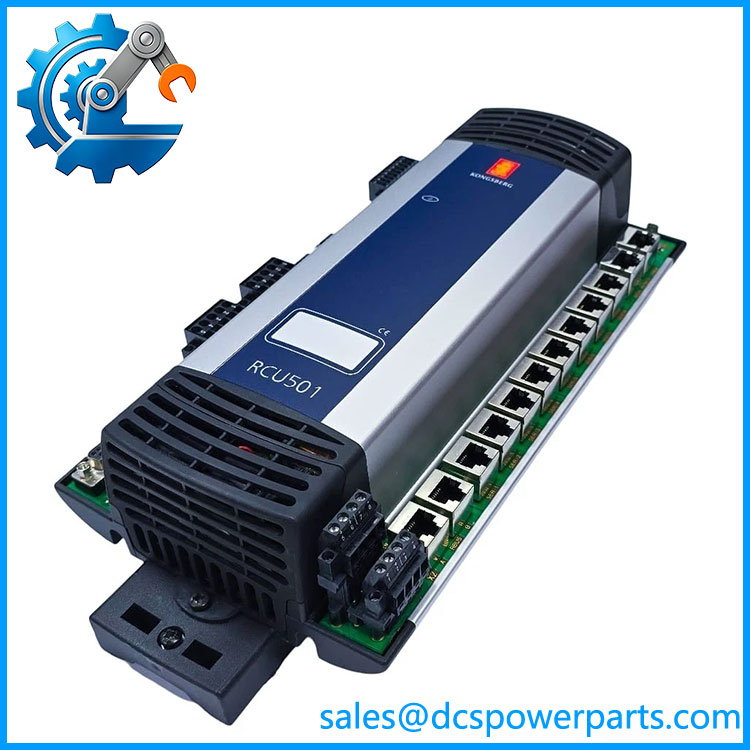
RCU501
400 MHz PowerPC architecture
The uses the MPC8245 PowerPC host processor at 400 MHz, with 64 MB RAM and 16 MB application flash. The documented operating environment is VxWorks.
The flash memory is particularly relevant when replacing a controller. A replacement unit that contains the correct hardware but lacks the required application image should not be assumed ready for service.
Dual Ethernet process networking
Two Ethernet interfaces provide the process-network connections, using 10BASE-T/100BASE-TX. The controller also has a dual RedNet Ethernet interface for redundant RCU configurations.
This separation is part of the Kongsberg architecture. The two Ethernet interfaces should not be treated as ordinary office-network ports without first confirming their configured system function.
Dual RBUS connectivity
Two dedicated RBUS interfaces connect the to Kongsberg RIO equipment. The documented RBUS link operates at 2 Mb/s, using Manchester encoding over an RS-485 multidrop physical layer.
The published hardware documentation specifies up to 200 m of copper cable between repeaters and permits up to three repeaters in the documented topology. Fiber extension is also described when used with an appropriate media converter.
Extensive third-party communications
The controller provides two CAN interfaces and two opto-isolated PROFIBUS DP interfaces. PROFIBUS communication is specified up to 12 Mb/s, while CANopen/DeviceNet interfaces support up to 1 Mb/s, with the documentation limiting DeviceNet to 500 kb/s.
This gives the a useful role as a communications bridge between the Kongsberg control environment and external equipment, although the actual protocol and device configuration remain application-dependent.
32 serial lines through RSER200
Kongsberg documents 32 insulated serial lines, distributed across eight RJ45 connectors and interfaced through RSER200 modules. Supported physical layers include RS-232, RS-422, and RS-485 multidrop, with a maximum documented bit rate of 115 kb/s.
For an old vessel automation installation with numerous serial instruments, this interface capacity can be more important than the CPU specification itself.
Local isolated I/O
The includes four opto-isolated digital inputs and four opto-isolated digital outputs. A separate opto-isolated watchdog output provides an external controller-status interface.
These eight local I/O points should not be confused with the larger distributed I/O capacity available through RBUS.
Redundant controller operation
Kongsberg documents single, dual, and triple controller topologies. The datasheet specifically identifies dual and triple hot-standby arrangements and hot-swap operation in redundant applications.
This is an important qualification: hot swap is documented for redundant applications, not as an unrestricted maintenance procedure for every operating configuration.
Built-in diagnostics
The includes extended built-in self-test, runtime monitoring, status LEDs, watchdog functions, and alarms associated with fan, temperature, and supply voltage. Kongsberg also describes preparation for online remote diagnostics and firmware upgrades.
For troubleshooting, these facilities can help separate controller faults from network, I/O-bus, and field-equipment problems.
Marine and hazardous-area approvals
Kongsberg’s published documentation lists compliance with IACS E10, IEC 60533, IEC 60945, IEC 61508, and IEC 62061. The datasheet also identifies Ex nA II T4 Zone 2 approval and type approvals from DNV, ABS, TÜV Rheinland, and Wurldtech.
The approval should always be checked against the actual vessel installation and applicable certificate revision rather than assumed from the model number alone.
Related Products
- RCU502 — Successor to in Kongsberg’s controller family. It retains the Remote Controller Unit role but uses a revised hardware platform; Kongsberg documentation explicitly identifies RCU502 as the successor to .
- RCU502i — Later RCU variant documented in Kongsberg certification material. Compatibility must be confirmed against the specific application and hardware revision.
- RMP200-8 — Eight-channel Remote Multi Purpose I/O module used within the RIO200 architecture. It handles field I/O rather than executing the controller application.
- RHUB200-5 — RBUS hub/repeater used to distribute RIO200 remote-I/O connections. It works with the RCU/RBUS architecture but is not a controller.
- RSER200-4 — Serial interface module used to provide field serial connections for equipment attached to the ‘s serial-link architecture.
- RMP420 — Kongsberg RIO420-family multipurpose remote I/O module used in architectures supported by the .
- RCU602 — Later Kongsberg Remote Controller Unit family documented in more recent platform certification; it should not be treated as a drop-in replacement without engineering verification.
- K-Chief 700 — Kongsberg marine automation platform in which hardware is documented as a process-station controller.
FAQ
What is the Kongsberg ?
The is a Remote Controller Unit and real-time process-control computer used in Kongsberg marine and offshore automation systems. It executes the application program and interfaces with remote I/O and external fieldbus equipment.
Is an I/O module?
No. It has four local digital inputs and four local digital outputs, but its primary role is controller processing and communication. Distributed I/O is connected through the ‘s RBUS interfaces.
What processor does use?
Kongsberg specifies a PowerPC MPC8245 running at 400 MHz, with 64 MB RAM operating at 133 MHz and 16 MB application flash.
Can I hot-swap the ?
Kongsberg’s datasheet specifically states hot swap in redundant applications, including dual and triple hot-standby and 1oo2 redundancy configurations.
That does not mean every single-controller installation can be serviced while energized. The actual redundancy arrangement and vessel maintenance procedure must be checked before removal.
Does support firmware v3.1?
The model number does not establish firmware v3.1. Kongsberg documents online firmware-upgrade capability, but the installed software revision is configuration-specific.
For a replacement, obtain the installed software/application version from the existing controller or system documentation rather than assuming a firmware revision from the hardware label.
What is the Kongsberg part number for ?
Kongsberg identifies 603439 as the article number.
Is compatible with RCU502?
RCU502 was specifically introduced as the successor to , and Kongsberg modified system software when introducing RCU502 into the AIM Safe architecture.
That establishes the family-level replacement relationship, but it does not prove that an RCU502 can be installed as a blind, plug-in replacement in every application. System software, hardware revision, I/O architecture, certification requirements, and controller topology must be checked.
How many remote I/O modules can handle?
Capacity depends on the application. Kongsberg’s datasheet gives configuration guidelines rather than one universal I/O limit: up to 800 I/O for ESD/PSD, 700 for fire and gas, and up to 2,000 for process/automation applications, with 1,280 I/O given as design advice for process/automation.
These figures are system-design guidelines, not a promise that any arbitrary installation can support those numbers.
What communication interfaces are available?
The provides dual 10BASE-T/100BASE-TX Ethernet process/redundancy networking, dual RBUS, two CAN interfaces, two PROFIBUS DP interfaces, and 32 serial lines through modules.
What should I verify before buying an ?
For a vessel-critical spare, verify:
- model marking
- Kongsberg article number 603439
- Hardware revision
- Existing application/software version
- Process-station address settings
- RedNet A/B topology
- RBUS A/B topology
- Connected RIO200/RIO420 modules
- serial configuration
- PROFIBUS and CAN devices
- Redundancy arrangement
- Zone 2/certification requirements
- Fan and connector condition
- Startup/BITE test evidence
Procurement Note
The Kongsberg Maritime is a specialized marine process controller. It combines a 400 MHz PowerPC processor with Kongsberg-specific RBUS, RedNet, Ethernet, PROFIBUS, CAN, and serial-link interfaces. Kongsberg’s own documentation identifies 603439 as the article number and specifies 24 VDC operation, approximately 0.8 A nominal current, 20 W maximum power consumption, and 1.35 kg weight.
For procurement, the critical issue is not simply obtaining an that powers up. The controller contains the process-control application and participates in the vessel’s configured communication and redundancy architecture. A replacement must therefore be evaluated as part of the complete Kongsberg system.
Kongsberg’s documentation specifically supports hot swapping in redundant applications, while its hardware documentation also describes built-in diagnostics, local flash boot capability, remote diagnostics preparation, and firmware-upgrade capability.
There is also a clear lifecycle consideration. Kongsberg’s hardware documentation identifies as its successor, and Kongsberg’s AIM Safe type-approval documentation records the introduction of to replace .
For a legacy vessel, an original can still be the correct spare when maintaining an existing validated configuration. If considering migration to or another newer controller, treat that as an engineering change rather than assuming a simple hardware swap.
When purchasing a used or surplus unit, request photographs of the identification label, hardware revision, connector condition, and address/mode switches. For a critical spare, functional evidence should include controller startup, Ethernet communication, RBUS communication, local I/O, and the relevant application software environment.
The safest procurement specification is therefore not simply . It should identify the / 603439 hardware, revision, application environment, controller topology, and required software configuration.