Description
Product Overview
KEYSYS-RJ-16CH-AD is a part number that tells you its own shape and nothing else. Read it as a code and it is legible: RJ for the physical interface, 16CH for sixteen channels, AD for analog-to-digital. That is a 16-channel analog acquisition front end on RJ45 connectors, a form factor that exists precisely because multi-conductor signal runs in industrial cabinets are increasingly terminated on RJ45 rather than on screw terminals or D-sub connectors.
The problem starts one level below the code. There is no manufacturer documentation for this part number — no datasheet, no product page, no certificate, no declaration of conformity. The name “KEYSYS” does not resolve to an industrial supplier: the two entities using it publicly are a software engineering consultancy in Birmingham, Alabama, and a Brazilian access-control platform, neither of which makes I/O hardware. Every substantive description of KEYSYS-RJ-16CH-AD in circulation comes from Chinese aftermarket resellers, and they contradict each other outright. One page calls it a 16-channel differential analog input module with a 16-bit ADC, 100 kS/s per channel, Modbus TCP and optional PROFINET. Another calls it a passive wiring terminal. A third calls it a 16-RJ45-port junction module rated for 10/100/1000 Mbps. A fourth calls it a 16-channel A/D card. One listing is even more revealing: the headline carries this part number while the attributes underneath describe an ELAU MC-4/11/01/400 servo controller — evidence that on these pages the title and the specification are written independently of each other.
So there are two candidate identities, and they are not variations of the same product. Candidate A is an active module: sixteen analog inputs, signal conditioning, an ADC, isolation, a communications interface, its own power terminals. Candidate B is a passive junction: sixteen RJ45 sockets or a bank of screw terminals wired straight through, no electronics, no power. They look similar in a photograph, cost differently by an order of magnitude, and do completely different jobs.
The discriminator takes about sixty seconds with the unit in hand, and it is worth more than any reseller page. Power terminals in addition to the signal connectors, an isolation barrier, an ADC or microcontroller, a configuration port or protocol LED, a printed input range on the label: any of these means Candidate A. None of them, with a continuous path from terminal to socket, means Candidate B. Until that check is done, a sensible buyer treats the part as an unpriced, unclassified item — because the only thing worse than not finding a datasheet is paying active-module money for a passive terminal block.
Technical Specifications
| Parameter | Value |
|---|---|
| Model | KEYSYS-RJ-16CH-AD |
| Brand / manufacturer status | KEYSYS; no verifiable OEM record, no datasheet or certificate located |
| Series / product family | Not published |
| Product type | Unconfirmed: 16-channel analog input module, or passive 16-channel RJ45 junction module |
| Channel count | 16, per the code element “16CH” |
| Field interface | RJ45, per the code element “RJ” |
| Signal function | Analog-to-digital conversion indicated by the “-AD” suffix; not confirmed by any primary document |
| Analog input range | Not published — reseller values cannot be relied on |
| Resolution and sampling rate | Not published — the widely repeated “16-bit, 100 kS/s” figures are unverified |
| Communications | Not published — Modbus TCP and PROFINET claims are unverified |
| Supply, isolation, operating temperature | Not published |
| Mounting | Not published; DIN rail is claimed by resellers but not confirmed |
| Documentation status | No OEM datasheet, certificate or conformity declaration in the public record |
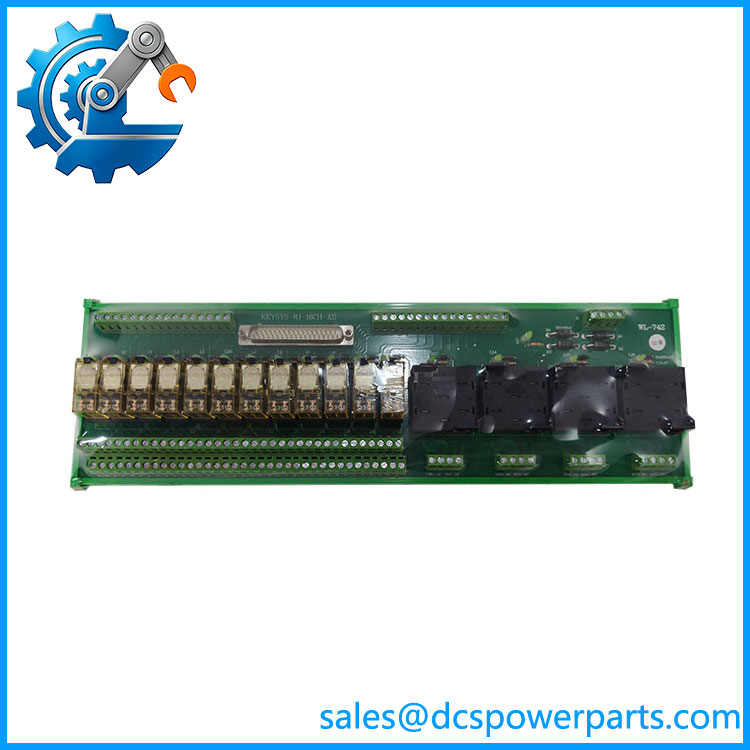
KEYSYS-RJ-16CH-AD
Key Features and Advantages
The code is more reliable than the copy: KEYSYS-RJ-16CH-AD names its interface, its channel count and its function. Sixteen channels on is a deliberate engineering choice — gives a keyed, latched, high-density connection with a defined pinout, and it lets sixteen analog loops leave a cabinet on patch cords that a technician can label, test and replace individually. Any page describing this part has to be consistent with those three code elements or it is describing something else.
Sixty seconds separates the two identities: the check is physical, not documentary. Look for power terminals besides the signal connectors, an isolation barrier or DC-DC converter, an ADC and a microcontroller, a configuration port, and a printed range or scaling table on the label. An active module has all of them; a passive junction has none and shows a continuous path from every terminal to its socket. Doing that before payment is the whole risk-management strategy for an undocumented part.
Where the active reading pays off: if this is genuinely a 16-channel analog front end, the value is density and cabling. Sixteen 4–20 mA or 0–10 V loops in one module, terminated on one connector type, is a marshalling cabinet’s worth of work in a single slot — and front ends are the reason a retrofit can add channels without rebuilding the terminal strips.
Where the passive reading pays off: if it is a junction, its value is different and no less real. Sixteen channels of tidy, labelled, keyed interconnection for the cost of a terminal block. On a panel where the acquisition card is healthy and only the wiring is a rat’s nest, a passive splitter is the correct and much cheaper answer.
Why the silence matters: a page that fills every cell of a specification table for a part with no manufacturer documentation is not being thorough, it is inventing. The honest position — sixteen channels, , A/D per the code, everything else unverified — is the only position that survives an incoming inspection, and the only one that lets a buyer plan around the right identity.
Applications
Panel consolidation on legacy analog loops: sixteen 4–20 mA transmitters or RTD transmitters in one cabinet, wired to a single front-end module instead of sixteen isolated terminals, a marshalling strip and a card. This is the application that makes a 16-channel front end worth buying, and the reason became a viable field interface for analog signals.
Retrofit of DCS and PLC I/O without re-terminating: on a plant where the existing analog card is still serviceable but the marshalling is failing, a front end that accepts existing field wiring on one side and presents a compact connector on the other lets the panel be rebuilt in a single outage instead of loop by loop.
Test and verification rigs: sixteen channels of instrumentation recorded together, with the connectors keyed so that a channel cannot be plugged into the wrong socket. In a lab, that is a commissioning-error suppressor rather than a convenience.
Re-cabling of machine cells: end-of-arm tooling and multi-sensor stations where sixteen signals already travel on a single multi-pair cable. An -based front end matches the cable that is already there instead of forcing a change of connector standard.
Cost-sensitive junction work: if the unit proves passive, it belongs on panels where the acquisition electronics are elsewhere and only the interconnection needs to be organised — the same job a terminal strip does, with keying and labelling built in.
Spares holding for undocumented parts: for a plant that already runs this part number, the practical use is to buy one verified unit, record its photographs, label and measured behaviour, and hold a second against it. Without a datasheet, that record is the datasheet.
Related Products
NI SCB-68 — 68-pin shielded connector block for 16-channel analog DAQ; the passive-junction counterpart in the test and measurement world, and the reference point for what a 16-channel front end looks like without electronics. NI CB-50 — 50-pin terminal block, the same class of passive interface for 16-channel analog input. Allen-Bradley 1756-IF16 — 16-channel analog input module for ControlLogix; the active-module counterpart, chassis-mounted, for comparing density and channel cost. Siemens SM 331 AI 8x16Bit (6ES7 331-7NF00-0AB0) — eight-channel analog input for S7-300; the usual comparison when a 16-channel module is proposed at twice the density. Advantech ADAM-4017+ — eight-channel analog input module, DIN-rail, Modbus; the closest packaged form factor to an active reading of this part. ICP DAS I-7017 — eight-channel analog input module with Modbus RTU; another packaged reference for channel density and wiring style. ELAU MC-4/11/01/400 — the servo controller whose attributes appear under this part number in one reseller listing; included as evidence that title and specification are decoupled on those pages, not as a related product.
Installation and Maintenance
Before installation: establish the identity first, on the bench, before the cabinet is opened. Photograph the unit, read the label for any printed range, scaling or supply voltage, and check for power terminals, an isolation barrier, an ADC or processor, and a configuration port. If it is passive, confirm continuity from each terminal to its socket pin and record the pinout; if it is active, confirm the supply voltage and the input range before connecting anything. Then verify the field wiring matches the channel numbering: sixteen channels on one connector means a pinout error moves a whole loop, not one terminal, so ring out each channel against the drawing and label both ends.
Installation: mount on DIN rail if the housing provides it, otherwise fix to the panel plate with clearance for connector latches. Terminate the field side with the correct conductor class and torque, keep analogue runs separated from drive and switching cables, and bond the shield at the cabinet entry rather than at both ends. On an active module, connect supply last and confirm the channel LEDs or the diagnostic view before any loop is brought into service; on a passive unit, there is nothing to power, so the check is continuity and labelling only.
Maintenance: because no datasheet exists, keep the commissioning record as the maintenance record — photographs, pinout, measured values per channel, and the supply voltage if applicable. Inspect annually for latch damage on the connectors, terminal looseness under thermal cycling, and corrosion at the field terminations; a channel that drifts on a passive unit is a wiring fault, while the same symptom on an active module points at the input stage or the reference. Replace patch cords before condemning the module, and never re-purpose a unit between panels without re-ringing the pinout, since the label is the only documentation the part will ever have.
Warranty and Quality
Every KEYSYS-RJ-16CH-AD is supplied as the unit that was inspected, not as the unit a reseller page described. Each item is photographed and its label, connector count and terminal layout recorded before dispatch, so the buyer receives evidence of what was actually shipped, and the identity question — active 16-channel analog input module or passive junction — is answered in writing rather than assumed. Units are checked for housing and connector condition, latch and terminal integrity, absence of corrosion, and, where the identity permits, continuity across every channel or a power-up check with the channel diagnostics observed. A 12-month repair, replacement or refund commitment applies, and if a unit proves not to match the identity stated at sale, it is taken back rather than argued about. Technical support is limited to what can honestly be said about an undocumented part: how to tell the two candidate identities apart in the field, what a printed label will and will not reveal, how to build a commissioning record that substitutes for a missing datasheet, and which mainstream modules to compare against when the application needs published specifications.
免费
今天 10:35