Description
Honeywell FS24X-912-23-1 QuadBand IR3+ Flame Detector
Product Introduction
The Honeywell FS24X-912-23-1 is an FSX™ F24X QuadBand™ IR3+ flame detector designed for industrial fire and flame monitoring. Honeywell’s product documentation identifies this exact configuration as a 90° field-of-view detector with a copper-free aluminum enclosure, two M25 cable entries, and factory-installed HART capability. The FS24X family uses multi-spectrum infrared detection rather than relying on a single optical wavelength, making it suitable for fixed flame-detection applications in industrial process environments.
The Honeywell FS24X-912-23-1 belongs to the FS24X-912 HART configuration. The “23” enclosure designation differentiates it from the stainless-steel and 3/4-inch NPT variants in the same family. Honeywell documentation specifically lists FM, cFM, IECEx, and ATEX approvals for this configuration, which is important when the detector is installed in a classified hazardous area.
The Honeywell FS24X-912-23-1 should be treated as a safety-related field detector rather than a conventional PLC or DCS input device. Its job is to detect flame conditions and provide the associated alarm/control signals to the fire-and-gas or burner-management system. Available product documentation identifies relay outputs and HART communication for this HART version. During replacement, the exact enclosure, cable-entry arrangement, field of view, approvals, HART configuration, mounting position, and detector-to-flame geometry should all be checked. A visually similar FS24X variant is not automatically an acceptable substitute.
Technical Specifications
| Parameter | Specification |
|---|---|
| Product Model | FS24X-912-23-1 |
| Manufacturer / Brand | Honeywell |
| Product Family | FSX™ F24X QuadBand™ |
| Product Type | IR3+ Flame Detector |
| Detection Principle | Triple infrared / multi-spectrum infrared |
| Field of View | 90° |
| Enclosure Material | Copper-free aluminum |
| Cable Entries | 2 × M25 |
| Communication | HART |
| HART Module | Factory installed |
| Outputs | Relay outputs / HART communication |
| Hazardous-Area Approvals | FM, cFM, IECEx, ATEX |
| Primary Application | Industrial fire and flame detection |
| Installation | Fixed flame-detector mounting |
| Power Supply | Verify against the applicable FS24X installation manual and site configuration |
| Operating Temperature | Verify against the exact installation configuration |
| Protection Rating | Verify against the applicable technical documentation |
| Detection Distance | Application-dependent; verify against fuel, flame size, optical conditions, and sensitivity setting |
| Accuracy | Not specified as a conventional measurement accuracy; detector performance is application-dependent |
The exact configuration information above is supported by Honeywell’s product guide and current product configuration records.
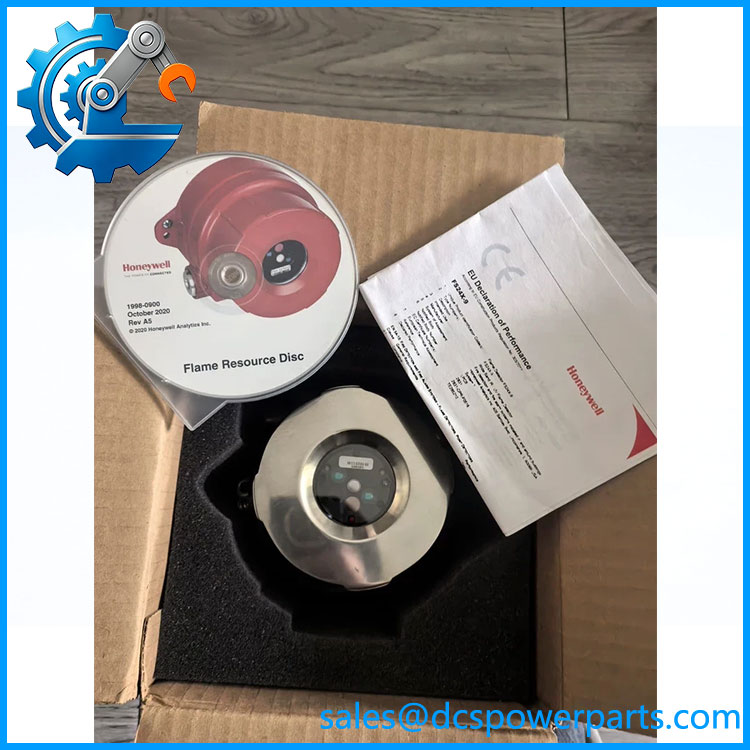
FS24X-912-23-1
Main Features and Engineering Considerations
1. QuadBand IR3+ Detection
The F24X family is described by Honeywell as a Triple IR Fire and Flame Detector (IR/IR/IR/Visible). The detector uses multiple infrared bands and visible-spectrum information as part of its flame-detection strategy.
This matters in industrial environments where the detector must distinguish a genuine flame from background radiation and other potential nuisance sources. Actual performance still depends on fuel type, flame size, detector distance, optical obstructions, environmental conditions, and the selected sensitivity.
2. 90° Field of View
The -9 configuration corresponds to a 90° cone of vision, while other configurations provide a wider field of view. A replacement should therefore preserve the original detector’s coverage geometry.
When installing or replacing the detector, verify the actual flame position, viewing angle, distance, and potential obstructions. Changing from a 90° detector to a different field-of-view configuration can alter the protected area.
3. Copper-Free Aluminum Enclosure
The 23 configuration uses a copper-free aluminum enclosure and two M25 cable entries. Honeywell separately lists stainless-steel and 3/4-inch NPT configurations, so these variants should not be treated as interchangeable without checking the site installation.
The cable-entry specification is particularly important in hazardous-area installations because the gland, sealing method, thread engagement, and associated certification must remain compatible with the installation requirements.
4. Factory-Installed HART
The 912 series is the HART configuration, with the FSX-A014R registered HART module factory installed. The detector also provides relay outputs.
For a DCS or fire-and-gas system, HART can provide diagnostic and configuration information in addition to the hardwired relay interface. The actual control-system integration should still be checked against the project I/O drawings rather than assuming that HART is being used simply because the detector supports it.
5. Hazardous-Area Certification
Honeywell’s exact product listing identifies FM, cFM, IECEx, and ATEX approvals for the -912-23-1 configuration.
For replacement work, certification is part of the equipment specification. The detector, cable glands, conduit system, junction box, grounding arrangement, and installation method need to remain consistent with the applicable hazardous-area requirements.
Application Scenarios
- Oil and gas processing facilities
- Petrochemical plants
- Gas turbine installations
- Power-generation facilities
- Burner and fuel-handling areas
- Industrial process units
- Hazardous-area fire-and-gas systems
- Combustible-fuel storage and processing areas
- Fixed flame monitoring around industrial equipment
Engineer’s Guide: Field Pitfalls
Do reat the as a generic flame switch. It is a multi-spectrum flame detector with a specific optical configuration, enclosure, communication option, and hazardous-area certification.
Check the field of view. This configuration is associated with a 90° field of view. Replacing it with another configuration can change the protected area.
Check the enclosure and cable entries. configurations are available with copper-free aluminum or 316 stainless-steel enclosures and different cable-entry arrangements. The M25 configuration must match the installed cable-gland/conduit system.
Do not ignore the HART option. The 912 configuration includes factory-installed HART capability. If the existing system uses HART diagnostics or configuration, a lower configuration number may not provide equivalent functionality.
Verify hazardous-area certification. FM, cFM, IECEx, and ATEX approval information is configuration-specific. Do not assume that every variant carries the same certification combination.
Check optical alignment after replacement. Even when the electrical wiring is correct, a detector can fail to provide the intended protection if its line of sight is obstructed, incorrectly aimed, or affected by changes in the protected equipment.
Do not use detector response as a substitute for commissioning. After installation, the detector should be tested using the approved flame-simulation/test procedure for the site and the applicable Honeywell documentation.
Frequently Asked Questions
Whatoneywell ?
It is a Honeywell FSX™ F24X QuadBand™ IR3+ flame detector configured with a copper-free aluminum enclosure, two M25 entries, and factory-installed HART capability.
What tr is ?
It is a triple-infrared / multi-spectrum IR flame detector in Honeywell’s F24X family. Honeywell describes the F24X as an IR/IR/IR/Visible flame detector.
What is the field of view?
The -9 configuration provides a 90° field of view.
Wdoes use?
It uses a copper-free aluminum enclosure with two M25 cable entries.
Does support HART?
Yes. The series is the HART configuration, with the HART module factory installed. Relay outputs are also associated with this configuration.
What approvals are associated with this exact configuration?
Honeywell’s product guide lists FM, cFM, IECEx, and ATEX for .
Is a PLC/DCS module?
No. It is a fixed industrial flame detector. It can interface with a PLC, DCS, burner-management system, or fire-and-gas system, but it is a field sensing device rather than an I/O module.
Procurement Note
For purchasing and maintenance records, specify the complete identifier:
oney — FSX™ F24X QuadBand™ IR3+ Flame Detector — 90° FOV — Copper-Free Aluminum Enclosure — 2 × M25 Entries — HART — FM/cFM/IECEx/ATEX.
Before approving a replacement, verify the complete part number, field of view, enclosure material, M25 cable entries, HART requirement, hazardous-area approvals, mounting arrangement, detector-to-flame distance, and existing control-system interface. For a safety-related flame detector, these details are more important than simply matching the family name.