Description
Product Introduction
Flare headers rarely provide ideal measurement conditions: gas composition can change, flow may fluctuate sharply, and wet or contaminated gas can complicate routine monitoring. The Panametrics DigitalFlow GF868 is designed for these service conditions, using ultrasonic measurement to monitor flare and vent gas without an intrusive moving measurement mechanism.
For plant operators, the GF868 can support flare monitoring, process diagnostics, and gas-flow reporting. When sourcing the exact GF868-1-1-1-2-1-0-1-4-0-0-0-RP T configuration, verify the channel arrangement, transducer type, I/O cards, and electrical supply before treating another GF868 unit as a direct replacement.
Key Technical Specifications
| Parameter | Specification |
|---|---|
| Manufacturer | Panametrics |
| Product family | DigitalFlow GF868 |
| Model code | GF868-1-1-1-2-1-0-1-4-0-0-0-RP T |
| Instrument type | Ultrasonic flare-gas flowmeter |
| Measurement principle | Ultrasonic transit-time |
| Primary application | Flare and vent gas measurement |
| Measurement outputs | Velocity, volumetric flow, and mass flow, depending on configuration |
| Moving parts | None in the ultrasonic measurement principle |
| Channel configuration | Must be confirmed from the full order code; is available in one- and two-channel versions |
| Transducer arrangement | Depends on the installed transducers and application |
| Analog and digital I/O | Configuration-dependent; verify installed option cards |
| Serial communications | RS-232 is documented; optional RS-485 support depends on the hardware and software configuration |
| Gas composition | Measurement and mass-flow calculation depend on the configured instrument inputs and application |
| Operating conditions | Confirm instrument and transducer limits against the applicable manual and installation |
| Exact option suffixes | Not fully verified for this specific code |
Panametrics publishes separate one-channel and two-channel programming manuals, along with service documentation and transducer installation guides. The manuals are the appropriate reference for confirming the installed hardware and programming requirements.
Application Scenarios & Pain Points
The main challenge in flare-gas measurement is maintaining useful flow data when operating conditions are less predictable than those found in a standard liquid-flow application.
- Refinery flare headers: Monitor gas flow during routine operation and changing process conditions.
- Petrochemical vent systems: Track vent-gas flow to support operational monitoring and reporting.
- Gas-processing facilities: Use flow data for process diagnostics and investigation of unexpected changes in gas movement.
- Flare-system maintenance: Replace or service measurement equipment while preserving the original transducer arrangement, instrument configuration, and site-specific settings.
Field note: an unstable or implausible flow reading does not automatically mean the meter electronics have failed. Check transducer condition, acoustic signal quality, pipe and gas conditions, and programmed pipe data before replacing the instrument.
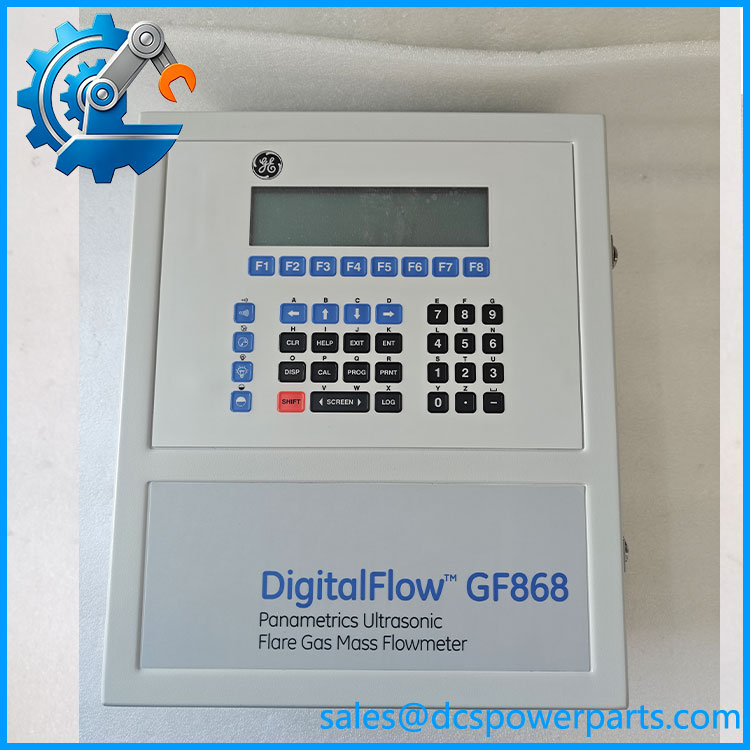
GF868-1-1-1-2-1-0-1-4-0-0-0-RP T
Related Products
These products are relevant to the same measurement family or adjacent applications; they are not necessarily interchangeable.
- DigitalFlow — The standard family for ultrasonic flare-gas measurement. Confirm the channel count and installed options.
- DigitalFlow XGF868i — An ultrasonic flare-gas flowmeter variant with its own configuration and installation requirements.
- DigitalFlow GM868 — Ultrasonic gas-flow measurement equipment intended for industrial gas applications; check the application and instrument specifications before substitution.
- one-channel configuration — Suitable only when the required measurement setup and installed hardware match the one-channel version.
- two-channel configuration — Intended for applications using the corresponding two-channel hardware and programming arrangement.
- T5/T5MAX flare-gas transducers — Associated transducer family with a separate installation guide; compatibility must be checked against the existing meter and application.
Engineer’s Guide: Three Replacement Checks
1. Match the complete order code. Do not purchase based on alone. Confirm the full model string, channel configuration, installed cards, supply requirements, and enclosure arrangement. The trailing RP T should be checked against the original order record rather than interpreted by assumption.
2. Confirm transducer and pipe compatibility. Verify the transducer model, mounting arrangement, cable type and length, pipe dimensions, and application conditions. A meter with the correct family name may still be unsuitable for the installed acoustic path.
3. Preserve site configuration and validate readings. Record pipe parameters, gas settings, input assignments, communications settings, and calibration information before removing the existing unit. After replacement, check signal quality, flow direction, zero-flow behavior, and agreement with the plant’s reference measurements.
Frequently Asked Questions
What is the Panametrics used for?
The DigitalFlow is an ultrasonic flowmeter for flare and vent gas. It measures gas flow using ultrasonic technology and can provide velocity, volumetric-flow, and mass-flow information depending on its configuration and programmed inputs.
Is suitable for flare gas with changing composition?
The manufacturer identifies flare-gas measurement under changing gas conditions as an intended application. However, the reliability of calculated mass or standard-volume flow depends on the measurement setup, the available inputs, and correct instrument programming. Confirm the requirements for your particular gas stream.
Is this exact model a one-channel or two-channel unit?
I could not conclusively decode the full order string from the available manufacturer documentation. Because the is available in both one-channel and two-channel configurations, verify the nameplate, internal option records, or original purchase documentation before ordering.
Can I replace this unit with a different model?
Only after comparing the channel configuration, transducer compatibility, I/O options, supply requirements, enclosure, and programmed settings. A different option configuration may require additional wiring or commissioning work.
What communications does the support?
The documentation describes serial communications, including RS-232 and optional RS-485 arrangements. RS-485 support can depend on the installed interface and software version, so confirm the actual hardware before planning the connection.
How can I assess a used or refurbished ?
Request photographs of the model label, terminals, display, and internal option cards where available. Ask for a functional test report that identifies the tested inputs and outputs, communication checks, and measurement verification. Also confirm whether the sale includes the transducers and connecting cables, since the instrument electronics alone may not complete the installed measurement system.
What should I provide when requesting a quotation?
Supply the complete model string, photographs of the nameplate, the existing transducer model, channel count, pipe details, required I/O and communication interfaces, condition requirements, and delivery deadline. Ask the supplier to confirm which accessories are included, the warranty, stock status, and lead time.
Procurement recommendation: For -1-1-1-2-1-0-1-4-0-0-0-RP T, the key purchasing risk is a configuration mismatch. Confirm the complete ordering code and transducer setup before approving a replacement or publishing detailed option-level specifications.