Description
GE IS200DTAIH1ABB | Mark VI DTAI Analog I/O Terminal Board
Key Technical Specifications
| Parameter | Specification |
|---|---|
| Manufacturer | GE |
| Board Number | IS200DTAIH1ABB |
| Functional Designation | DTAI |
| Platform | GE Mark VI |
| Product Type | Simplex Analog Input/Output Terminal Board |
| Analog Inputs | 10 |
| Analog Outputs | 2 |
| Input Transmitter Types | 2-wire, 3-wire, 4-wire, externally powered |
| Standard Output | 0–20 mA |
| Configurable Output | One output can be configured for 0–200 mA |
| Processor Interface | VAIC |
| Board Connector | 37-pin D-type, JR1 |
| Field Termination | 48-position screw terminal block |
| Mounting | DIN rail via plastic holder |
| Ground | SCOM connections |
| Output Load, 4–20 mA | Up to 500 Ω |
| Output Load, 200 mA | Up to 50 Ω when used with compatible VAICH1C configuration |
| Typical Field Cable | #18 AWG shielded twisted pair |
| Maximum Field Cable Distance | Up to 300 m, application dependent |
| Architecture | Simplex |
The DTAI architecture uses a single 37-pin connection to the VAIC. One VAIC can support two DTAI boards, giving a combined capacity of 20 analog inputs and 4 analog outputs.
Product Introduction
The GE IS200DTAIH1ABB is a DTAI analog input/output terminal board used in GE Mark VI turbine control systems. It provides the field termination and signal-conditioning interface for ten analog inputs and two analog outputs, while the VAIC performs the primary analog I/O processing. The board is mounted on a DIN rail using its plastic mounting assembly and connects to the VAIC through a 37-pin D-type connector.
The ten inputs can accommodate different transmitter wiring arrangements, including 2-wire, 3-wire, 4-wire, and externally powered transmitters. The two current outputs normally operate in the 0–20 mA range, with one output configurable for higher-current operation through jumper selection.
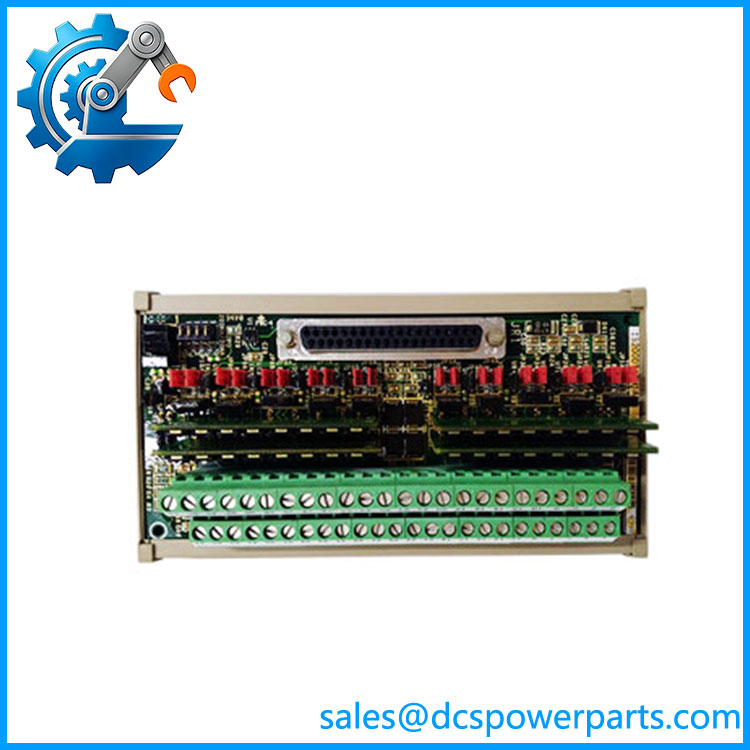
IS200DTAIH1ABB
Application Scenarios & Field Pitfalls — Engineer’s Perspective
Engineering Pain Point
A fault involving the IS200DTAIH1ABB can originate from the terminal board, VAIC processor, 37-pin interconnect, transmitter power, field wiring, or the connected transmitter. If multiple channels fail simultaneously, checking the common VAIC connection and DTAI interface is more productive than replacing individual transmitters.
Typical Applications
- GE Mark VI gas and steam turbine control systems
- General-purpose analog signal acquisition
- Pressure, temperature, flow, and level transmitter interfaces
- Analog control loops for valves and other actuators
Technical Pitfalls to Avoid
- Do not confuse DTAI with DTAO.
DTAI provides 10 analog inputs plus 2 analog outputs. DTAO is a different Mark VI terminal-board family intended primarily for analog-output interfacing. The two boards should not be treated as interchangeable. - Verify the VAIC configuration.
The DTAI is a terminal board, not the main analog I/O processor. The installed VAIC, its configuration, and the 37-pin interconnect must match the terminal-board arrangement. One VAIC can support two DTAI boards. - Check the output jumper configuration before replacement.
One analog output can be configured for 0–200 mA rather than the standard 0–20 mA range. Reproducing the existing jumper configuration is important when replacing the board. - Inspect the SCOM grounding.
The board provides dedicated SCOM/ground connections. Poor grounding or excessive field noise can create analog signal problems that resemble an input-channel failure. - Match the complete part number.
The basic DTAI designation appears in several related listings, but IS200DTAIH1ABB is the specific assembly being replaced. Do not substitute an IS200DTAIH1A or another DTAI revision solely because the functional designation is the same.
Related Products
- GE VAIC — Mark VI analog I/O processor that interfaces with DTAI terminal boards.
- GE VAICH1C — Related analog I/O processor configuration associated with high-current 200 mA output applications.
- GE IS200DTAOH1ABA — DTAO simplex analog-output terminal board; functionally different from DTAI.
- GE IS200TBAIH1C — TBAI analog input terminal-board family for Mark VI analog I/O architectures.
- GE IS200TBAOH1C — TBAO analog-output terminal-board family.
- GE IS200DTTCH1A — Mark VI DTTCH thermocouple terminal board for temperature inputs.
- GE IS200DTRTH1A — Mark VI RTD/temperature-related terminal-board family.
- GE Mark VI VME I/O system — Controller/I/O architecture in which the VAIC and DTAI are used.
Procurement Check
Before approving an IS200DTAIH1ABB replacement, verify:
- Exact board marking:
- Mark VI rather than Mark VIe architecture
- DTAI functional designation
- Installed VAIC processor
- 37-pin JR1 connector and cable
- Ten-channel analog-input requirement
- Two analog-output requirement
- Existing output jumper configuration
- 48-position TB1 terminal block
- SCOM grounding arrangement
- Transmitter power arrangement
- DIN-rail mounting hardware
- PCB revision and conformal coating
- Existing turbine application configuration
Recommended procurement description:
GE DTAI Simplex Analog Input/Output Terminal Board, Mark VI Speedtronic, 10 Analog Inputs, 2 Analog Outputs, 0–20 mA Outputs, One Configurable to 0–200 mA, VAIC Interface, 37-Pin JR1 Connector, DIN-Rail Mount.
The key point is that is a field termination/interface board rather than the VAIC analog processor itself. For a field replacement, match the exact board suffix, VAIC architecture, connector arrangement, and output jumper configuration rather than selecting a DTAI board based only on the family name.