Description
Foxboro SCD2200 R23 MC-31
Product Introduction
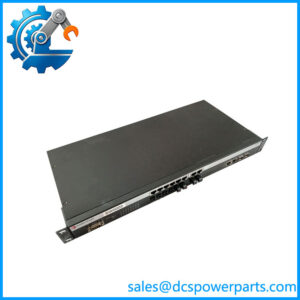
The Foxboro SCD2200 R23 MC-31 is the communications module used in the SCD2200 SCADA Remote Terminal Unit architecture. Schneider Electric documentation identifies R23 specifically as the MC-31 SCD2200 Model RTU Communications Module, with hardware version 2.3.A and an operating temperature range of -40°C to +85°C. The module provides the communications layer between the SCD2200 RTU and supervisory systems, remote devices, serial networks, and other field communication infrastructure.
The MC-31 includes a fixed 10/100Base-T Ethernet communication port and two optional communication positions that can be populated with different interface boards. Supported options include V.34 PSTN dial-up, serial-over-fiber, HART Bell 202, isolated RS-232/RS-485/RS-422, dual isolated serial interfaces, V.23 leased-line/radio interfaces, spread-spectrum radio options, and an additional 10/100 Ethernet option. The exact communication capability of an installed R23 therefore depends on the option boards fitted to the particular module.
The Foxboro SCD2200 R23 MC-31 requires the CP-3 processor module as a prerequisite. The architecture uses plug-in modules mounted on passive backplanes, with the RTU processor, communications hardware, I/O modules, and power supply arranged according to the required system configuration. The MC-31 supports communication functions including Modbus and DNP3, with serial and Ethernet implementations available within the architecture.
For maintenance procurement, the complete designation matters. R23 identifies the MC-31 module, while the communication option board codes determine the additional physical interfaces installed. A replacement R23 without the same option configuration may fit the system but still fail to reproduce the required communications interfaces.
Technical Specifications
| Parameter | Specification |
|---|---|
| Product Model | R23 |
| Module Designation | MC-31 |
| Manufacturer | Schneider Electric / Foxboro |
| Product Type | RTU Communications Module |
| System | Foxboro SCADA RTU |
| Fixed Ethernet | 10/100Base-T |
| Optional Communication Ports | 2 |
| Supported Optional Interfaces | V.34 PSTN, fiber serial, HART, RS-232, RS-485, RS-422, V.23, spread-spectrum radio, additional Ethernet, depending on option board |
| Communication Protocols | Modbus, DNP3, P6008, Terminal Server, depending on configuration |
| Processor Dependency | Requires CP-3 module |
| Hardware Version | 2.3.A |
| Operating Temperature | -40°C to +85°C |
| Mounting | backplane/module system |
| Backplane Architecture | Passive backplane |
| Protection Rating | Not specified in the cited module documentation |
| Power Requirement | System/backplane dependent; verify power-supply configuration |
| Exact Option Configuration | Must be verified from installed option-board part numbers |
The specification identifies the MC-31 with a fixed Ethernet interface and two optional communication ports. The CP-3 processor itself has an ARM9 processor, 64 MB SDRAM, 16 MB Flash, 512 KB battery-backed SRAM, real-time clock, and Ethernet interface; these are CP-3 specifications and should not be incorrectly assigned to the R23 MC-31 module.
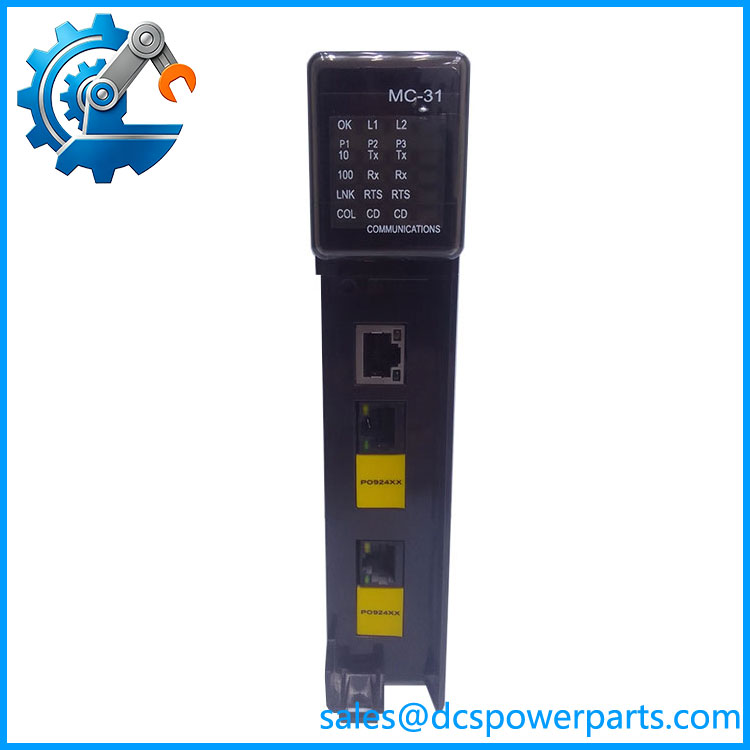
SCD2200 R23 MC-31
Main Features and Engineering Considerations
Fixed Ethernet Communication
The R23 MC-31 provides a fixed 10/100Base-T Ethernet interface. This gives the RTU an Ethernet communications path for supervisory and control-network integration. The specification also identifies an optional T3 communication board providing another 10/100 Mbit Ethernet interface through an RJ-45 connection.
Two Configurable Communication Positions
One of the most important procurement details is that R23 does not define one universal communication interface configuration. The MC-31 accepts option boards in its communication positions. Available options include isolated serial interfaces, HART, optical serial, dial-up modem, radio interfaces, and Ethernet.
A replacement should therefore be compared against the actual option-board part numbers, not just the R23 designation.
Serial Interface Flexibility
The isolated serial option supports RS-232, RS-485, and RS-422. A dual-channel version is also available. This makes the MC-31 suitable for legacy field equipment and remote devices that do not use Ethernet.
SCADA Protocol Support
The platform supports Modbus and DNP3 communications, including serial and Ethernet implementations. DNP3 master/slave functionality and DNP3 Secure Authentication are documented for the platform. These protocol capabilities should be checked against the installed firmware and application configuration rather than assumed solely from the R23 hardware label.
Harsh Remote-Station Environment
The specified -40°C to +85°C operating range makes the R23 suitable for remote RTU installations exposed to substantial ambient temperature variation. This specification applies to the R23 module itself; an entire RTU assembly may have a narrower system-level limit because of other modules, power supplies, communication option boards, or enclosure conditions.
Legacy Replacement Risk
The is a legacy SCADA/RTU platform, so replacement work should include a configuration comparison. Check the CP-3 firmware, R23 hardware version, option boards, communication addresses, protocol configuration, modem/radio parameters, Ethernet settings, and application database before replacing the module.
Application Scenarios
- Oil and gas remote terminal units
- Water and wastewater SCADA
- Pipeline monitoring stations
- Remote production facilities
- Wellhead and field instrumentation
- Pump and compressor stations
- Remote Modbus networks
- DNP3-based SCADA networks
- Legacy serial field-device networks
- Ethernet-connected RTU installations
Engineer’s Guide: Field Pitfalls
1. Do not confuse R23 with R22.
R22 is the CP-3 processor module. R23 is the MC-31 communications module.
2. Check the option boards.
An R23 fitted with an isolated RS-485 board is not equivalent, from a field-wiring standpoint, to one fitted with a fiber or modem board.
3. Check the CP-3 dependency.
The MC-31 requires the CP-3 processor module. It is not a standalone RTU CPU.
4. Verify Ethernet configuration.
The fixed Ethernet port and an optional Ethernet port are separate hardware capabilities. Do not assume that two Ethernet interfaces automatically provide network redundancy.
5. Preserve communication parameters.
Before replacement, record IP configuration, serial parameters, protocol settings, radio/modem settings, station addresses, and application-specific routing.
6. Confirm the hardware revision.
The documented R23 configuration is hardware version 2.3.A. For an existing installation, compare the revision on the replacement against the installed module and project documentation.
Frequently Asked Questions
What is R23?
R23 is the ordering designation for the MC-31 communications module in the Foxboro RTU.
Is R23 the CPU?
No. R22 is the CP-3 processor module, while R23 is the MC-31 communications module.
What Ethernet interface does the MC-31 have?
The MC-31 has a fixed 10/100Base-T Ethernet port. An additional Ethernet interface can be provided through the appropriate optional communication board.
Does R23 support RS-485?
Yes, when the appropriate isolated serial option board is installed. The documented option supports RS-232, RS-485, and RS-422.
Does the MC-31 support HART?
Yes. A dedicated HART Bell 202 option board is documented for the CP-3/MC-31 platform. Its specification describes support for 1–15 devices in multidrop operation.
What is the operating temperature?
The R23/MC-31 is specified for -40°C to +85°C. Individual communication option boards can have different temperature limits, so the installed option configuration must also be checked.
Procurement Note
For an replacement, specify the item as Foxboro R23 / MC-31 Communications Module, then separately document every installed communication option board. This is the critical point. R23 alone does not fully describe the communication hardware configuration.
Before approving a replacement, compare the module label, hardware revision, option-board part numbers, CP-3 compatibility, Ethernet requirements, serial wiring, and protocol configuration against the existing RTU. For a running oil, gas, or water SCADA station, this verification is more important than simply matching the R23 designation.