Description
FOXBORO P0924AW
Product Overview
The Foxboro P0924AW is the DO-2 relay-output I/O module for the Foxboro SCD2200 Remote Terminal Unit platform. Schneider Electric identifies it specifically as an I/O module with 16 single-pole, normally-open relay outputs, making its role fundamentally different from the P0924AU digital input module and from the solid-state/open-drain P0924AX output module. The P0924AW provides the physical relay interface through which discrete commands from the SCD2200 RTU can be transferred to external field circuits.
Within an SCD2200 installation, the Foxboro P0924AW belongs to the field-I/O layer rather than the CPU, communications, or power-supply layer. The SCD2200 is a modular RTU architecture intended for remote SCADA applications, with processor, communications, power, and I/O functions separated into dedicated modules. This architecture is particularly relevant to remote oil, gas, water, utility, and infrastructure installations where discrete commands must be transmitted over long-distance SCADA networks to field equipment. Schneider Electric describes the SCD2200 as a modular RTU with redundancy available at CPU, communications, and power-supply levels.
For legacy-system maintenance, the Foxboro P0924AW should be treated as a system-specific replacement component rather than a generic 16-channel relay card. Channel count alone does not establish interchangeability. The output circuit, relay contact arrangement, SCD2200 backplane, field termination, application logic, and load characteristics all need to agree with the installed configuration. This matters especially when the controlled device is a solenoid, motor starter interface, alarm circuit, or another device whose electrical behavior is different from a low-current logic input.
Product Introduction
When a remote SCADA command has to leave the RTU and operate a physical field circuit, the output interface is just as important as the processor issuing the command. The Foxboro P0924AW provides 16 single-pole, normally-open relay outputs in the architecture, giving the RTU a discrete relay interface for external equipment.
For a system upgrade or legacy replacement, the critical check is not simply “16 outputs.” The is a relay-output module with hardware version 2.2, while other output modules use different contact or semiconductor-output arrangements.
Key Technical Specifications
| Parameter | Specification |
|---|---|
| Product Model | |
| Manufacturer / Brand | Foxboro / Schneider Electric |
| Product Series | SCADA RTU |
| Module Designation | DO-2 |
| Product Type | Relay Digital Output I/O Module |
| Number of Outputs | 16 |
| Output Type | Single-pole, normally-open relay outputs |
| Output Configuration | SPST / normally-open contact arrangement |
| Operating Temperature | -40°C to +85°C |
| Hardware Version | 2.2 |
| Installation | modular backplane |
| Primary Application | Remote discrete control / SCADA field output |
The manufacturer’s ordering table is the primary reference for the model identification and confirms the 16-channel normally-open relay configuration and -40°C to +85°C operating range.
Important: I have deliberately not inserted a contact-voltage or contact-current rating that cannot be verified from the Schneider Electric documentation located for this model. Some secondary listings publish numerical relay ratings, but those figures should not be treated as authoritative without the applicable hardware installation manual.
Major Features / Practical Advantages
1. Sixteen Relay Output Channels
The defining feature of the is its 16 single-pole, normally-open relay outputs. This gives an RTU a concentrated interface for discrete field commands while keeping the output function separate from analog measurement and digital-input acquisition.
Typical system-level applications can include discrete commands to auxiliary relays, annunciation circuits, permissive interfaces, valve-control circuits, and other equipment that accepts an electrically isolated relay contact.
The actual load, however, must be checked against the applicable contact rating and the characteristics of the controlled device. A relay output is not automatically suitable for every inductive load simply because the load is nominally within a particular voltage class.
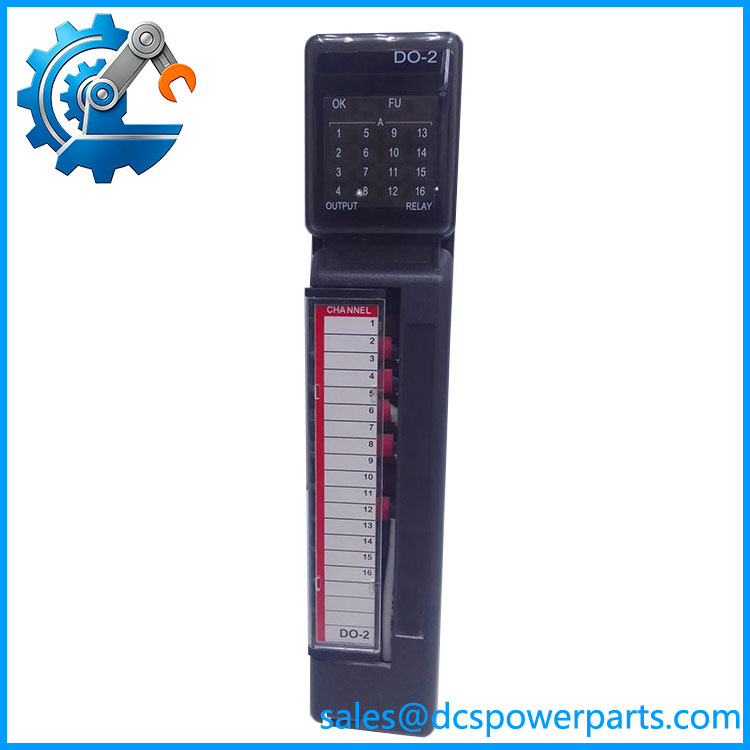
P0924AW
2. Normally-Open Contact Architecture
The DO-2 is explicitly specified with normally-open relay outputs. That distinction matters during both design and troubleshooting. A normally-open contact does not provide the same field behavior as a normally-closed relay or a semiconductor output.
For a replacement project, compare the existing wiring diagram with the ‘s specified contact arrangement before moving wires. If a legacy application depends on a particular fail-state behavior, that behavior must be validated at the system level rather than assumed from the module’s output count.
3. Clear Separation from P0924AU Digital Inputs
The and P0924AU can appear similar because both belong to the same P0924 family, but their functions are opposite.
P0924AU acquires field signals through 16 digital inputs, while provides 16 relay outputs for field control. Schneider Electric identifies P0924AU as DI-10 and as DO-2.
That distinction is important when purchasing legacy spares. A supplier description that simply says “16-channel I/O module” is not sufficient for technical approval.
4. Different from the P0924AX Solid-State Output
The P0924AX is the DO-6 module and uses 16 digital relay-driver/open-drain outputs, whereas the uses mechanical relay contacts.
This is not a cosmetic difference. Relay contacts and semiconductor outputs have different electrical behavior, switching characteristics, leakage considerations, load requirements, and failure modes. Do not substitute one for the other without checking the circuit design.
5. Designed for the Modular RTU
The is an I/O module rather than a general-purpose PLC output card. Schneider Electric describes the as a modular RTU for remote measurement and control, with scalable architecture and redundancy options at key system levels.
This architecture allows field I/O to be organized around the RTU application without turning every module into a processor or communications device.
6. Wide Environmental Operating Range
The manufacturer’s ordering information specifies an operating temperature of -40°C to +85°C for the .
That range is relevant to remote installations where RTU cabinets may experience significant seasonal or enclosure-temperature variation. It does not mean the complete assembled cabinet has the same rating; power supplies, termination hardware, wiring, and adjacent modules still have their own limits.
7. Legacy Replacement Considerations
belongs to the legacy platform, so procurement should focus on exact hardware identification rather than generic functional similarity.
A proper replacement check should include:
- Complete part number
- Hardware revision/version
- backplane model
- Existing field termination arrangement
- Controlled-load voltage and current
- Relay contact requirements
- Existing RTU database and logic
- Physical condition of the relay contacts
- Actual nameplate and PCB identification
This is especially important for shutdown-critical installations. A module that looks identical in a photograph may still have a different revision or history.
Related Products
- P0924AV — DO-1 digital output module with 8 normally-open and normally-closed relay contacts. It provides fewer output channels and a different contact arrangement than the .
- P0924AX — DO-6 module with 16 digital relay-driver/open-drain outputs. Functionally similar at the command level but electrically different from the ‘s relay contacts.
- P0924AU — DI-10, 16-channel digital input module for acquiring field status rather than issuing relay commands.
- P0924CJ — DI-5, 16-channel digital input module for 12–24 VDC applications. It is an input module, not an output substitute.
- P0924AY — IO-3 combination I/O module with analog and digital inputs, analog output, and relay outputs. Useful where mixed I/O is required rather than 16 dedicated relay outputs.
- P0924XW — IO-5 combination analog/digital I/O module using sinking solid-state outputs instead of the ‘s relay-output architecture.
- P0924CV — AO-3 analog output module with four analog outputs and 12-bit resolution. It handles continuous signals rather than discrete relay switching.
- P0924AS — AI-10-1 module with eight analog inputs for continuous process measurements.
- R22 — CP-3 processor module. It provides the RTU processing function and should not be confused with the field-output module.
FAQ
What is the Foxboro used for?
The is the DO-2 16-channel relay-output I/O module for the Foxboro RTU. Its documented output configuration is 16 single-pole, normally-open relay outputs.
Is a digital input module?
No. is a digital output module. For 16-channel digital input acquisition in the same family, is the relevant model.
Can I hot-swap the ?
Do not assume unrestricted hot-swapping. The documentation does not provide a basis for treating the as a generic live-removable relay card.
For an operating plant, use the approved maintenance procedure, determine whether the associated outputs can be safely isolated or bypassed, and establish the required fail-state before removing the module.
Does support firmware v3.1?
There is no reliable basis for assigning firmware v3.1 to the from its part number. Schneider Electric’s ordering information identifies hardware version 2.2 for this module. Hardware revision should not be confused with RTU application or processor software version.
Is interchangeable with P0924AX?
Not as a direct electrical substitution. Both provide 16 output channels, but uses normally-open relay outputs, while P0924AX uses digital relay-driver/open-drain outputs. The connected field circuit must therefore be evaluated before any substitution.
Can replace P0924AV?
Not automatically. P0924AV provides 8 relay-output channels with normally-open and normally-closed contacts, while provides 16 single-pole normally-open relay outputs. The channel count and contact architecture are different.
Will replacing the change my RTU logic?
Replacing the physical I/O module does not inherently rewrite the application logic, but the replacement must be validated against the existing RTU configuration. Check output addressing, channel mapping, field termination, commanded state, and fail-state behavior after installation.
How should a New Surplus be verified?
Ask for photographs of the actual nameplate, hardware identification, connector area, and PCB where accessible. Verify the model against the installed configuration and request inspection or functional-test evidence where available.
Do not accept “Foxboro 16-channel output” as sufficient identification. The distinction between relay outputs and solid-state outputs is technically significant.
Procurement Note
The is specifically documented by Schneider Electric as the DO-2, 16-channel single-pole normally-open relay-output module, with hardware version 2.2 and a specified operating temperature range of -40°C to +85°C.
For a replacement order, verify the complete part number and hardware version against the installed module. More importantly, verify the field load and contact requirements. A relay output that is functionally correct at the RTU level can still be the wrong choice if the controlled load, inductive characteristics, or required fail-state does not match the installation.
For shutdown-critical systems, actual nameplate photographs, revision information, and test evidence are worth requesting before procurement. This is one of those legacy modules where exact identification beats a generic “compatible” description.