Description
Product Introduction
The FOXBORO P0916PH is a termination assembly designed to interface a compatible FBM207 with 16-channel 240 VAC voltage-monitor inputs. The documented logic thresholds are 0–40 VAC for logic zero and 160–280 VAC for logic one, with a typical logic-one input current of 1.6 mA maximum.
The FOXBORO P0916JS serves a different field-signal application. Schneider Electric’s current Foxboro documentation lists it as a termination assembly for FBM207b 16-channel 24 VDC contact inputs. This distinction is important: P0916PH and P0916JS should not be treated as interchangeable simply because both are associated with FBM207-family hardware.
The termination assembly provides the physical interface between field wiring and the FBM. It should therefore be selected according to the actual field signal type, FBM variant, termination type, cable arrangement, and certification requirements. A secondary listing also identifies P0916JS specifically as a “Comp Term Assy, FBM207B, Contact Sense.”
Main Features and Engineering Considerations
P0916PH — 240 VAC Voltage Monitoring
The P0916PH is intended for a 16-channel FBM207 voltage-monitoring application. The documented 240 VAC input range is substantially different from a low-voltage contact-input arrangement. Logic zero is specified as 0–40 VAC, while logic one is 160–280 VAC.
This makes P0916PH appropriate for monitoring AC-powered discrete states where the field voltage itself represents the logical condition.
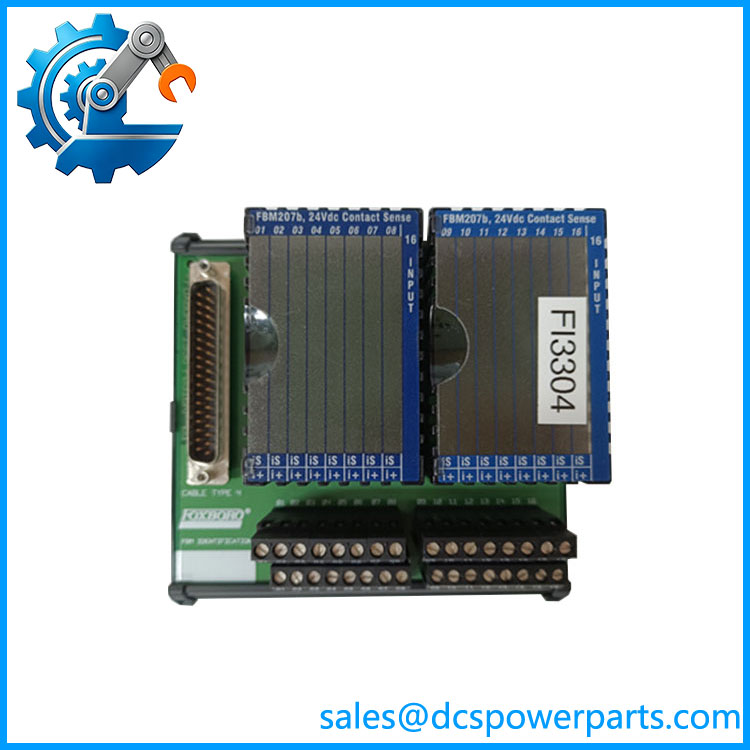
P0916PH P0916JS
P0916JS — 24 VDC Contact Input
The P0916JS is associated with the FBM207b 16-channel 24 VDC contact-input configuration. Schneider Electric lists P0916JS together with P0916PP and P0916XT for this application.
This is a fundamentally different field interface from P0916PH. If the existing system uses dry contacts or 24 VDC discrete signals, the termination arrangement is the relevant one.
Do Not Confuse the Two
This is the most important procurement point:
- → 240 VAC voltage-monitoring input
- → 24 VDC contact input
A catalog entry that simply groups under a generic Foxboro I/O description can be misleading. The official Foxboro documentation separates their intended signal applications.
Typical Applications
These termination assemblies can be encountered in:
- Foxboro I/A Series DCS
- Foxboro Evo systems
- FBM207/FBM207b installations
- Process plant discrete monitoring
- Motor and equipment status monitoring
- Circuit-breaker/status contacts
- AC voltage presence monitoring
- 24 VDC contact monitoring
- Alarm and permissive inputs
Engineer’s Guide: Field Pitfalls
⚠️ is not the same electrical interface as .
Do not substitute one for the other without verifying the FBM and field wiring.
⚠️ Verify the FBM version.
is documented with FBM207, while is documented with FBM207b in the current Foxboro termination documentation.
⚠️ Check the field voltage before connecting.
is designed for a 240 VAC monitoring application. Applying that assumption to a 24 VDC contact-input installation would be a serious wiring error.
⚠️ Check certification requirements.
Foxboro termination assemblies have different certification combinations depending on the application and ordering option. Schneider Electric documentation lists certification types alongside the termination assemblies.
⚠️ Confirm the cable type.
The documented termination configuration uses a specific cable arrangement. Existing cable and connector identification should be checked before replacement.
Frequently Asked Questions
What is FOXBORO ?
It is a termination assembly for a 16-channel FBM207 240 VAC voltage-monitoring input application.
What is FOXBORO ?
It is a termination assembly associated with the 16-channel 24 VDC contact-input FBM207b configuration.
Are and interchangeable?
No—not by default. Their documented field-signal applications are different.
Are they I/O modules?
No. They are termination assemblies (TAs) that provide the field-wiring interface for the associated Foxboro FBM.
What should be checked before ordering?
- Exact part number:
- FBM model: vs. FBM207b
- Field voltage
- Contact vs. voltage-monitoring application
- 16-channel configuration
- Termination type
- Cable type
- Certification requirement
- Existing wiring
- Physical connector/terminal arrangement
Procurement note: If your requirement is , I would treat these as two separate termination-assembly references, not one combined product number. The signal type should determine which one is actually required.