Description
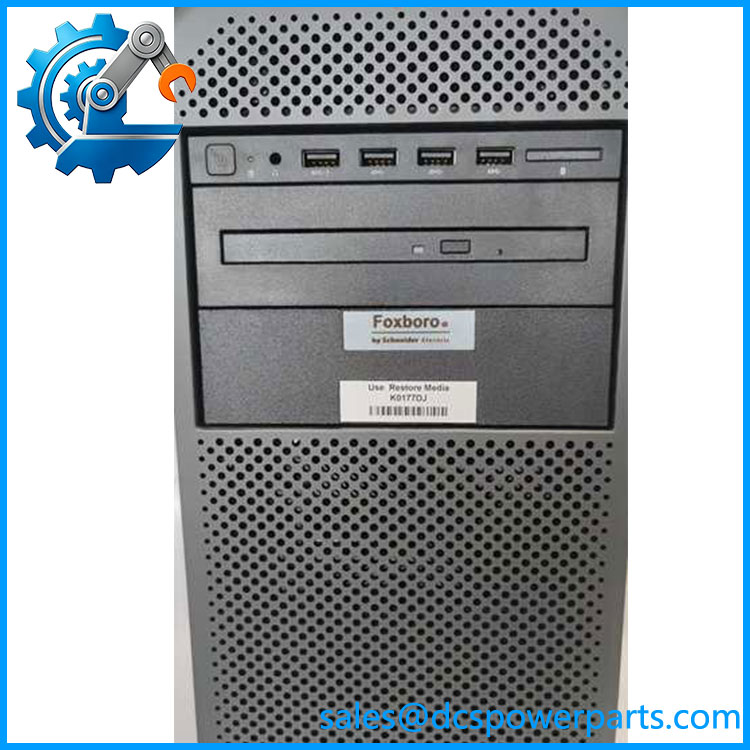
Foxboro H90QNVD044L0
Key Technical Specifications
| Parameter | Specification |
|---|---|
| Product Model | H90QNVD044L0 |
| Manufacturer | Foxboro / Schneider Electric |
| Product Type | DCS workstation server |
| System | Foxboro I/A Series / Foxboro Evo |
| Chassis | 2U rack-mount server-class platform |
| Processor | Intel Xeon-class, configuration dependent |
| Memory | ECC registered memory, configuration dependent |
| Storage | SAS; RAID options available on H90 platform |
| Network | TCP/IP Ethernet |
| Operating System | Configuration dependent |
| Mounting | Standard rack installation |
| Primary Role | Control station hosting, data processing, monitoring, file/server functions |
| Application Environment | Industrial process control |
Schneider’s H90 specification describes a server-class architecture with Intel Xeon processing, ECC registered memory, SAS storage, RAID1/RAID5 capability, TCP/IP networking, and support for multiple displays and USB peripherals. These are H90 platform capabilities, not necessarily proof that every option is fitted to H90QNVD044L0.
Product Introduction
The Foxboro H90QNVD044L0 belongs to the Foxboro H90 workstation-server platform used within I/A Series and Foxboro Evo process automation environments. Unlike a conventional operator panel or standalone HMI, the H90 is a server-class computing platform that can host DCS applications, provide operator or engineering workstation functions, process acquired data, and support networked clients.
For legacy DCS maintenance, the critical issue is not simply whether the replacement server powers up. The hardware configuration, Windows version, Foxboro software release, control-network configuration, domain membership, storage arrangement, and application image all affect whether the replacement can actually assume the original station’s role. Schneider continues to document H90 hardware within its Foxboro DCS/I/A Series product specification system, while older H90 generations have been superseded by newer workstation/server models.
H90QNVD044L0
Engineering Pain Point
Replacing an H90 in an operating DCS is closer to replacing a configured control-system node than replacing an ordinary PC. A server with similar processor and memory specifications can still fail the replacement test if the Foxboro software release, system database, network identity, disk structure, or licensing environment does not match the existing installation. The hardware should therefore be evaluated together with the station’s software image and DCS architecture.
Typical Applications
- Foxboro I/A Series control stations: Hosting workstation or control-system applications within established DCS architectures.
- Foxboro Evo environments: Server-class platform for Control Core Services, Control Software, monitoring, and related applications.
- DCS data processing: Historical/data-acquisition and processing functions where the installed Foxboro software configuration supports them.
- Legacy system maintenance: Replacement of aging H90 hardware where maintaining the existing Foxboro architecture is more practical than an immediate system migration.
Technical Pitfalls to Avoid
- Do not match the replacement by “H90” alone. H90 hardware exists across multiple operating-system and generation configurations. Schneider documents H90 versions for Windows Server 2008 R2 and Windows Server 2016, with newer H90 documentation covering Windows-based Foxboro DCS environments.
- Verify the operating-system generation. A hardware replacement with the wrong Windows generation can create a software compatibility problem even when the chassis and processor appear equivalent.
- Check the Foxboro software release and station role. An H90 can serve different functions, including control-station hosting, data acquisition, monitoring, file serving, and network services.
- Check storage and RAID configuration. The H90 platform supports SAS storage and RAID1/RAID5 configurations, but the actual installed drive arrangement must be confirmed before replacement.
- Do not overlook network identity. TCP/IP communication is fundamental to the H90’s role in the Foxboro environment. IP configuration, hostname, domain membership, control-network connections, and application configuration need to be reproduced correctly.
- Treat the complete ordering code as significant. For
H90QNVD044L0, verify the physical nameplate, hardware revision, installed drives, memory, operating system, Foxboro software version, and licensing before approving a replacement.
Related Products
- Foxboro H90 — Server-class workstation platform for Foxboro DCS/I/A Series environments; configuration and operating-system generation must be matched.
- Foxboro H90 Windows Server 2008 R2 configuration — Earlier H90 generation documented by Schneider for Foxboro Evo applications.
- Foxboro H90 Windows Server 2016 configuration — Later H90 generation with updated Windows Server support and security architecture.
- Foxboro H92 — Workstation platform rather than the H90 server platform; application role and hardware architecture should be checked before considering substitution.
- Foxboro M90 — Earlier industrial server platform used in Foxboro/I/A Series environments; not automatically interchangeable with H90.
- Foxboro H94 — Newer Foxboro DCS server platform documented by Schneider; intended for newer system configurations rather than being treated as a drop-in H90 replacement.
Procurement check: For H90QNVD044L0, request or record the complete nameplate code, CPU configuration, RAM, installed disk/RAID arrangement, Windows version, Foxboro software release, station role, and control-network configuration. Those details matter considerably more than the H90 family name when determining direct replacement compatibility.